Bonsai: The Green Art That Leaves Memories Slightly Tipsy
In the past, I paid little attention to potted plants and flowers. My love for bonsai began only in recent years. There was a time when my father's flower pots were the last thing I wanted to help tend. Now that I am devoted to bonsai, my family teases me: "You're getting old!" Hearing this, I laugh. Indeed, I am beginning to grow old, but not in the sense of being aged! It's just that my heart has grown quiet. I no longer want to live under pressure; I simply want to pass the days in leisure.
As early as the Tang Dynasty, Yan Liben's "Portraits of Periodical Offering" already depicted a scene of a landscape bonsai being presented as tribute. Tao Yuanming, the famous author of the Eastern Jin Dynasty's "Returning Home" and founder of South China bonsai, had already used the two characters "penzai" (potted plant) in his essay praising wild chrysanthemums after resigning from office and retiring to his hometown of Lili. Through the Tang, Song, Yuan, Ming and Qing dynasties and down to the present day, there is abundant historical literature available for verification. For example, "Treatise on Superfluous Things" by Wen Zhenheng of the late Ming Dynasty, "Six Records of a Floating Life" by Qing Dynasty literary figure Shen Fu, and "Flower Mirror" by Qing Dynasty horticulturist Chen Haozi (Chen Haozi) - all contain records of the refined appreciation of bonsai. This shows its elegant charm.
The Hehuang Valley, situated in the borderlands, was naturally influenced by the customs of the Central Plains. I enjoy tending bonsai, exploring mountains for old stumps, and repotting and pruning branches and leaves - the pleasure is considerable. Especially in the old Dongguan Hui courtyards of the past, gardens would be carved out as much as possible. A garden a few meters square would be enclosed by low walls about half a chi high, with a ledge running around the top, filled with flower pots and old stumps. There were pomegranates, Xifu crabapples, bianma (broom-like shrub), sand willows and wild huaqing, as well as rarer pines, cypresses and other fruit tree bonsai. In the middle of the garden, golden thread lotus, ornamental peach and peonies would be planted... it was a scene of abundant vitality. This shows how strong the Hui families' fondness for bonsai and flowers was. It also reflects how the Hui community, who follow the worldly religion of Islam, has passed down through generations and upheld their commitment to obeying Allah, relying on nature, and living a halal life.
I remember the elder Hui men on clear days would move a chair into the courtyard, brew a bowl of tea (gaiwan tea), and carefully study that pot of Xifu crabapple. Pick off a withered leaf, remove a broken branch, then take two sips from the bowl (drink two mouthfuls of tea). Then they would pluck a few weed seeds, leisurely enjoying the better part of the day.
There were also those who loved the wild mountains and hiked as swiftly as if flying. Every mid-spring, they would search the mountains and streams for sand willows, wild huaqing and bianma with aged postures and vigorous, sinewy branches. They would carefully and meticulously dig them out, then patiently plant them into deep earthenware pots, placing them in a semi-shaded, well-ventilated spot. From time to time they would spray water on the branches to keep them moist. With such careful tending and eager anticipation, some would gradually sprout tender buds and flourish with lush leaves, while others would gradually wither and become dry firewood. The feelings involved are hard for outsiders to understand!
Later, with urban construction and the rapid expansion of real estate demolition, the once-friendly single-story houses crumbled. No more courtyards, no more neighborhood communities, no more leisure. The love of bonsai became restricted by circumstances, and it faded until it nearly disappeared from everyone's sight.
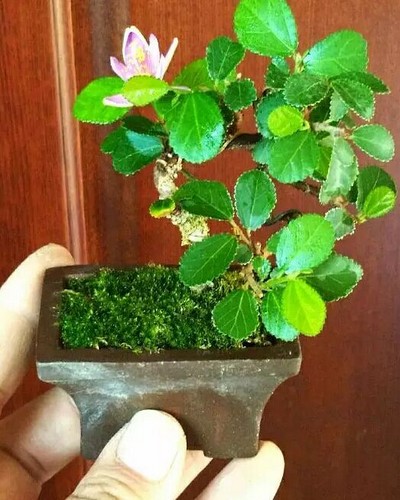
However, by human nature's instinctive yearning for the natural and pastoral, and with the awakening of appreciation for beautiful things and traditional culture, bonsai - this thing that lets you get close to nature - has slowly reappeared in our view. Of course, due to limitations of environment and space, it is impossible to make the relatively large bonsai of the past anymore. People began to grow manageable, portable, appropriately sized ones - namely micro-pots and small bonsai. The largest no more than a chi or so, the smallest down to a cun or so. In these sized pots, one entrusts the feeling of communing with nature, relieving the oppression of the urban concrete forest. They can be placed in the living room, letting emerald cypress and sturdy pines add elegance; letting the passion of pomegranate and crabapple bring the four seasons indoors; or a pot of Serissa japonica (June snow), its verdant green cooling the summer heat a little; you can also place a small curio shelf on a desk or table, with some bean pots and micro-landscapes - no need to pick chrysanthemums by the eastern hedge, the natural charm is right before your eyes in a tiny pot.
Those who like to do it themselves can, in early spring, find a small sand willow seedling on the north or south mountains, wrap and twist it with aluminum wire, shape it into the posture of a weeping willow by the Wei River or Ba Bridge, plant it in a shallow pot, and place it on the balcony. Each day the slender branches grow, gradually drooping, pale green and lush like mist, making you feel as if you have stepped into a Tang poem of farewell. Or at the start of the year, on a spring outing, by a collapsed cliff or eroded gully, you may find a small but aged bianma just a chi tall. Pick it up, plant it in a square purple clay pot. Once it recovers, its fine leaves are emerald green, its branches vigorous. By midsummer, golden cups bloom one after another, placed on the desk, refreshing to heart and mind. Even more, in the rocky crevices of the Hehuang mountain wilds, wild huaqing that has endured frost and bitter cold can, if you are fortunate, be collected and transplanted. Its leaves are so green they seem about to drip, its branches twist and sprawl with vigor, its trunk aged and its bark wrinkled with wild charm born of nature. When autumn deepens, set off by green leaves and brilliant red fruit, it smiles radiantly, displaying the natural scenery and seasonal changes to the fullest in a one-chi pot.
After the midday prayer on a mildly warm early summer day, three or five friends gather, set out the tea tray, bring out a newly acquired purple clay shi piao teapot, with true cypress, sand willow and emerald bamboo beside them. Put some narcissus tea leaves into the shi piao, wait for the water in the iron kettle to boil like peony blossoms, pour from high, and the tea leaves tumble in the purple clay. In a moment, the tea's fragrance lightly suffuses the freshness of cypress, and the understated elegance of blue-and-white porcelain is filled with amber-colored rock rhyme. At this moment, through the tea's mist, the bonsai seems to enlarge, becoming a natural mountain wilderness. Then a gentle breeze blows, the earthy wild scent refreshes the senses, time is very slow, very slow... as if you are in a courtyard deep in an old Dongguan alley: outside the deep gateway comes the sound of children calling friends and companions; on the platform of the north room Grandfather's lounge chair sways gently; in the courtyard corner the hand pump Uncle welded is gurgling with clear cold water; on the garden wall that pot of bianma with blooming yellow flowers trembles slightly, interacting with bees; the dappled light cast through the branches and leaves paints pictures on the steps; a squatting boy wets the ground with a water pitcher, intently building the ravines and long rivers in his mind... everything slow and warm as a gentle breeze, like a dream!
I'm a little dizzy! In the natural wilderness of bonsai, in a relaxed and serene state of mind, I am joyfully drunk! Put down the busyness and restlessness, go and play with and tend a pot of natural wild charm! Let the days be a little more serene! Go close to nature, comply with nature, and live a simple, leisurely halal life. (Recorded by the Rooftop Farmer at Baiyu Lane, Empty Well)