Detailed Explanation of the Definition and Creative Philosophy of Shohin Bonsai
In today's world where land is measured in inches of gold, when it comes to enjoying bonsai, it is shohin bonsai that take up the least space. A small rooftop or balcony can accommodate more than a hundred shohin bonsai. Furthermore, the raw material for shohin bonsai is cheaper than that for medium and large bonsai, so you can enjoy and appreciate them without spending much, and even if your creation fails, it won't hurt as much.
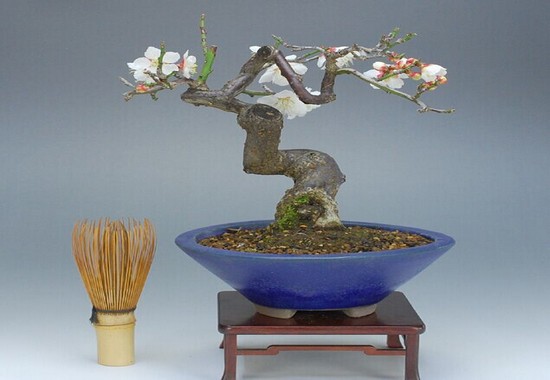
What is shohin?
Shohin bonsai refers to bonsai of 15 to 20 cm. Bonsai under 15 cm are called super-mini bonsai. Bonsai of 20 to 30 cm are called small bonsai. Although these bonsai lack the ancient, majestic appearance and imposing presence of medium and large bonsai, the exquisitely delicate shohin bonsai, small as a sparrow but complete in every organ, are compact and charming. They can likewise express the beauty of each tree species in a small form with great presence, and cultivate the style and temperament that bonsai should have. Truly, heaven and earth fill a square inch, and the joy is harmonious.
The raw material for shohin bonsai is relatively easy to obtain, and can be acquired by sowing seeds, cuttings, or air layering. They can take shape for appreciation in a short time; unlike medium and large bonsai, which often take decades to complete, shohin bonsai can produce a tree form of high quality in just three to five years. At the same time, they offer the pleasure of display: because of their small size, they are easy to move and can be placed at will indoors, in an entryway, on a desk, or on a tea table, combining bonsai with daily life and making the environment lush and green with a sense of the seasons. In addition, shohin bonsai are easy to manage and can greatly save time. Therefore, shohin bonsai have recently developed rapidly at home and abroad and are quite popular, and the age range of enthusiasts is very broad, truly suitable for young and old alike.
Creative philosophy:
Because of their height limit and small size, in the creative process shohin bonsai should omit as many unnecessary branches and leaves as possible, simplifying and unifying the entire form and structure, so that the key points can be emphasized even more and the imagery the creator wants to express can be conveyed to the viewer. Therefore, shohin bonsai can also be called imagery bonsai. The basic principles for appreciating shohin bonsai are no different from those for medium and large bonsai; there are still delicate requirements for the root base, trunk, branches, crown outline, and overall tree appearance. In addition, besides the beauty of each individual tree, special emphasis is placed on the comprehensive beauty of the entire display arrangement when exhibited.
Because shohin bonsai are small and less conspicuous, most are exhibited in groups of five or seven; or they are displayed in two-point or three-point arrangements together with wild grasses, bare winter trees, flowering and fruiting species, and red-leaf maples. To make the display effect more varied, the pots of each tree, besides being harmonious in size, should preferably differ in color and shape. In a display unit, the composition is essentially a trinity of tree, pot, and display stand. Only when they are matched just right can they complement and enhance each other, and only then can it count as an ideal shohin display arrangement. Therefore, the size of the pots, the variation in color, and the size and height of the stands must all be unified and harmonious.
For the display arrangement of shohin bonsai, it is best to choose tree species with different characteristics, and avoid having the same tree species or the same tree form appear in the same arrangement. Among them there should be majestic, imposing trees and slender, gentle trees, flowing wind-swept trees and free-spirited literati trees, flowering and fruiting bonsai with red flowers and green leaves and abundant fruit to provide contrast, and there should be tall and short ones. Try to balance the entire layout so that it looks harmonious, in order to achieve visual enjoyment.
The tree at the very top of a shohin display arrangement is called the main tree. It is best to display one that is more majestic and heroic, with a greater sense of age, or one with deadwood, or a distant-mountain stone may be used instead. The central display is the most eye-catching place, even more conspicuous than the one above, and is the focal point of the viewer's spiritual experience. Good trees should be placed in the center as much as possible, because the quality of the central display has a considerable influence on the entire arrangement, so special attention must be paid to it. In the lower part, place elegant stones or wild grasses, so that the overall space looks more ample and gives a feeling of unhurried ease.
For shohin display arrangements, also note that when placing them, trees on the upper and lower levels should avoid directly overlapping, and trees on the left and right should not be the same height or the same size; following the flow direction of the main tree, the whole should be harmonious and stable. The companion trees on both sides of the stand should not be too eye-catching, and their placement should not be too high. In keeping with the changes of the four seasons, fully express natural ecology: in spring, focus on flowering species and the tree forms of newly sprouting trees; in summer, mainly use trees with luxuriant green leaves, brimming with a cool feeling; in autumn, focus on trees whose red leaves have changed color; in winter, use bare winter trees in keeping with the season. Clever matching makes the entire arrangement more vivid and lively, and through the conveyance of artistic conception, allows the viewer to resonate.
What is special about shohin bonsai is that they are small and exquisite. From birth to maturity, they hardly change at all in terms of "size," yet in terms of shape they become more and more refined and their form becomes better and better looking. Growing shohin bonsai requires calming the mind and shaping and caring for them with care. This, like hobbies such as practicing calligraphy and painting, plays a role in cultivating the character and refining one's sentiments.
Today's art forms are diverse. As young people also join the ranks of shohin bonsai enthusiasts, the forms of display have become more diversified and the accessories used have become more fashionable. Some exhibits even use cartoon animals, anime characters, modern architecture, and so on. While surprising people, because of their coordinated overall feel and quite youthful flavor, one cannot help but applaud! So it can be said that no art is fixed, formatted, or impossible to transcend. As long as it is a creation or reworking that makes people feel beautiful, it is art, including ancient bonsai.
Besides the three essential elements of bonsai - tree, pot, and stand - a distinctive accessory has also appeared in small bonsai exhibitions, namely wooden mats, bamboo mats, grass mats, and so on. They are generally placed beneath a certain accent to create a sense of range and layering and appear more refined. Although they are a relatively new compositional element, if they can echo the theme and add the finishing touch when arranged, they are also extremely brilliant.