What Happens If You Don't Repot a Bonsai? My Experiment Record
According to traditional thinking, a bonsai should be repotted every two to three years or every four to five years. This heavy task consumed a great deal of manpower, materials and time. Especially for large-scale production and collection units, repotting became an even bigger burden.
At first, I also repotted every three to four years. While it was tiring and troublesome, I kept thinking about whether there was a good way to avoid repotting, so I began experimenting in the early 1980s. At first I was afraid of failure. Later, an old podocarpus at an old friend's home helped me make up my mind.
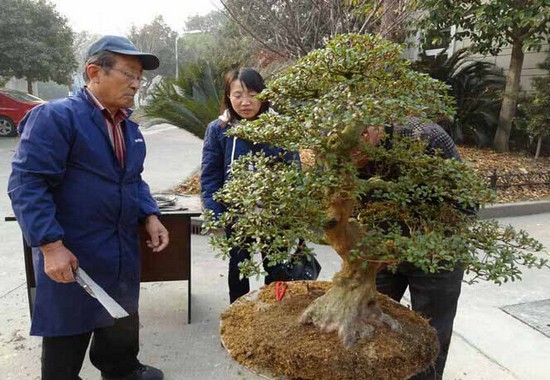
That was in the spring of 1983. At an old friend's home I saw an old green ceramic pot holding a well-growing old podocarpus (Podocarpus macrophyllus). My 76-year-old friend told me this potted plant had been passed down from his ancestors. He normally did not take much care of it: when the soil was dry he watered it thoroughly, and in spring, summer and autumn he applied a compound fertilizer at a concentration of no more than 2% once each season. He never repotted it, only transferring it before Liberation from a smaller pot, with the original soil ball intact, into the larger green ceramic pot before my eyes, and it had now gone 34 years without repotting. This accidental discovery strengthened my determination to try growing bonsai without repotting.
When proposing a new viewpoint or theory, one must never seek quick success and instant benefit, and the worst thing is to draw conclusions from one or two accidental discoveries. To withstand the test of time and plants, from the spring of 1984 to the autumn of 1985, using potting soil I mixed myself, I successively planted 200 medium and large tree-stump bonsai (all from trees over 50 years old) and 200 miniature tree-stump bonsai (pot size 11.5 X 7.5 X 3.5 cm), involving nearly 20 kinds of plants such as banyan, Chinese hackberry, wintersweet, elm, Chinese plum yew, boxwood, negundo chastetree, pomegranate, sago cycad, crape myrtle, tiger thorn, banana shrub, gardenia, Chinese ixora, podocarpus and bougainvillea. By 2008, of these 400 bonsai, apart from 12 medium tree-stumps that had grown too large and were transferred with their original soil ball into a pot one size bigger, the rest had never been repotted. Two medium, one large and five miniature ones died because the drainage holes at the bottom of the pots became blocked and no measures were taken in time, a failure rate of 2%; the rest all grew very well, and the flowering and fruiting types still bloomed and bore fruit. I believe that this 2% of failures could have been completely avoided if the problems had been discovered in time and proper measures taken.
Can potting soil go for decades or even a hundred years without being changed and still adapt well to the growth of the potted tree? The key lies in whether the potting soil contains appropriate gaps and whether these can sufficiently guarantee the normal metabolism of the root system. The formation of gaps in the potting soil comes mainly from two aspects: first, soil particles of varying sizes that are hard to dissolve, which are the original condition for forming gaps in the potting soil; second, the naturally decayed parts from the metabolism of the root system, which are an auxiliary factor. These two points form network-like gap channels, allowing water, fertilizer and air to be stored and circulate normally in the potting soil, ensuring the normal metabolism of the potted tree.
If you want a bonsai to go without repotting, the mixing and use of the potting soil become very important. The initially selected potting soil must be a medium with low stickiness, low solubility and good permeability. After comparison, I chose pure coal cinder. Coal cinder has a neutral pH and can widely adapt to the growth of various plants; its viscosity is very low, and it is hard to dissolve and bind into sticky, impermeable clumps of soil, which helps form network-like gaps; it also contains a variety of minerals and can provide various trace elements. Once the medium is chosen, the method of mixing and using it must not be neglected either. First crush the coal cinder into granules, sift out the powder, and divide it into two specifications, one about 2 cm in diameter, and the other a mixture of particles below 1.5 cm in diameter, kept separately for later use. When planting, first use a piece of tile to set up a water channel over the drainage hole at the bottom of the pot, then evenly lay a layer of coal cinder chunks about 2 cm in diameter, next use the mixed coal cinder below 1.5 cm to firmly secure the potted tree, and finally spread a layer of coal cinder chunks 2 cm in size to protect the middle mixed layer. Do not fill it too full; leave a certain amount of space at the pot surface to facilitate future fertilizer and water management.
Daily management is the same as for traditionally repotted bonsai. What to note is: first, water thoroughly when dry, and do not water when not dry; apply thin fertilizer frequently, once a month in spring, summer and autumn, and when using compound fertilizer it must be mixed into an aqueous solution at a concentration of no more than 2%. Second, keep the drainage hole at the bottom of the pot unobstructed to prevent roots from extending out through it and causing blockage. Third, when the potted tree needs repotting because it has grown larger or for creative needs, you can change only the pot without changing the soil. When repotting, first use a piece of tile to set up a channel over the drainage hole at the bottom of the new pot, then lay a layer of coal cinder chunks 2 cm in size, then move the entire original soil ball, or one with a small portion of old soil removed from around the edges, into the new pot, fill firmly around it with coal cinder 1.5 cm in diameter and below, and cover the pot surface with another layer of coal cinder chunks 2 cm in size. The repotting procedure is then complete.
The above is my experiment over 23 years. As I finish writing, I always feel that the views I hold need more colleagues to carry on the research so that they may be enriched and developed. I hope this modest work can serve as a brick to attract jade.