What are the advantages and disadvantages of planting miniature bonsai in purple clay (zisha) pots versus porcelain pots?
Most bonsai enthusiasts believe that purple clay pots are more suitable for growing bonsai than porcelain pots, the reason being that the walls of purple clay pots are breathable and permeable to water, which benefits root growth and development, keeps the plant growing well, and prevents root rot. Porcelain pots are different: many enthusiasts who use porcelain pots go to great lengths to modify the inner walls of the pot, though whether this actually achieves the imagined effect is hard to say.
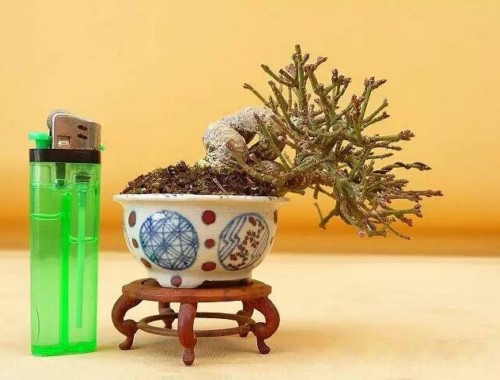
In fact, comparison reveals that purple clay pots and porcelain pots each have advantages and disadvantages for growing miniature bonsai: because the walls of purple clay pots are breathable and permeable, the soil loses moisture quickly, so watering must be frequent, sometimes heavy, and in summer even twice a day or more. The drawbacks of frequent watering are obvious.
1. It costs labor, time and water.
2. The environment inside the pot soil changes frequently, which is not conducive to root growth and development.
3. With frequent watering, the pot soil spends more time low in air content, and repotting is no exception.
4. With frequent watering, the pot soil easily becomes alkaline and nutrients are lost.
5. With frequent watering, it is inconvenient to withhold water, which increases the chance of leggy growth. This is especially true for flowering and fruiting bonsai, since withholding water is an effective measure to make the plant stocky and strong, induce flower buds, promote flowering and set fruit. Being inconvenient to withhold water is a disadvantage for flowering and fruiting bonsai. The walls of porcelain pots are relatively less breathable and permeable than those of purple clay pots, so moisture loss depends mainly on evaporation from the pot surface and transpiration from the plant, and the rate of moisture loss is greatly slowed compared with purple clay pots.
The advantages of this characteristic of porcelain pots are also obvious, especially in the care of miniature bonsai:
First, the frequency of watering can be greatly reduced, saving labor, time and water, so watering need not be done too often.
Second, because watering is less frequent, alkaline damage to the pot soil and nutrient loss are correspondingly reduced.
Third, lengthening the interval between two waterings reduces the number of times the roots are waterlogged, and the environment inside the pot soil changes more gradually, so the period suitable for root growth and development becomes longer. When the pot soil is at a moisture level suitable for miniature bonsai growth, covering the pot surface with materials such as sphagnum moss gives even better results.
Fourth, it makes withholding water convenient. Fifth, it reduces the chance of leggy growth, and so on. These are very important for miniature bonsai, especially flowering and fruiting bonsai that are required to be low, stocky and strong, to form flower buds, bloom and bear fruit.
Notes on growing in porcelain pots:
First, choose a growing medium with good permeability;
Second, lay a drainage layer at the bottom of the pot;
Third, strictly follow the principle of watering thoroughly only after the soil has dried out completely. If it is not dry, do not water under any circumstances. If the surface is very dry but the soil below is not, and the plant shows no signs of drought stress, watering should also be delayed. Fourth, after watering, place the pot in a well-ventilated spot and do not let it get rained on; on overcast and rainy days, avoid watering as much as possible, and if watering is essential, give only a little, then water thoroughly once the weather clears.
In addition, in summer avoid harsh sun exposure to prevent high pot-soil temperatures from damaging the roots; the pot surface can be covered with materials such as sphagnum moss. The above is what I have learned from many years of practice. So there is no need to avoid using porcelain pots for growing plants; you can absolutely choose pots according to the location and the plant.