What soil should be used to plant Acorus gramineus? A soil analysis for cultivation tells you
Acorus gramineus is one of China's traditional flowers, and together with orchids, narcissus and chrysanthemums it is known as the “Four Elegants of Flowers and Plants”. In recent years it has become hugely popular in the flower market and has gradually become a new favourite of consumers. Acorus gramineus as a potted ornament was already widely popular as early as the Song Dynasty. As in Su Shi's poem: “Speckled broken stones grow Acorus gramineus, a spoonful of clear spring and half a stone bowl”; and Lu You's poem: “Today by the stream where my heart finds comfort, I seek out white stones myself to grow Acorus gramineus”. Poems and prose like this are seen again and again.
As a potted ornament, Acorus gramineus has a history of over a thousand years even counting only from the Song Dynasty. The ancients had no red jade immortal soil, no peat or jade fertiliser, yet they still raised a clump of wild grass from mountain streams into lush, dense, soft-as-silk green leaves! What planting medium did the ancients use to cultivate Acorus gramineus?
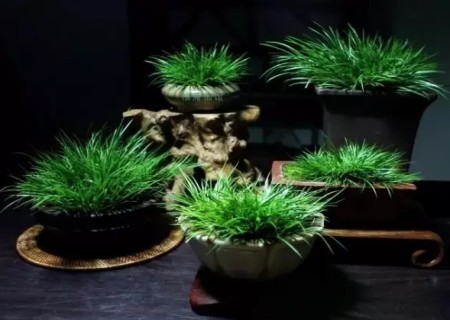
What soil is used to plant and grow Acorus gramineus? Acorus is not like orchids; orchids are a stubborn breed, and give you the cold shoulder at the slightest neglect - if summer care is not thorough, there will be no flowers when spring comes. Acorus is different; it only needs shallow water and cool breezes. Whether the soil is thick and fertile or thin and poor makes no difference, and whenever you look at it there is green to be seen.
Acorus gramineus is not choosy about soil; generally a loose, breathable soil with good water retention is chosen.
1. Patterned stone (wen stone)
The role of wen stone in cultivating Acorus gramineus is not to have the Acorus grow attached to the stone, but more to create a landscape pairing for the Acorus. A single clump of Acorus grown in a pot is, from an ornamental point of view, too plain and “lonely”, and the ancients' aesthetic sense in this regard was the same. Therefore, choosing stones with grain or shaped form as the Acorus's “companion” becomes especially important and natural. After pairing Acorus with a “beautiful stone”, the ornamental value of the Acorus is enhanced, and it also fits the character of a scholar's desk ornament, a refined object for elegant enjoyment.
Acorus gramineus grows together with stones in nature, and the ancients, taking their method from nature, naturally thought first of stones. Scholars and refined gentlemen of successive dynasties had various methods of growing stone-attached Acorus. The Yunlin Stone Manual was completed in the third year of the Shaoxing era of the Southern Song Dynasty; the "xisun" mentioned in the text refers to Acorus gramineus, which shows that by this time the ancients had already discovered Kunshan stone and combined it with the then-popular Acorus-stone basin, planting Acorus in the ingenious crevices of Kunshan stone. This method of growing Acorus with Kunshan stone went a step further than Su Dongpo's “take it together with the stone” or “intersperse with wen stone”, and became the true beginning of stone-attached cultivation.
2. Tile fragments
Acorus gramineus likes clear spring water, that is, it prefers a relatively clear water environment. From this we can also infer that Acorus does not like a relatively fertile “soil environment”. In Wang Xiangjin's Erru Ting Qunfang Pu, in the section on Acorus gramineus, it is described thus: “Plant with clear spring water and stone, mound with tile dust from years-old ditches, and the leaves will be fine”. Tile fragments themselves are made of earth, coming from roof tiles. After long exposure to wind and sun and watering by rain, they inherently have good water retention and breathability. At the same time, tile fragments also contain certain nutrients beneficial to plant growth; therefore, tile fragments are also a relatively ideal cultivation medium for potted stone Acorus gramineus.
On the matter of using tile dust, the Ming Dynasty's Wang Xiangjin spoke in more detail, appending the process of making and using tile dust: first break hard tiles into pieces, then remove the too-coarse and too-fine particles, use the remaining tile dust of moderate size to mound around the roots of the Acorus, then plant it densely and firmly. Combining theory with practice, the ancients' hands-on ability was by no means weak!
3. Sand
Using sand to cultivate Acorus gramineus is mainly applied in the process of raising Acorus seedlings; ancient scholars considered it a relatively ideal choice as the soil medium for Acorus seedlings. Of course, we should be selective about the sand quality. Choose coarser-grained sandy soil and place it at the bottom of the pot as the base medium, which helps drain water from the pot. Then choose finer sand and spread it level with the pot surface.
Because Acorus gramineus “grows fine when it sees stone, and coarse when it sees soil”, the ancients, in order to make the Acorus fine and lovely, used stone and tile dust, and were simply unwilling to use garden soil. Sandy soil is a soil containing many small stone particles, perfectly solving the problem of stone versus soil. The so-called Hengyun Mountain sandy soil should be similar to today's mountain soil mixed with crushed stone - it retains water and drains water, is loose and breathable, and also takes soil fertility into account; it is an ideal Acorus planting medium, more balanced than purely inorganic media like tile dust, so Acorus can flourish naturally with just “a light sprinkling of water”!
4. Charcoal
Using charcoal to grow Acorus was a new trick the ancients came up with after finding ideal Acorus planting media. After charcoal burns, its structure is loose, free of insects and sterile, very suitable for Acorus growth. The Qing Dynasty's Chen Haozi was even more ingenious: he chewed rice together with Acorus seeds, sprayed the mixture onto the charcoal fire, and used the charcoal as a seedbed for Acorus; this kind of Acorus is extremely fine from the start and does not need repeated pruning!
The planting medium for Acorus gramineus must take several factors into account: loose and breathable, water-retaining and free-draining, moderate fertility, free of insects and sterile. The ancients basically noticed all these factors, and simply used common things around them like roof tiles and charcoal; with just a casual touch of transformation, there were spirit seedlings sprouting green - one cannot help but marvel at the wisdom of the ancients, skill approaching the Way!
Editor's note:
Acorus has a bitter fragrance; I always say that is the smell of a man - only when you break a leaf or damage a tip can you smell the true flavour. The fine leaves are stubborn and upright, having leaves without waiting for flowers, and blooming without seeking fruit; it can grow even in extreme hardship, neither arrogant nor restless, neither resentful nor worried - this is why I love Acorus.