What should you pay attention to when buying bonsai? Be sure to remember these points
What is bonsai? The art of bonsai originated in our country, with a long and enduring history. It uses the pot as paper and the tree as painting, and through ingenious processing and cultivation, applies the Chinese painting technique of "a thousand miles within a foot, the great seen in the small," giving people the artistic feeling of "a thousand miles within a foot, the great seen in the small," "a single tree evokes ancient trees towering to the sky, a single peak evokes Mount Hua rising a thousand fathoms, a single spoonful evokes rivers and lakes stretching ten thousand miles"; it reproduces the appearance of nature with both spirit and form, brimming with poetic charm amid hills, valleys, forests and springs, achieving an artistic effect that originates from nature yet rises above it. Therefore, bonsai is called "silent poetry, three-dimensional painting," and is renowned throughout the world as "living sculpture."
When first getting into buying bonsai, the key is to consider the growing environment, and then choose a tree species suitable for planting.
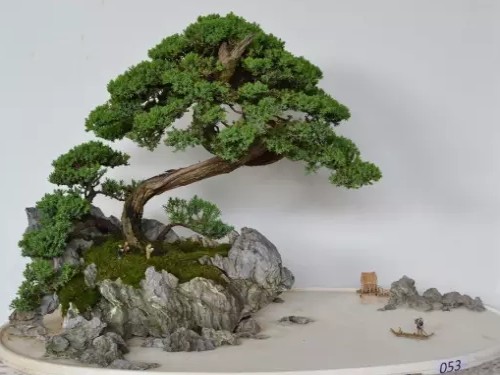
How do you choose your first bonsai?
Bonsai prices vary depending on tree species, technique, age and other factors. Beginners just getting started are advised to find a reputable bonsai nursery and start with saplings or inexpensive bonsai material. Do not buy on a whim, or you will only watch the bonsai gradually wither at home, and your love for bonsai will gradually fade along with it, so that you never want to touch bonsai again.
When buying bonsai, you need to pay attention to the following factors:
1. Choose healthy plants:
Check the leaf surface for abnormal signs such as yellowing, spots or curling, which may indicate disease or pest damage. The underside of the leaves should also be checked; some small insects hide on the underside of leaves, so pay attention when buying.
The branches and trunk should be thick, with many branches emerging, dense foliage, and strong, healthy tree vigor.
Choose a root flare that is slightly exposed above the pot surface, which indicates the plant has been planted for some time and has adapted healthily; if it has just been repotted or just finished being propagated from cuttings and has not yet rooted, there may be problems such as poor adaptation or failure to root, which is riskier, so you can wait a while to observe the tree's condition before deciding whether to buy.
2. Requirements for the environment:
(1) Sunlight and placement location: full sun, partial sun. If an indoor bonsai is already accustomed to an indoor environment, abruptly moving it outdoors means it cannot adapt to the change and is prone to damage.
(2) Climate and ambient temperature: spring, summer, autumn, winter, rainy season, etc. Different tree species have different requirements for the environment. Before acclimation, you need to provide the same growing environment as its place of origin, then acclimate it gradually. Beginners are advised to buy tree species already adapted to the local environment.
(3) Soil: Bonsai growth requires absorbing nutrients from the soil through the roots, so soil is very important for plant growth. Bonsai soil should be breathable and well-draining. If the soil becomes sticky after watering and drains poorly, oxygen cannot enter the soil, and the plant roots suffocate inside, causing the root hairs to turn black and rot.
(4) Fertilizer: Plants absorb more than 16 elements from the soil. Soil in the mountains is generally natural soil, and natural soil contains the nutrients plants need to grow. The soil in a bonsai pot itself has limited nutrients, so fertilizer needs to be added additionally to supplement the insufficient nutrients.
(5) Watering: A saying often circulated in the bonsai world goes: "three years of skill for watering," meaning it takes three years of learning to master watering. Watering potted plants is not simply about giving the roots water to absorb; the newly poured water also expels the old air in the original soil and introduces new air, thereby promoting the respiration of the plant roots in the pot. Water only when the soil surface is dry. If you are too attentive and water frequently, the soil becomes waterlogged and cannot breathe, easily leading to root rot.
3. Preventing and controlling pests and diseases:
If problems that cannot be solved arise during bonsai care, such as infection, pest damage, or causes that cannot be determined, please contact the original seller or consult an experienced expert. Do not apply medicine indiscriminately, lest the situation become irreversible.
The above is a brief discussion of the points to note when buying bonsai. Wishing you a good start in growing bonsai, and as you watch your favorite bonsai grow stronger day by day, you will naturally feel indescribable satisfaction and a sense of achievement.
When buying saplings or tree stock for making tree bonsai at a farmers' market or flower shop, you should pay attention to the following points:
1. Suit measures to local conditions
When buying saplings or tree stock for making bonsai, you should choose suitable varieties according to your own cultivation conditions. Some beginners making tree bonsai do not quite understand certain tree habits (mainly whether they prefer sun or tolerate shade, and how adaptable they are; for example, banyan and orange jasmine are highly adaptable and can grow in both southern and northern China, while zhui wood has poor adaptability and grows poorly in the north), and buy blindly. Some have insufficient light where they cultivate trees, yet buy sun-loving trees such as Japanese black pine, tamarisk, five-needle pine, plum blossom and pomegranate, so that the phenomenon of "green the first year, yellow the second year, meet the King of Hell the third year" often occurs. Some, though lucky enough to escape death, still grow poorly, with plum blossom and pomegranate failing to bloom and bear fruit or blooming very little. If the cultivation spot has insufficient light, you should buy trees that are highly adaptable and shade-tolerant, such as boxwood, Buddhist pine, serissa and Japanese apricot. If you have a small courtyard at home and a small greenhouse, the range of tree varieties you can choose from is much wider. There are many tree species that can be made into bonsai, but none are more loved than evergreens and flowering and fruiting types. In winter, when the hundred flowers wither, especially in the north where there is a lack of red and green, placing a few pots of spring-filled evergreen bonsai indoors will add vibrant life to the room.
2. They must be easy to keep alive
When buying tree bonsai or saplings, besides paying attention to the tree variety, you should also see whether the tree can survive. To judge whether a sapling or a tree bonsai can survive, mainly observe the growth of the roots, branches and leaves. Plant growth mainly relies on fibrous roots to absorb nutrients and water; trees without fibrous roots or with very few fibrous roots are hard to keep alive. Although some trees have many fibrous roots, if they are severely dehydrated or have already dried up, they are also hard to keep alive.
At the same time, also check whether the branches and bark are plump and of proper color. If the branches and bark are shrunken or the color is abnormal (meaning different from the color when the tree is growing normally), it indicates that the tree was dug out a long time ago, or that the plant lost too much water due to poor storage, making it hard to survive. Some trees still have leaves, making it easy to judge whether they can survive: if the leaves are emerald green, the survival rate is high; if the leaves are yellow and fall off at a touch, the survival rate is low.
In addition, one more point to note is that those with native soil around the roots survive more easily than those without. This is because the native soil around the roots retains some intact fibrous roots and also contains a certain amount of moisture. In recent years, it is common for some flower shops and flower growers to pass off inferior goods as good to cheat money, wrapping tree stock dug from the mountains that has few or even no fibrous roots with the lateral roots and fibrous roots of other trees and straw before selling it; those lacking experience are often taken in.
3. Pay attention to observing the growth vigor
Bonsai is a plastic art. The quality of a tree bonsai lies not in its size, nor entirely in whether the tree species is rare, but mainly in its growth vigor. On the premise that it can survive, you should try to buy plants with potential for development.
Whether a tree stump or sapling has potential for development is mainly observed from three aspects: roots, trunk and main branches:
Generally, a well-developed root system, with relatively thick lateral roots and more fibrous roots, is suitable for future cultivation into the form of "exposed roots and claws."
The trunk is the main basis for determining the style of a tree bonsai; among tree bonsai styles, most are named according to the different postures of the trunk. Especially after potting, the trunk grows taller easily but grows thicker with difficulty; the trunk is generally relatively thick and hard, and it is quite difficult to change its original form. Therefore, when selecting tree stumps and saplings, those with a thick, short trunk and a certain amount of twisting are preferable. However, some straight-trunk tree stumps also have their own character, and if the branches and trunk are handled properly, they are also very attractive.
Besides the roots and trunk, you also need to observe the ratio of the main branches to the trunk. If the thickness of the main branches is similar to that of the trunk, the bonsai made from such tree material will not be beautiful. At the same time, look at the distribution of the main branches: main branches in an opposite arrangement are not beautiful, while an alternate arrangement makes shaping easier.