How many years does a bonsai pomegranate tree generally need to be grown before it bears fruit?
Everyone has a destined bonsai; even the most ordinary individual hides deep within a dream of a poetic life. A poetic life begins with bonsai! With its exquisitely crafted, graceful tree form, the pomegranate bonsai has passed through a long period of blooming splendor accompanied by green leaves. It brings us a tree full of red lanterns symbolizing happiness and reunion, making one's mouth water. Thanks to Boya Bonsai for providing such fine works, a feast for the eyes.
Zhang Hua of the Jin Dynasty, in his "Bowu Zhi" (Records of Wide-Ranging Matters), says: Zhang Qian of the Han Dynasty was sent on a mission to the Western Regions and obtained pomegranate seeds from the state of An and Shi, bringing them back, hence the name "An pomegranate." It also states: According to the "Qimin Yaoshu" (Essential Techniques for the Common People), anyone planting pomegranates must place dead stones and dry bones beneath the roots, and then the flowers and fruits will be abundant. Thus the meaning of the name "An Shi" may derive from this. As for "Ruo Mu" being another name for the hibiscus, the pomegranate flower's red resembles it, hence it is also called "Dan Ruo."
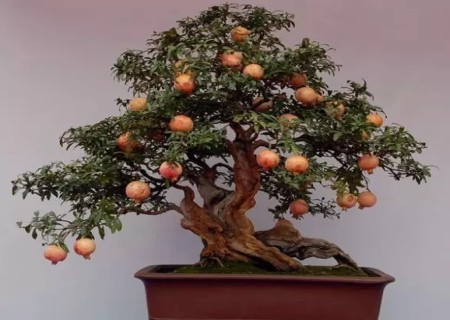
After the pomegranate was introduced to China, it became deeply beloved for its beautiful flowers and fruits and its ease of cultivation. It was listed as the "month flower" of the fifth lunar month, and the fifth month came to be called "Pomegranate Month." The pomegranate has many beautiful names: Wodan, An Pomegranate, Ruo Liu, Dan Ruo, Golden Ying, Golden Pang, Tulin, Tianjiang, and more. During the Yuan Dynasty, the "Pomegranate Song" was popular, and planting pomegranates in courtyards and growing them as bonsai began to spread. Later, the pomegranate was listed by people as one of the bonsai "Eighteen Scholars."
The fruiting habits of the pomegranate:
The pomegranate bears fruit by sending out fruiting branches from bearing mother branches. The bearing mother branches are mostly primary branches grown in spring, or secondary branches from early spring. Because these branches form relatively early, their growth and development are relatively substantial. In the second year, new fruiting shoots about 6-20 cm long emerge from the terminal or axillary buds of these branches. On these new shoots, generally 1-5 flowers can be borne. Such flower-bearing and fruit-bearing new shoots are called fruiting branches. Of the flowers borne on a fruiting branch, one is terminal and the rest are axillary. The terminal one sets fruit best. When two fruits set at the same time, it is called "twin pomegranate"; when all five flowers set fruit, it is called "five sons passing the imperial examination."
Because the fruiting branch of the pomegranate tree has already borne fruit at its tip, it can no longer continue extending and growing forward, so its nutrients are relatively concentrated and its development is relatively thick and sturdy. In the second year after fruiting, the branches below it can still form bearing mother branches or vegetative branches.
The pomegranate tree produces a great many flowers, but flower and fruit drop is severe and the fruit-setting rate is very low, so the yield is unstable and the alternate-bearing (on- and off-year) phenomenon is rather pronounced.
How many years does a bonsai pomegranate tree take to bear fruit?
A bonsai pomegranate tree grown from pomegranate seeds needs 6-8 years to bloom and bear fruit; a planting stock obtained by high-level layering from a fruiting pomegranate branch needs only 3-4 years to bloom and bear fruit.
Pomegranates can not only be planted in the open ground, but can also be grown in pots for three-dimensional display or as background material. Their brilliantly colorful flowers and bright red fruits are much loved, making them a good tree species for beautifying the home. To make a bonsai pomegranate bloom and fruit more, we need to do the following work well:
Timely transplanting: For pomegranates sown in spring, if managed promptly, when the seedlings reach 20 cm to 30 cm in May or June, they can be transplanted into pots, and by early August they can bloom and bear fruit.
Reasonable fertilizing: Pomegranates like fertilizer more than ordinary bonsai flowering plants. For newly potted pomegranates, add to the pot a humus soil made by composting cake fertilizer, poultry manure, leaves, weeds, sandy soil, and the like.
Correct watering: During the pomegranate's bud stage, spray clear water on the leaf surface, then shortly afterward water the pot, repeating several times, and in about 25 days flower buds will appear. During the plant's normal growth period, water once every 2 to 3 days.
Thinning buds and flowers: From bud emergence to full bloom, remove all bell-shaped buds and open bell-shaped flowers, keeping the tube-shaped flowers and gourd-shaped flowers.
Hand pollination: When the first flush of flowers has just opened, use a brush to lightly dab the stamens a few times, then use the same brush to lightly dab the pistils a few times, repeating several times to achieve the purpose of hand pollination and enable normal fruit set.
Thinning branches and pruning: Proper pruning can make a bonsai pomegranate have lush branches and many flowers. Each spring when the bonsai pomegranate has just sprouted, dead branches, root suckers, and weak branches should be cut away; afterward, the water sprouts sent out in spring should also be cut away. Doing so helps flower buds grow at the tips of new branches.