Can a potted avocado bear fruit without grafting? How many years does it take to bear fruit?
For many fruits, it is often possible to use leftover seeds or pits for sowing and propagating seedlings, but many people find that no matter how they care for their own potted fruit trees, or how long they grow them, they never see them bloom or bear fruit. In fact, propagating seedlings by direct sowing generally makes it easy for them to take root and sprout, but getting them to bloom and bear fruit is not so simple.
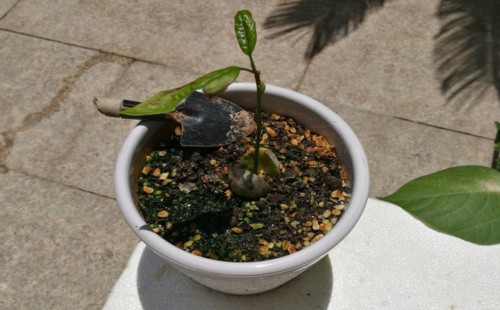
For potted fruit trees propagated by sowing, it is generally quite difficult for them to bloom and bear fruit. Even if some tree species eventually can bloom and bear fruit, the quality of the fruit is not high, and it may even be inedible. Of course, it cannot be ruled out that some fruit tree species can bloom and bear fruit, and the fruit can also be eaten, but the taste is often rather poor, and the nutritional value is also greatly reduced. Friends familiar with this naturally know how to handle it, generally improving the variety through grafting, so as to produce high-quality fruit for eating.
So, will a potted avocado bear fruit without grafting? If it can bloom and bear fruit, how many years does it generally take to bear fruit? In fact, the avocado is different from many other fruit trees. The day before yesterday, many fruit trees needed grafting before they could bloom and bear fruit normally, but the avocado can also bloom and bear fruit even without grafting improvement. However, if you want a potted avocado to bloom and bear fruit, it generally needs to go through a relatively long time, about 3-4 years, and the care environment must be suitable and the management methods scientific for this to be achieved.
In order for a potted avocado to bloom and bear fruit without grafting, first we need to scientifically prepare the potting soil for it. The soil is required to be fertile and loose, breathable and well-draining. Leaf mold mixed with river sand can be used, or nutrient soil mixed with perlite can be used; either is fine.
In addition to preparing the soil scientifically and reasonably, you also need to pay attention to water and fertilizer management. During the care and management period, ensure sufficient water and fertilizer, but do not overdo it. Keep the potting soil slightly moist; the humidity must not be too high, otherwise it will affect growth. Fertilization should be scientific and reasonable, mainly light and diluted. In the early stage, appropriately apply nitrogen fertilizer to promote growth, and in the later stage, apply phosphorus and potassium fertilizer to promote blooming and fruiting.
In addition to the potting soil, water and fertilizer needing to meet the plant's growth needs, light and ventilation must also be ensured. If the plant remains in a shaded state for a long time, it naturally cannot carry out photosynthesis normally, so it generally shows leggy growth, and leggy growth is an important factor inhibiting blooming and fruiting. When the plant shows leggy growth, promptly increase light, improve ventilation, reasonably control water and fertilizer, and at the same time carry out the necessary pruning of leggy branches.
Of course, in order to make the potted plant's shape more beautiful and also stimulate the plant to sprout more side branches, making the plant shape look fuller, more luxuriant and suitably tall, we should promptly pinch or top the seedlings in the seedling stage, and if necessary, top them multiple times. Of course, topping also needs to be combined with pruning, and pruning mainly means cutting off diseased and weak branches, leggy branches, overly dense branches, horizontal branches, etc. This can not only increase the ventilation and light transmission of the potted plant, increase the light-receiving area, and promote the plant's growth, but also make the plant shape more beautiful, which is also very important for promoting blooming and fruiting.
Of course, in addition to the care and management work in the above aspects, we also need to do a good job in temperature regulation, especially cold protection and warmth in winter, and reasonably adjust the environmental humidity to make the environment more suitable for the growth of the avocado plant. I believe that through everyone's unremitting efforts, your potted plant is expected to bloom and bear fruit.