Is Lucky Bamboo better in water or in soil? A comparison of the two care methods
Lucky Bamboo (Dracaena sanderiana) has evergreen leaves, high ornamental value, and a strong ability to purify the air, and more importantly, it can be grown both in water and in soil. So, is Lucky Bamboo better in water or in soil? Many plant lovers surely have this question. Today, let's explore it together.
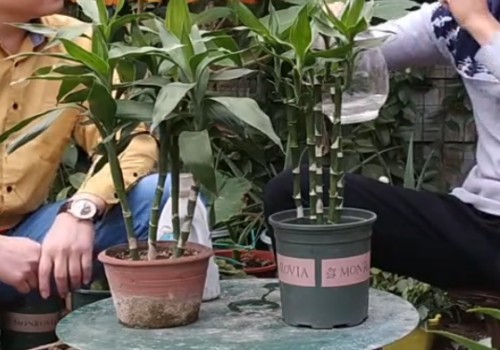
First, we need to be clear that Lucky Bamboo is a fairly shade-tolerant ornamental plant; as long as it gets enough bright indirect light, it can meet its photosynthesis needs and keep growing well. And whether it is grown in water or in soil, Lucky Bamboo is suitable for keeping at home.
However, for most plant lovers who have long lived in cities, it is common to choose a transparent glass bottle to grow Lucky Bamboo in water, because this makes the environment look cleaner and tidier, and it is also very easy to manage, generally only requiring regular water changes.
Not only that, growing Lucky Bamboo in a transparent glass bottle also makes it very easy for us to observe the plant's rooting situation and changes in water quality and water level. This is very important for growing Lucky Bamboo well in water, and it may also be one of the reasons why more plant lovers prefer water-grown Lucky Bamboo.
However, compared with soil-grown Lucky Bamboo, water-grown Lucky Bamboo also has its own shortcomings. That is, Lucky Bamboo in a water environment grows somewhat worse than Lucky Bamboo grown in soil. Because flowering plants generally like to grow in soil, and soil can also provide richer nutrients.
The reason water-grown Lucky Bamboo grows more slowly and worse than soil-grown Lucky Bamboo is that when a transparent glass container is used, the plant's roots remain exposed to light for a long time. The plant will not only grow slowly, but if nutrients in the water are not supplied in time, yellow leaves are also more likely to appear.
Therefore, if we consider the plant's growth, the original author still recommends using soil culture to grow Lucky Bamboo. Moreover, Lucky Bamboo is an acid-loving plant, and it is relatively more suitable for growing in southern China. Because in northern China, both the water quality and the soil quality are mostly alkaline, which is unfavorable for the growth of Lucky Bamboo.
In northern China, it is generally relatively easy to create more suitable growing conditions for the plant. To make the growing environment more suitable, it is usually also necessary to use a little ferrous sulfate or similar substances to adjust the pH. As long as this problem can be solved, soil culture is still recommended in northern China, and the plant's growth will be better.
This is mainly because when Lucky Bamboo is grown in soil, its roots will not be exposed to light for long periods like they are in water culture, so it grows faster and better. But at the same time, it should be noted that Lucky Bamboo is also relatively fond of moisture, so if grown in soil, watering must be timely to create a suitable humidity environment for it. As long as watering is not excessive, root rot generally will not occur; and using a little ferrous sulfate appropriately can also prevent yellow leaves.
When using ferrous sulfate on Lucky Bamboo, it is generally enough to apply it once a month, with the concentration controlled at 0.1%. When watering it each month, just water it with the ferrous sulfate solution. But if it is water culture, adding ferrous sulfate to the water means the roots of Lucky Bamboo cannot absorb it, and it can also easily cause root rot, leaf rot, yellow leaves, and so on.
It can be seen that in northern China, generally only soil culture is suitable for Lucky Bamboo. And if in southern China, since there is no problem with the pH of water and soil, it can be grown both in water and in soil. As for which method is better, everyone can choose according to their own needs.