When does water-cultured peace lily bloom? Detailed explanation of the flowering period
Baibai repotted the plant once or twice. Choose a time in spring, from March to May, preferably on a cloudy day. First remove the plant, then clean the roots. Place it in the planting basket and secure it. Choose a new pot suitable for its volume and place it. After that, it needs watering.
1. Time for repotting
Peace lilies grow relatively fast, so they must be repotted once every one or two years. When the plant's branches and leaves are too dense, with a ratio of three to one to the pot, it should be repotted. The time is preferably chosen in spring, especially from March to May. However, if the plant grows too fast, it can be repotted in autumn. When repotting, it can be combined with pruning. In the interval between two repottings, you can loosen the soil from time to time.
2. Specific steps
(1) Cleaning: Take the plant out of the pot, clean the old soil from the roots, then rinse the roots with water. After that, cut off the aged and rotten roots.
(2) Planting: Put the plant into the planting basket and secure it. If you want to do hydroponics afterward, you can add some stones to the hydroponic container (if the container is a narrow-mouth bottle, you can directly use stones to secure it, and you do not need a fixing basket), then place the plant. For example, after soil cultivation, loose new soil must be prepared, as well as a larger pot suitable for the current plant volume. Place some of the original soil mass in the center, put the plant into the soil, fill in new soil, and then pour in water. Until excess water drains from the bottom of the pot.
3. Notes
(1) When repotting, attention should also be paid to the weather, preferably on a cloudy day. However, sunny weather is also fine and does no harm to the roots.
(2) If it is soil cultivation, the new pot should be better than the original pot, because the plant is longer and sufficient space must be provided.
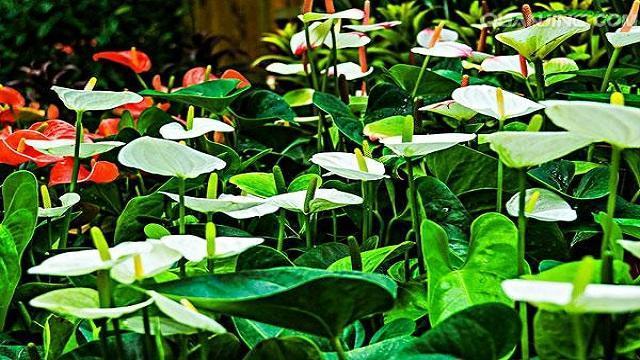
Do you think the peace lily will not bloom? It turns out you have not been raising it properly!The peace lily flower is white, with a curved white spathe surrounding pale yellow (of course, other colors too) flowers, yellow-green white flowers and green leaves, giving a clean and elegant feeling. But what many people regret is that many flower lovers who have peace lilies at home only see their leaves, but they cannot see their flowers.
Peace lilies still grow very fast, and can grow to fill the entire pot within a year. The flowering period of peace lilies is concentrated in summer, usually from May to August, and the flowering period can last more than a month. So those who sigh about why they have never seen flowers, do not worry, you need patience, and this is the season for peace lily flowers.
Now is not the time to wait for the flowering season. We need to understand some habits of the peace lily. It prefers ventilation and enjoys sufficient sunlight, so if you put it in a dark, unventilated room, it is very unfavorable for growth, and it will be difficult to bloom!
In terms of watering, spring and summer are the growing and flowering seasons. Watering should be done more. The autumn climate is dry, but it can also be watered moderately. In winter, when it grows slowly, watering should be slightly reduced. In summer, evaporation is high. After pouring enough water into the soil (not waterlogging), you can spray extra water on the leaves to increase humidity.
Peace lilies are heavy feeders. If they are to bloom, fertilizing is a very important process. When mixing soil, it can be combined with humus soil and peat soil, adding perlite to increase permeability, and finally mixing with organic fertilizer or ash to increase nutrients. After the root system grows stably, fertilizer can be applied in spring, summer and autumn.
Fertilizer can be used as liquid fertilizer, applied once every 10-15 days during the growing season; or compound fertilizer applied once every 15 days; a small amount of potassium fertilizer can also be applied, which is beneficial to leaf growth; or a small amount of plant ash can be added to the soil surface. Nutrients. In late spring and early summer, you can spray a little gibberellic acid to promote flowering. Usually, pay attention to loosening the soil more, which is beneficial to the root system's absorption of nutrients and can also increase ventilation.
Why does the peace lily in your home never bloom?The peace lily is also known for being smooth sailing. It is deeply loved by everyone because it symbolizes good luck and is easy to care for. Today, I will briefly explain the reasons why peace lily leaves do not bloom and the solutions.
The fact that peace lilies only grow leaves without blooming usually has the following five reasons:
First, insufficient light
Peace lilies are shade-tolerant, but if we keep them indoors in a light-deficient environment for a long time, it is unfavorable for peace lily flowering. We should place them in a place with ventilation where scattered light can shine.
Second, improper fertilization
With excessive fertilization and excess nutrients, peace lilies can only undergo vegetative growth. With too little fertilization and insufficient nutrients, reproductive growth cannot occur. In both cases, peace lilies will not bloom. During the growing period from May to September, peace lilies can be given some granular compound fertilizer every two months, which will lead to leaf growth and flowering;
Third, insufficient growth space;
Peace lilies grow relatively fast, especially in summer. Usually, within 1-2 years, the plant will fill the pot and the leaves will be crowded. This has a competitive absorption effect on nutrients. The plant only has very long leaves and it is difficult to bloom. We need to repot in time, or cut off some old and weak branches in time so that nutrients can be properly utilized. After repotting, it cannot be placed directly in the sun. We can put it in a shady place, then slowly move it to semi-shade, step by step, and let it pass through the slow-root period.
Fourth, the surrounding air is too dry
The growth of peace lilies requires high humidity. If the surrounding air is too dry and the air humidity is insufficient, it is unfavorable for flowering. Therefore, in summer, when the temperature is high, we need to spray water on the leaves frequently, which can not only lower the temperature, but also improve the humidity of the surrounding air and promote the flowering of peace lilies.
The soil is not loose enough and has poor air permeability
Peace lilies like to grow in loose, well-ventilated soil. If the soil is too sticky, root growth is hindered, which is unfavorable for the absorption of nutrients and also easily causes water accumulation in the pot. Therefore, in the process of planting peace lilies, we can add a certain amount of sand, which can play a very good role in improving the soil's permeability and water permeability.
@@@