How to grow Cymbidium sinense? Master the cultivation methods and precautions
When orchids bloom, the fragrance is rich and the colors are varied. The beautiful and unique leaf shapes are the reason friends like them. They are truly a highlight of indoor cultivation. How do you propagate them? This is something to think about. Below, the editor introduces the cultivation methods and precautions for Cymbidium sinense. I hope everyone likes it.
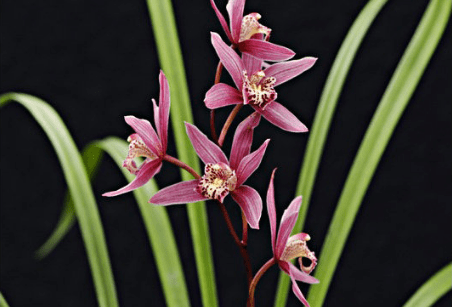
Cultivation methods for Cymbidium sinense
Soil selection
The soil for growing Cymbidium sinense is rich in humus, weakly acidic, loose and breathable, and beneficial for water and fertilizer. For example: humus soil from forests, coarse sand from rivers, dead tree bark, crushed brick, rice husks, sphagnum moss, edible mushroom waste, etc.
Pot change selection
Commonly used orchid-growing pots include: clay pots, ceramic pots, glazed pots, and plastic pots, suitable for balconies, rooftops, and indoors.
However, most home orchids are ornamental, so it is better to use purple clay pots or plastic pots. Orchid-specific purple clay pots are mostly tall trumpet-shaped, with a porous bottom, hydrophobic and breathable, and uniquely shaped; plastic pots are deep, porous, lightweight, clean, low in price, easy to move, and reduce floor pressure.
Lighting requirements
Cymbidium sinense likes a semi-shaded environment; the weaker light in winter and the softer light in spring are suitable for the growth of Cymbidium sinense. The sun is strong in summer and autumn, so appropriate shading is needed. You can place the orchid under the eaves so it only receives light in the morning or evening, and no light after 9 a.m.
Temperature requirements
The temperature for orchid rooting and normal growth is between 20 and 28°C. Growth is slow at 20°C. It grows rapidly above 25°C and will enter a dormant state above 30°C.
In winter, with daytime temperatures of 10°C~16°C and nighttime temperatures of 5°C~10°C, Cymbidium sinense can sleep normally. There are more houses at home than in winter, and it is safe to pass through the cold period in winter and spring without taking warming measures. If overwintering in a courtyard or on a balcony, you can use plastic film to build a temporary greenhouse.
Fertilization methods
Fertilization of Cymbidium sinense "ldquo;should be light and avoided", generally starting in late spring and stopping in late autumn.
When the temperature is 18~25°C, fertilizer can be applied once every 20 days. After fertilizing, spray a small amount of water to prevent fertilizer from contaminating the leaves.
Breeding considerations for Cymbidium sinense
Avoid sunlight......
Cymbidium sinense can be placed on east, south, and west balconies. The cultivation effect on east and west balconies is better; the sunlight on a south balcony is too strong. Because Cymbidium sinense is moderate in height, it can be placed anywhere.
Repotting
Ornamental orchids also have limits. The best viewing time is 57 years after planting. Without repotting, the ornamental value will decline after 2 years, so the pot needs to be turned in time.
Flowering time of Cymbidium sinense
The flowering period of Cymbidium sinense generally runs from October each year to March of the following year, that is, winter and spring. The fragrance is medium, and the best viewing times are around 10 a.m. and 7 p.m.
Of course, Cymbidium sinense also has autumn-flowering varieties, such as Qiubang and Qiuxiang. There are flowers in late winter and early spring, such as Damimg orchid. When the orchid blooms and the temperature is very high, the temperature is high; when the temperature is low, the temperature is low.
Flowering conditions for Cymbidium sinense
Potting substrates usually use rotted tree bark, peat soil, and humus soil. Watering should be clean, to avoid directly spraying tap water. Water once a day in summer. From 4—winter; once every 5 days.
Room temperature should not be too high, otherwise it is easy to get sick in spring. Fertilize once a month during the growing period, prevent autumn drought, and do not let it become too wet in winter.