Can Fuchsia be grown hydroponically? Hydroponic methods and precautions
Potted fuchsia plants are suitable for guest rooms, flower racks and desk decoration. They can be inserted into a bottle with clean water, allowing you to view and root them. Let's share the issues concerning fuchsia hydroponics. I hope it can help everyone.
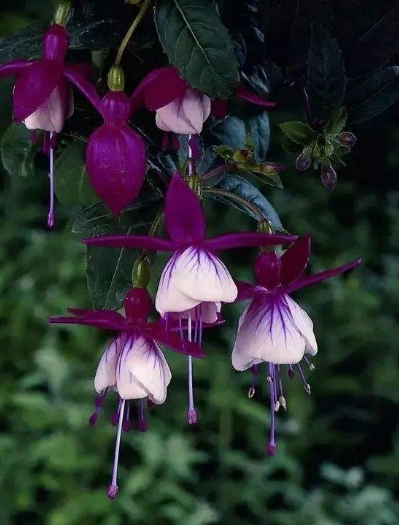
Can fuchsia be grown hydroponically
Some friends may think this plant can only be cultivated in soil, cannot be grown in water, and dare not try. In fact, it is fine. Moreover, if maintained properly, the plant can even grow better than in soil. And if it is placed in a transparent container with water, then there is a kind of light, and it looks very beautiful. Compared with local culture, the ornamental value is stronger. However, there are many issues to pay attention to; some are unique to hydroponics, and some are related to soil.
Issues to pay attention to in fuchsia hydroponics
(1) Changing the water
This is very important. If the water is not changed for a long time, the water will become cloudy, and the plant will grow very poorly. I must change it in about a week. If the temperature is high, it needs to be done more often. In addition, it is better to expose the water to sunlight for a while, and then change it when it is roughly the same as room temperature. Do not just change it directly from the tap.
(2) Nutrient solution
Plants grown in water are not soil-cultured, and they cannot extract the same nutrients from soil. Therefore, in order to promote the growth and development of aquatic plants, it is better to use some nutrient solution to help. There is no special requirement for the type; a general nutrient solution bought from a store can be used. When changing the water, you can add some.
(3) Light
This plant is very bright. Whether in soil or water, light is indispensable. It can be placed in a bright place, such as a balcony or windowsill. This is good for it, and it can make it look better.
(4) Ventilation
As with soil, water needs to be placed in a well-ventilated location.
Pruning methods for fuchsia
Seedling plastic pruning
The so-called seedling pruning is to shape the fuchsia before it has formed. The main goal is to cultivate a beautiful plant shape during protection, and to determine different pruning methods according to the growth characteristics of different varieties.
Cross-shaped pruning method
This method is suitable for varieties with a small opening angle (branches raised), such as "Zijin Hammer" and so on. When the seedlings are taller than 20 cm, they should be topped to promote the sprouting of new shoots. Because the side branches are usually symmetrical, when pruning, keep the upper two symmetrical branches and erase the lower branches and leaves. The side branches need to be filled to about 10 cm. It is good to let the new branches grow after they grow. Be careful to cut off side branches that grow inward and downward at any time.
For potted plants of the same length with a diameter from 15 cm to 18 cm, keep 8 to 10 flower branches.
Tower-shaped pruning method
This method is suitable for varieties with a large lateral opening angle (tender spreading) and strong growth, such as "White Calyx", "Girl's Skirt", and so on. When the plant type is small, do not top it; when it is 20 cm long, cut off all branches and leaves below 10 cm. After the side branches grow, in order to avoid overlapping branches, a layered pruning method can be adopted. Leave one symmetrical branch at each layer, remove a pair of symmetrical branches, then leave one layer of symmetrical branches, and repeat this.
Natural-form pruning method
Suitable for varieties with slender branches, strong or weak growth, and large, heavy varieties. Prune it into a natural shape according to its form. When the seedlings grow to 30~40 cm, top the trunk, remove adjacent overlapping branches, and shorten long branches to promote branching. Cut off inward-growing side branches at any time to promote a beautiful plant type.
Pruning during flowering and after flowering
Fuchsia belongs to the natural environment of the north, with a flowering period from April to July. Therefore, in March of spring, pruning should be stopped, and flowering in mid-April should be ensured. Because fuchsia flowers are good at the top, the flowering branches will continue to extend. When the flowering branches grow to a certain length, they should be topped, and new branches can continue to bloom.
When planting, cut off the branches and leaves in the center of the plant at any time to avoid consuming nutrients and to improve ventilation and light transmission.
Plastic pruning after flowering
In July the temperature rises, and when the temperature reaches 30°C, the plant will enter a semi-dormant state. The leaves will gradually weaken, and at this time heavy pruning is needed to reduce nutrient consumption and promote safe summering. The longer branches are all cut off, leaving only the backbone branches, and the old leaves are all removed and placed in a shady place. If there are flower buds at this time, they should be removed promptly. New branches will grow in September, and at this time the plant type will be compact.