How to care for four-season kumquat in winter? Master these care methods
Kumquat is also called round kumquat. It is warm and slightly cold-tolerant. It can be planted in the ground or in pots. Kumquat is evergreen, blooms in summer, and ripens in autumn and winter. Its golden-yellow fruit, set off by green leaves, is especially beautiful. In autumn and winter the fruit ripens and is either yellow or red, dotted among the green leaves, with extremely high ornamental value, and it is a better choice for winter. Placed in the hall and living room, it adds a new idea and elegance. It is one of the better potted plants for the home.
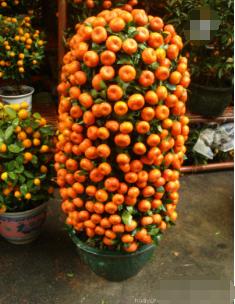
Seedling cultivation and management Potted kumquat is usually used as rootstock for grafting and propagation. The grafting method is carried out in June, and the rootstock should be planted one year in advance. After grafting, the seedlings are propagated asexually so that they grow into plants early, and can be properly pruned to form a certain tree shape. Generally, kumquat that survives the current year should be watered once a day or once every other day, and liquid fertilizer should be applied 4-5 times in summer and autumn, mainly nitrogen fertilizer, with an appropriate amount of phosphorus and potassium fertilizer. .
Potted kumquat is repotted every 2 to 3 years, and it is better to complete it before the orange buds sprout in March to April. The pot is based on the size of the plant. The potting soil should be made of loose and fertile acidic loam, which can be made by mixing humus soil, compost or horse manure and coarse sand. When changing the pot, keep the old soil, cut off the rotten roots, and cut off the thick roots. Note that the new soil does not directly touch the roots, fill the pot with water, keep the soil moist, and keep it out of sunlight for 10 days.
After the plant resumes growth, carry out normal management to prevent the kumquat's summer shoots from growing, promote the accumulation of nutrients in the tree, form flower buds, and "reduce water" before the heat, and gradually reduce watering ten days before the heat. Stop watering 5 days before the heat. To prevent the leaves from dehydrating, you can spray the leaves with water in the morning and evening and spray a small amount of water. When most of the axillary buds change from green to white, the axillary buds will expand from green to white. Restore the water supply in time.
Pruning To make the crown of a home potted kumquat even and beautiful, promote the sprouting of thick branches, cultivate strong fruiting mother branches, and shape it during growth. Generally, after spring sprouting, 2 or 3 spring buds will be removed, and weak or overly dense buds will be removed in summer and early autumn from June to August. Buds sent after mid-August should be completely removed. During the flowering and fruiting period, special attention should be paid to fruit thinning to improve the fruit-setting rate, and preserve fruit on all four sides of the potted orange to improve ornamental value. After harvesting the fruit in winter, all the fruit can be removed between late March and early April, and the fruit is cut again during the period from the spring equinox to the green stage.
How do you grow potted kumquat to produce more? A method for treating potted kumquatIn the new year, we often see many friends growing kumquat at home. In fact, it carries a meaning of good fortune. Kumquat is very fragrant when it blooms. When the fruit is ripe, it can cover the branches. Whether for ornamental flowers or fruit, potted kumquat has a certain ornamental value. So how do you grow potted kumquat to make it more productive? How do we maintain it in daily life? Then follow the editor.
Kumquat
How do you grow potted kumquat to make it more productive?
Reasonable pruning. After spring, the temperature rises and kumquat grows faster, so it must be pruned. That is, keep the branches of the round-headed crown as needed, choose 3-5 main branches to keep on the trunk, and cut off other excess trunks and the base. Then according to the strength of the remaining scaffold branches, for shortcutting, strong branches can be cut leaving 4-5 buds; weak branches can be cut leaving 2-3 buds. In this way, the growth of branches can be regulated, the strong spring branches of each main branch can be promoted, and the material foundation for flowering can be laid. After two months of growth, the new shoots are roughly flush. In order to control it from growing too long, a first pruning is needed. However, the amount of pruning can be reduced, mainly based on cutting. In the future, when the new shoots have 8 leaves, they should be topped once. The purpose is to induce a large number of summer shoots to obtain more flowering and fruiting. The last pinching is determined by the fact that the summer shoots can form buds.
How do we maintain potted kumquat in daily life?
(1) Reasonable fertilization and "water withholding". Kumquat is suitable for fertile, loose, acidic sandy loam. When potting, it is recommended to use a culture soil mixed with 4 parts humus soil, 5 parts sand and 1 part cake fertilizer. After the first pruning, decomposed organic fertilizer (such as human waste, green manure, bean cake, fish oil, etc.) should be applied, and then applied once every 10 days. At this time, the temperature is suitable and the fertilizer is sufficient, which is conducive to multiple spring branches. When the new shoots are flushed, after pinching, quick-acting phosphate fertilizer (potassium dihydrogen phosphate, superphosphate) must be used to promote flower bud formation. The key to forming flower buds is that the nutrients stored in the kumquat are not consumed in the process of excessive branch and leaf growth, but are consumed in the reproductive development of flower bud differentiation. "Water withholding" can also promote flower bud differentiation. As the saying goes: "dry flowers, wet fruit" means that during the flower bud differentiation stage, an appropriate amount of watering is needed. This is "water withholding". In flower cultivation, the water reduction method is often used to inhibit plant growth and promote flower bud differentiation. Specifically, in order to control the growth of summer branches, kumquat gradually reduces watering for more than ten days before the heat, which is conducive to the formation of flower buds. About 5 days before the summer festival, stop watering. After being exposed to sunlight for 3-4 days, the upper leaves of the kumquat show slight wilting and drooping, and the potting soil is grayish white. However, to prevent slight wilting from excessive dehydration, a small amount of water should be sprayed on the leaves in the morning and evening, and water can be poured into the pot at noon; when the main buds and front buds of the kumquat expand, and when they change from green to white, it indicates that flower bud differentiation has been completed. At this time, it is necessary to restore the amount of watering in time, and apply fertilizer, and it will bloom soon.
Kumquat
(2) Fruit preservation, freshness preservation and yellowing. Potted kumquat often produces fallen flowers and fruit. If the flowering period is rainy, water is excessively controlled, or fertilizer is in short supply when new shoots are removed, high temperatures can easily cause fallen flowers and fruit. For this reason, fruit-stage management should be done well. Before and after flowering, in addition to properly managing fertilizer and water, water should also be sprayed on the leaves in the afternoon and evening. If new shoots are found, they should be removed in time. When flowering, appropriate flower thinning should be used to save nutrients. After flower thinning, 0.3%-0.4% urea or 0.3% compound fertilizer can be sprayed, with 15 ppm of 2,4-D added. This has a significant effect on preserving the fruit of potted kumquat. After the young fruit is born, when the young fruit grows to 1 cm, fruit thinning is necessary. Usually, it is appropriate to leave 2-3 fruits per branch. Within the same petiole, sometimes 2-3 young fruits are produced, and only one can be selected, so that the fruit is evenly distributed throughout the plant. In the future, it is necessary to cut off autumn branches in time rather than seeking the first result, so that the fruit develops well - the fruit shape and maturity are consistent, and the ornamental value is improved.
Under normal circumstances; after winter the fruit gradually turns yellow. To coordinate with Spring Festival viewing, if the fruit matures earlier, shading and nitrogen fertilizer (0.4% urea) can be used to delay ripening. If the fruit matures later, and by the Spring Festival it is not as yellow as desired, 1500 ppm ethephon or 25-50 ppm gibberellin can be applied 25 days before the scheduled ripening.
Kumquat
The above is an introduction to the knowledge about potted kumquat. Potted kumquat should be placed in a sunny place, and pruning should be carried out to promote the growth of new shoots. Kumquat is a heavy-feeding crop. During the planting process, frequent fertilization to maintain moisture is beneficial to its growth. The editor reminds that during the flowering and fruiting period of kumquat, it is not suitable to pour a large amount of water. The fruit must be stable before normal watering.
Cultivation methods of kumquat tree to improve kumquat treeIn life, many people buy kumquat trees at home as ornamental green plants and decorations. The fruit of the kumquat tree is golden yellow, which is also a good decoration. The taste is sweet and sour, and kumquat trees in the south are often warm. It is used as a fruit tree. So how is the kumquat tree cultivated? Are there any good breeding methods? The following is a brief introduction to the cultivation methods of kumquat tree.
1. The best planting environment and time
Kumquat trees can be planted in spring, summer and autumn, but the best season for planting is autumn, and the general survival rate can reach more than 90%. The growth rate of the kumquat tree means watering the plant once or twice a day. We need to adjust the amount of water according to changes in weather temperature. The best growth temperature for kumquat trees is 24 to 28 degrees Celsius. As for the light requirements for growth, kumquat trees are cleaned in summer, and in conditions of sufficient light, we should place it in a darker hiding place.
2. The best breeding
For the cultivation method of kumquat tree, there are some requirements for watering. It is forbidden to spray water during the flowering period to prevent the kumquat tree from being exposed to rain during the flowering period. At the same time, it is also necessary to ensure fresh and sweet flowers on the flowers, prevent the kumquat tree flowers from rotting, and ensure normal pollination of the kumquat tree. In fertilization, we must ensure fertilization once every 8 to 10 days, and the concentration of fertilizer should not be too high. During the bud period, sufficient phosphate fertilizer should be applied to ensure that the fruit is full and plump. For the locals, we must ensure that when the nutrients in the potting soil are absorbed by the kumquat tree, the potting soil is replaced, and new nutrient soil is replaced in about two to three years. At the same time, remove some dead branches and old stems around the clay pot, evenly mix organic fertilizer and nutrient soil at the bottom, and then add the surrounding fertile soil and water.
3. Key points of kumquat tree pruning
Generally speaking, when the kumquat tree is young, we should adopt the "light cutting" pruning method. We usually only cut off those long branches and dead branches to ensure that the young kumquat tree can have sufficient nutrient supply.
2. When the kumquat tree enters a period when fruiting is more flourishing, we can cut off all the leaves and foliage that have lost the ability to restore the kumquat tree to a flourishing state. For a branch or one end with 2 to 3 treetops, we can choose the "strong and weak" pruning method to ensure that the strong branches produce enough complete fruit.
When it is cold in winter, we can cut off the soft woody branches. The kumquat tree has some long branches. For these long branches, they will not only disturb the shape of the tree, but also hinder the growth and fruiting of other branches. We can choose to cut off all the parts that do not bear fruit or hinder the growth of other branches, so as to avoid excessive nutrients and no fruit.
The above is the relevant content of the kumquat tree cultivation method introduced for everyone. The kumquat tree is a very good ornamental fruit tree. Its value is very high, and reasonable planting can ensure the robust growth and good appearance of the kumquat tree. You can refer to some of the agricultural techniques described in this article for specific reference. I believe everyone can grow a pot of golden and fruity kumquat tree.