How to care for a fuchsia? Detailed care methods
Many flower lovers are often attracted by the golden bell-shaped patterns, but when they buy them back, they quickly find fallen flowers and buds, and even the leaves are crushed. If the leaves are yellow, they easily hang. Why?
I once raised an upside-down fuchsia. When the flowers were in full bloom, I bought it back and changed the pot. Since there was no original soil, I found no change, and there were no fallen buds. Usually it is better not to change the pot during the flowering period, as this easily causes problems.
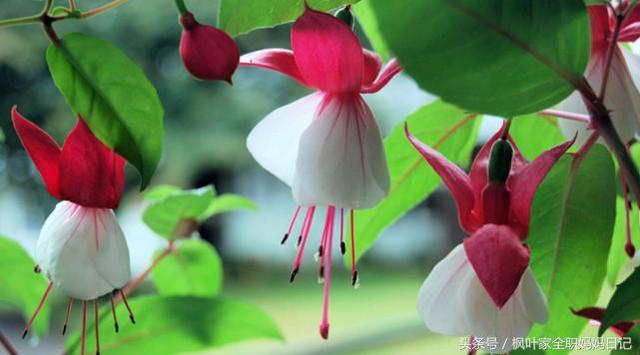
I saw that it had adapted well to the pot, so it was moved into the sun. The weather was quite cool, and the sun was weak. The flowers took several hours.
Why hang a fuchsia in the sun? However, the plant's leaves did not droop, nor did they have any spirit.
There are different opinions on the sunlight issue:
1 Full-day sun is also full of vitality. Premise: start from seedlings; in fact, seedlings adapt to the environment better than mature plants. Finished plants are used in greenhouses. After buying them back, they need some time to adapt to the environment. You cannot buy them back and put them in direct sunlight; you can start with diffused light, and the length of sunlight should be gradually increased.
2 Sufficient sunlight time is strict. Generally, you can get sunlight before 9 a.m. and after 4 p.m., avoiding strong sunlight exposure.
Let me talk about what happened to my fuchsia. Last summer, I put it in diffused light for a while, then moved it into direct sun all day, and soon the whole leaf turned yellow, but when it was hot in summer, it miraculously revived and many flowers opened. However, Nanjing is too hot. When the outdoor temperature was as high as forty degrees for several days, I did not move it to a shady place. In the end, it still got too hot, and the review was over!
Characteristics of the upside-down golden bell: native to Peru, Chile; likes a cool, sunny, well-ventilated environment. It is not tolerant of high temperatures, stuffiness, or rain; suitable for humus soil, breathable and fertile sandy soil; growth temperature 15~25°C.
Safe summer notes:
1 Create a cool environment, strengthen ventilation, pay attention to shading, and be careful not to let it rain. If it rains, the water in the pot needs to be removed promptly, otherwise it is easy to rot.
2 Pay attention to humidity. On sunny days, water is sprayed on the leaves, and the dust is cooled.
3 Try not to fertilize during the hot season from June to August, because it enters a dormant period in summer and grows slowly or even stagnates. Most plants do not fertilize during dormancy; give it time to recover.
4 The soil should be airy, loose, and highly drainable to prevent root rot caused by summer stuffiness.
5 Watering with potting soil should be slightly dry. If the potting soil is often too wet or stuffy and not ventilated, it will cause the plant to turn yellow or rot at the roots and die.
6 For breeding new seedlings, old plants are generally sensitive to high temperatures, while new seedlings are more heat-tolerant. So in summer, you should back up cuttings and cut new seedlings.
Text: Maple Leaf
Welcome to follow: Maple Leaf Family Full-Time Mom Diary
What are the reasons for old clock collapse? How to maintain it daily?Morphological characteristics of the upside-down golden bell flower
The upside-down golden bell, also called bell-shaped sea otter, is an evergreen shrub of the Asteraceae family, born in leaf axils and depressions. Flowers are divided into single petals and double petals; the sepals are red, and the corolla is purple, blue, white, rose red, pink, etc. It blooms all year round at suitable temperatures, especially in spring and autumn. There are many varieties. Currently, there are white stork, golden bell, double-flowered upside-down, narcissus upside-down, long scroll, and lychee.
Growth habits
The upside-down cool golden hook likes a cool and humid environment, fears high temperature and strong light; fertile, loose, slightly acidic soil is suitable; in winter it needs warmth and moisture, sufficient sunlight, and air circulation; in summer it needs high dryness, cool and semi-shady conditions.
The upside-down golden hook avoids hot summer heat, rain, and sunlight. The growth temperature is 15-25°C. The winter temperature is not lower than 5°C. When the summer temperature reaches 30°C, growth is very slow, and at 35°C, a large number will die. The lower temperature of the winter greenhouse should be kept at 10°C; it is susceptible to frost damage at a low temperature of 5°C. The room temperature is 10-25°C, and high air humidity is needed.
The upside-down golden hook should use fertile sandy loam rich in humus and well-drained.
Maintenance of the upside-down navy department:
The upside-down golden bell is a cool, humid environment. In winter, it needs sufficient sunlight. In summer, it needs a cool, ventilated, semi-shaded environment; it is very hot, but not too cold. The upside-down golden bell thrives in spring and autumn. It is recommended to keep the soil moist. Every 7 to 10 days, combine loosening the soil with thin liquid fertilizer or compound fertilizer to provide enough nutrients and promote more flowering.
Plant growth is slow or stops in summer, in a dormant or semi-dormant state, and it can be placed under a ventilated shed without direct sunlight. Do not pour too much water and stop fertilizing. When the potting soil is dry, pour a small amount of water, and do not expose it to rain, so as to avoid stuffiness and humidity, which make the leaves yellow, wither, rot the roots, and even cause plant death. After the weather cools in autumn, resume normal water and fertilizer management. After September, the soil should be kept moist and fertilized.
In winter, place the flowerpot in a sunny indoor place; in winter it can be safely kept at a temperature not lower than 5°C. If the air is drier, water can usually be sprayed on the plant to increase air humidity, but the soil should not accumulate water. Every year in June and July, some leaves are cut off to make the plant gradually dormant. In the early autumn after dormancy, branches that are too long, too dense, or otherwise affected are cut off or shortened to promote new shoots.
Upside-down golden bell potted flower seedlings with fresh flowers hanging fuchsia potted plants lantern flower hanging orchid indoor balcony plant
9.5
Buy
Since most of the flower buds of the upside-down golden bell are formed in the leaf buds of new shoots, attention should be paid to topping during cultivation to promote the germination of new shoots and the formation of flower buds, thereby achieving the purpose of more flowering. The flowering period can also be adjusted by topping, and new branches can bloom 15 to 25 days after topping. In addition, topping can also make the plant shape full. Replace the pot once a year in autumn, remove 1/3 to 1/2 of the old soil when changing the pot, and add new soil. The potting soil should be fertile and loose; sandy soil rich in humus and well-drained.
The upside-down golden bell can be propagated by cuttings and sowing. Among them, cuttings are the most commonly used and can be carried out all year round. The most suitable times are March to May and September and October. Cut a 7 to 10 cm long branch from the year, insert it into river sand or vermiculite at a depth of half the cutting, and roots will form half a month after insertion. The base of the cutting can also be rooted, then watered and rooted in about ten days.
What are the reasons for old clock collapse:
1. Overly wet watering causes the golden bell to fall. Usually watering should not be too wet; overly wet soil easily accumulates water, causing root rot, yellow leaves, and shedding. It is better to keep the soil dry and then water, so that the root system is not easy to grow.
2. The soil is hard and impermeable; the water after watering cannot penetrate the soil layer, and most roots cannot absorb water and nutrients. The symptoms of flower loss caused by loss of water and leaves are caused. The better method is to loosen the soil appropriately to promote loose soil and permeable drainage, which is beneficial to root growth.
3. Because of insufficient light, long-term growth inside the fuchsia pot causes yellow leaf symptoms and shedding. It is better to place it in an indoor sunny and ventilated place, which is beneficial to its photosynthesis and reduces the phenomenon of yellow leaves falling. It is best to remove it freely after 1 hour of outdoor sun; the sun will enhance photosynthesis.
Pests and diseases can also cause flower loss. It can be observed that if the leaves are caused by pests, insecticides can be used to kill the insects. If it is caused by bacteria, antibiotics can be used to treat the disease.
Insufficient nutrients or excessive fertilization can easily cause yellow leaves to fall from the leaves. Dig a hole on one side and bury compound fertilizer and mineral additives with high phosphorus and potassium content. The amount should not easily prevent excessive damage.
Upside-down admiral flower bells, snapper, bell, flower, lantern, flower, potted plant, flower, green plant, hanging orchid seedling
5.8
Buy