How to care for a received bouquet so it stays fresh longer
On birthdays or holidays, you will always receive a bouquet as a gift. Different flowers carry different meanings and can be given to different people.
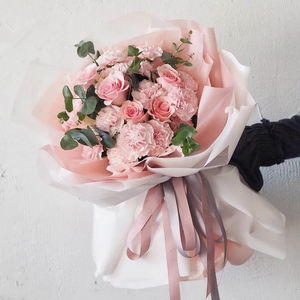
Some flowers express thanks, some express blessings, some express love, some express respect, some express longing, some express mourning...
For parents, you can choose a carnation bouquet; for a partner, you can choose roses; for friends, you can choose sunflowers; for elders, you can choose lilies.
On Valentine's Day, Qixi, Mother's Day, Women's Day and Christmas, giving bouquets is most popular, but many people cause huge waste because they do not know how to care for them.
The bouquets you receive are all cut flowers. Once separated from the soil that supports their roots, they will certainly dry up and wither quickly, and throwing them away is too wasteful.
So some bouquet care measures are needed to make this affection you received last longer.
Today, follow us and take a look at "how to care for a received bouquet."
1. The bouquets received now generally have floral foam at the bottom, so they can be stored for a long time and are not easy to rot.
But floral foam is still not as good as water culture. After keeping it in floral foam for about 5 days, you can unwrap the bouquet and care for it in water.
2. Use scissors and a small knife to carefully separate the wrapping paper from the fresh flowers, then rinse off the traces of floral foam and tape at the bottom with water.
3. Pick out any stems with wounds and do not use them for water culture; they can be hung upside down to make dried flowers. Cut off most of the leaves to avoid contact between the leaves and water, so as to prevent rot, which would cause the flowers to rot one after another. Just leave 3 or 4 leaves for decoration.
4. You can burn or scald the bottom of roses, and cut diagonally at 45° at a place 3 cm from the end. This is to expand the contact between the roots and water and make it easier for the roots to absorb.
5. Choose a vase of suitable size according to the number of fresh flowers, and wash the vase clean with a disinfectant to prevent bacteria from breeding in the water.
6. Add some water to the vase. It does not need to be too much; just enough to cover 1/3 of the flower stems.
7. Place the vase indoors in a windless place, away from air conditioning and heat sources, to avoid accelerating the loss of moisture from the surface.
8. Change the water in the vase every day, and you can also add some flower nutrient solution. Cut the stems once every two days, cutting diagonally at 45° according to the above method.
9. Definitely do not sprinkle water on the surface. Many people think that sprinkling water can ensure the flowers' moisture, but in fact cut flowers separated from the soil do not absorb well through the petals, and sprinkling water will cause the flowers to rot.
Note: Bouquets with a strong fragrance, such as lilies and tulips, should not be placed in a closed bedroom, to avoid causing insomnia and breathing difficulty.
Bouquets cared for strictly according to the above method can be kept for 7-15 days in summer and 10-25 days in winter.
Of course, after being kept in water, a bouquet cannot be as delicate and lovely as when it was first brought home, but it can slow down the process of withering and fading.
Placed at home, watching it change little by little every day is also very interesting.
However, there is no need to be sad about the decline of fresh flowers. They have completed their mission in another way and live in your heart.
In addition, flowers with relatively little moisture, such as baby's breath and forget-me-nots, can be placed naturally in a vase after you bring them home, without adding water.
With the influence of temperature and wind, they will slowly lose moisture, but their color and shape will not change much.
After air drying, baby's breath and forget-me-nots can be kept for several months, and they have no fragrance either.