How to care for a Buddhist pine just after potting? These care tips you need to master
In the past, I knew about Lohan Guo, but I didn't know about Buddhist pine. I had never even heard of it. Later I learned that there is a Buddhist pine bonsai. I naively thought Lohan Guo was the fruit of the Buddhist pine. Only one day did I realize how ignorant I was. Have you ever had the same confusion as the editor?
Buddhist pine
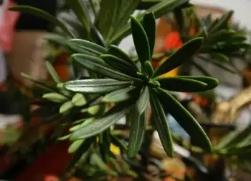
The first one introduced is the most common Podocarpus macrophyllus var. maki, which is a small-leaf pine, and the most famous are 'Zhejiang Luoke' and 'Nantong Luoke', which are relatively good. Its characteristics are a rounded head and obvious texture. The platycladus is very eye-catching and has high ornamental value.
Taiwan Buddhist pine
Taiwan Buddhist pine is produced in Lanyu, Taiwan, China, hence the name. It differs from the tongue-shaped dark green leaves. Its leaves are green and evergreen. Its leaves are oval and have obvious texture. They bloom from March to May every year, and the flowers are yellow-green, born under the leaves. Because of the Taiwan Buddhist pine, the red fruit is like a cunning arhat. The growing environment required by Taiwan Buddhist pine is very tolerant; it only needs enough sunlight and humidity, so it is very popular among collectors.
Japanese Buddhist pine
Japanese Buddhist pine is a more individual species. Its trunk is dark gray, with leaves and pine characteristics. It is scaly and cracked, and the leaves are needle-like. The flowers of Japanese Buddhist pine range from white to purple or purple. The temperament of Japanese Buddhist pine is like that of a Japanese samurai. It is soft and gentle, but good ones do not produce.
Rice-leaf Buddhist pine
Rice-leaf Buddhist pine is very special. Unlike other varieties, it is a short-leaf Buddhist pine. It was originally planted in southern China, and the rice-leaf pine of Wenzhou is relatively good. In recent years, it has been grafted. The technique is very developed, widely used, and has a high success rate, so there is more circulation on the market.
Pearl Buddhist pine
Pearl Buddhist pine is named because its leaves are very similar to pearls. Its leaves are small and round, just like a cute red pearl when it grows out. Buddhist pine is produced in Guangxi mountains and Sheng Tang mountain in China. Its quantity is very small and it is very valuable.
Buddhist pine
Buddhist pine can grow in sunny places and can also adapt to negative environments; it belongs to semi-sun and semi-shade plants. Wild Buddhist pine has been listed by China as a good second-class protected plant. The Buddhist pine (Podocarpus) is elegant and has high ornamental value. It is a potted species and is very popular in every household.
After staying with the editor's introduction, do you have more understanding and love for Buddhist pine? But please note. When buying Buddhist pine, you should pay attention to its characteristics and avoid buying fakes! Buddhist pine not only has high ornamental value, but its medicinal value should not be underestimated. In the editor's view, Buddhist pine is a gift from nature!
Indoor bonsai protection and cultivation of Buddhist pine - Chinese-style bonsaiBuddhist pine is a small evergreen tree. It has evergreen seasons, narrow needles, dark green color, vigorous stems, and a long lifespan. It is a common tree species for making bonsai. Among them, Buddhist pine, whose leaves are only 2 cm long, has a beautiful tree shape. It is a valuable tree species for making bonsai. Buddhist pine likes a warm and humid environment, is more shade-tolerant, and prefers fertile, loose, well-drained, slightly acidic sandy loam.
The bonsai making method is as follows:
I. Seedling source and reproduction
The seedlings of Buddhist pine bonsai are usually obtained through artificial propagation methods such as harvesting and cutting. There are also wild Buddhist pine trees in the mountains, usually born in stone cracks. The plants are short, the branches are quaint, and the posture is exquisite. Propagation methods: commonly used cutting methods; harvesting methods and grafting methods can also be used for reproduction. The cutting time stops in mid-March or during the dry season from June to July. Cuttings are used for cutting, and the seedbed needs to be covered. Transplanting is most suitable in March in spring. Harvest in late August, then sow, or harvest sand in March. Because cuttings grow slowly, it is recommended to use large-leaf or small-leaf Buddhist pine as rootstock; early spring grafting has a higher survival rate.
II. Modeling
The theme of Buddhist pine artistic modeling is "tree form" and "independent application of art", using exquisite artistic expression techniques to excavate a higher artistic realm from ordinary tree forms and maximize the appreciation value. Commonly used modeling techniques include cutting, tying, pressing, binding and hanging. Pruning shapes are more complicated, and modeling methods such as tying, pressing, binding and hanging are even more difficult. The artist's artistic imagination, operating skills, and the tree's stems and branches must all be higher. In the modeling process, it is necessary to rely on the seedling itself. Natural beauty prevents artistic processing, that is, it must adapt to the tree, be beautiful and pleasing, making the shape strong yet weak, with clear layers.
1. Scissors: It can be applied to the characteristics of pruning and trimming, and can be used to make various shapes, such as spherical, conical, multi-layer spherical, etc., just prune according to needs. To the pre-designed pattern. For example, when pruning a three-layer sphere, first choose a seedling with a clear trunk and a better upright shape. For example, if the total height of the pruning design is 2 m, the height of the lower layer is about 50 cm, the height of the two layers is about 40 cm, and the height of the lower layer is 30 cm. It must be cut off 45 cm between the excellent layer and the excellent layer, and cut off 35 cm between the excellent layer and the third layer. All branches, then prune the three spheres. The above three middle and third spheres are more suitable, making the proportions coordinated and better appreciated. When common new shoots are 20-30 cm, pruning should be repeated to make the layers round and compact.
2. Tying: For the tying style, strong bamboo sticks and strong hemp rope can be selected, and the bamboo branches and branches are tied with hemp rope, solidly, and then one end of the bamboo stick is fixed on the trunk so that the direction of the bamboo stick can be adjusted so that the branches grow in a specific direction according to the sculptor's wish and achieve the purpose of modeling. The requirement is that the tying model is suitable for young Buddhist pine, while older Buddhist pine is difficult to shape because of its thin branches.
3. Pressing: The compression method is a secondary method of bending and tilting the trunk, so that the tree body has different artistic beauty on the slope. Because the stems of Podocarpus macrophyllus var. maki are like human arms, and the hemispherical leaf clusters grow at the top of the branches, like human palms, and then the curved tree, as if a welcoming person is bending on the arm. Saying goodbye to the arrival of guests is very vivid and abstract. It should be noted that after bending the tree body, the inclined end must be supported with wooden stakes to avoid excessive tilting and lodging of the tree body, and place straw of moderate thickness between the contact surfaces, wooden stakes and the tree body to prevent the tree from falling. Damage.
1. Potting
Buddhist pine usually blooms in the pot before spring germination. The pot soil should be slightly acidic sandy loam, loose in texture and well drained. Because the posture of Buddhist pine is simple and rustic, it is better to use a purple clay pot or a glazed pottery pot, and the pot shape is determined by the tree shape.
2. Modeling
The shape of Podocarpus is mostly stopped during the dormant period. Because the branches of Buddhist pine are soft, easy to cut, and can be pruned, the shapes are diverse. Rare methods include bent-dry, inclined-dry, horizontal cloud, cliff and peduncle. Branches and leaves can be pruned into sheet-like or taro-like shapes.
3. Planting and protection
Buddhist pine can be grown in plants and potted plants, and management requirements are not strict. In spring and autumn, only apply nitrogen fertilizer once or twice as a topdressing, and excessive phosphorus and potassium fertilizer is not needed. For formed bonsai, attention must be paid to topping and pruning to avoid the length of the leaves maintaining the original posture. For the top pruning task, it is better to stop in spring and spring. Home-grown Buddhist pine should be placed outdoors in a ventilated place for maintenance all year round. It should not be placed indoors for a long time, otherwise yellow leaves will cause death. In winter, the temperature should not be exposed to sunlight, and it should be placed in semi-shade for maintenance. During the growing season, the water may be slightly more; in hot summer, the pot soil should be watered in time, and watering should be thorough; in autumn and summer, the water can be appropriately increased. In summer in East China, when the temperature drops to 5°C, it should be overwintered indoors, and the amount of watering should be controlled.
(1) Location
Buddhist pine should be placed in a warm, humid and air-circulating center in winter, and placed indoors above 5°C in winter. However, the temperature should not be too high, so as not to affect its dormancy.
(2) Watering
Buddhist pine likes moist soil. It should be watered frequently during the growing season. The pot soil remains moist, but the pot does not become waterlogged. In winter, water is often sprayed on the leaves or the air, and the leaves are bright.
(3) Fertilizing
A Buddhist pine that has already been formed should not be fertilized more. Usually, during the growing season, apply decomposed thin liquid fertilizer once every 1 month, and no longer fertilize after autumn.
(4) Pruning
Buddhist pine should be pruned frequently to maintain the tree shape. It is better to remove flower buds in time when flowering, so as not to consume nutrients.
(5) Turning the pot
Buddhist pine usually has its pot turned once every 2-3 years. Usually stops from March to April. (6) Pest and disease control: Attention should be paid to the prevention and control of pests and diseases, especially in winter and low-temperature seasons, and attention should be paid to the prevention and control of insects and red spiders, coal pollution, leaf spot disease and other good diseases, 0.5% to 1% Bordeaux mixture, plum blossom one month before the dry season, spray once every 10 days, 3 times in total, can control the effect. Secondary pests include large moths, red wax scale insects, red spiders, etc., which can be sprayed with 1200-1500 times liquid of dichlorvos, or 40% dimethoate sprayed with 1500 times liquid spray.