Sika Deer Farming Technology Video Tutorial Collection: Costs, Profits, Risks, Prospects and Sales Channels
The sika deer is a rare protected species in the world. Due to human hunting and the destruction of the natural environment, the number of wild sika deer in China is very small. As we all know, every part of the deer is treasured; velvet antler and its by-products have health benefits and hold high medicinal and economic value on the market
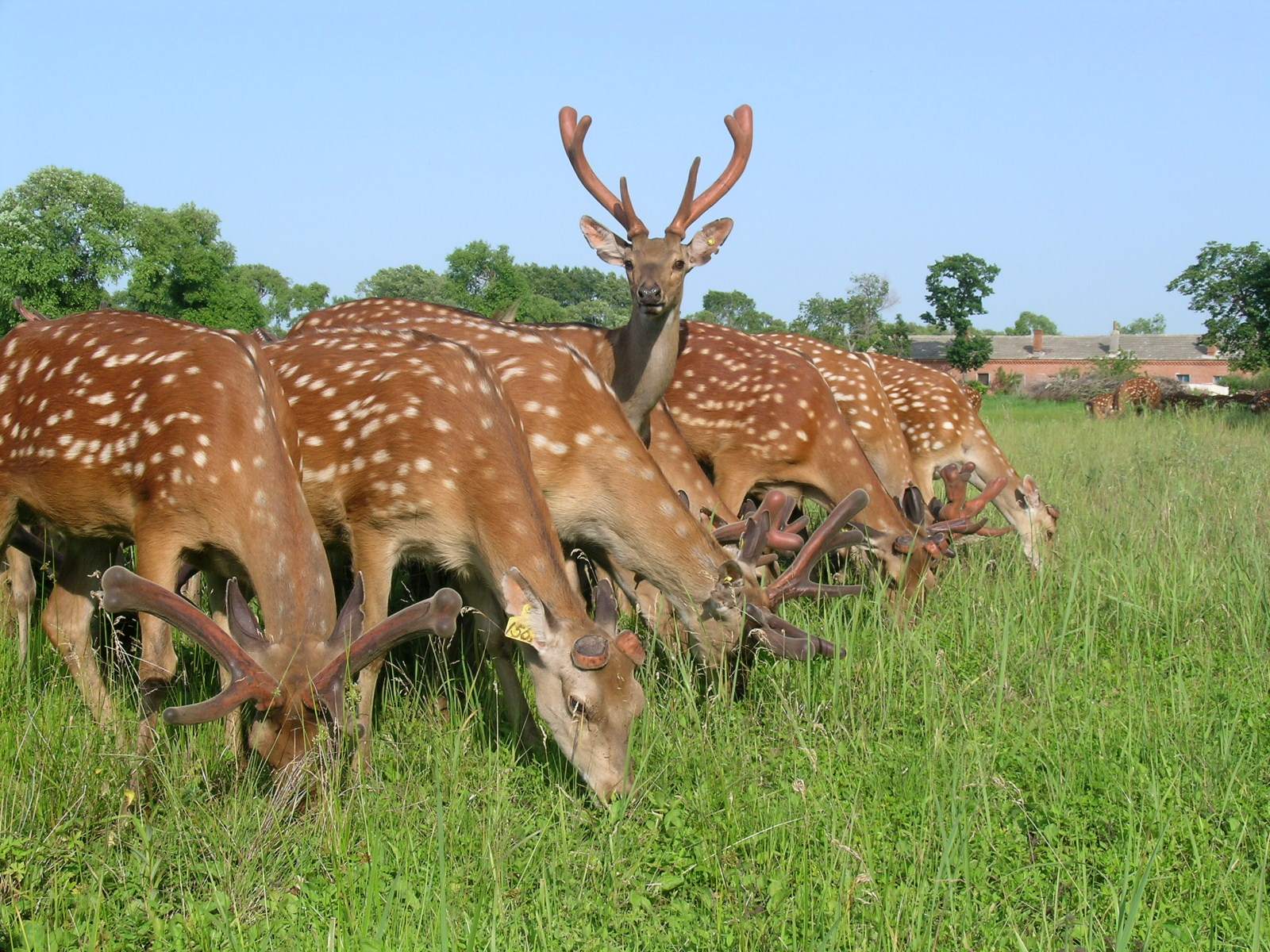
Living Habits of the Sika Deer
1. The sika deer is an animal that likes to live in herds, with each herd consisting of anywhere from 2 to several dozen deer. However, the structure of the herd changes with the seasons. During the breeding season, the herd is composed of 1 sturdy adult stag, 1 to more than 10 adult hinds, and some sub-adults and fawns, which is called a "breeding herd." From May to July, it is the fawning season for sika deer; the hind about to give birth leaves the herd for a quiet, secluded place to deliver. Afterwards, she lives with her fawn on her own or joins with other mother-fawn groups, sometimes numbering as many as several dozen. This is called a "mother-fawn herd." Outside the breeding season, there are small groups made up entirely of several adult stags or adult hinds, called "stag herds" and "hind herds."
2. The sika deer is mainly active at dawn and dusk, mostly wandering in places not far from water sources and with abundant food, with a range of activity of about 5-15 km.
3. The sika deer is a purely herbivorous animal, feeding on the leaves, buds and tender twigs of various herbaceous plants, trees and shrubs.
4. The sika deer is a seasonally estrous animal. It comes into estrus every autumn, with October to November being the peak mating period. At this time, they appear restless and irritable with reduced appetite, especially the stags, which become aggressive and combative. If there are more than two adult stags in the herd, fierce fights will inevitably occur, and the result is either both being badly injured or the stronger driving the weaker out of the herd. Only after the mating period ends do they gradually return to normal. The gestation period is 7.5-8 months, with 1 fawn per litter and very rarely 2. Fawns gain weight fastest within 3 months of age, and the rate gradually decreases afterwards.
What Conditions Are Needed for Sika Deer Farming?
1. Site conditions: For sika deer farming, choose a place with relatively dry terrain, facing south or slightly southeast, with a 5-degree slope and sandy or stony soil. In mountainous areas, choose a spot not threatened by mountain floods, sheltered from the wind and with good drainage.
2. Feed conditions: A fully confined sika deer requires an average of 350-400 kg of concentrated feed and 1750-2000 kg of roughage per year, so lush pasture is required throughout all four seasons.
3. Water source conditions: Before building a sika deer farm, necessary surveys and investigations must be conducted on the groundwater level, natural water sources, water quantity and water quality, and attention must be paid to the inorganic salt content in the water. Avoid using natural surface water sources such as rivers, or water sources polluted near the site.
4. Transportation conditions: The site for a sika deer farm should preferably be 1.0-1.5 km from a road and 5-10 km from a railway, so as to facilitate the supply of equipment and feed, the shipping of products, and the daily life of workers. At the same time, the power supply must be sufficient and close to the site.
5. Social conditions: A sika deer farm should not be located near industrial and mining areas or public facilities, and should not be built on land contaminated by cattle and sheep infectious diseases or on livestock farms. Attention should also be paid to resource conditions near the site, such as whether building materials are convenient and whether labor is sufficient.
Preparatory Work in the Early Stage of Farming
1. Site preparation: Choose a place with high, dry terrain, sheltered from the wind and facing the sun, with good drainage and convenient water sources to build the deer farm. Deer are quite active, so the deer shed should cover 2-3 sq m per deer, and the exercise yard 8-10 sq m. Use stone slabs, smooth wooden boards or cement boards for the flooring so that manure and other waste is easy to clean. Set up railings around the deer farm, 2.5-3 m high, to prevent the deer from escaping by jumping. It should not be located near industrial and mining areas or public facilities, and should not be built on land contaminated by cattle and sheep infectious diseases or on the former site of a livestock farm.
2. Facility preparation: Deer sheds, warehouses for concentrated and rough feed, a feed processing and mixing room, silage pits (trenches), processing rooms for velvet antler and other deer products, a veterinary room, and buildings for other sideline production.
3. Technical preparation: Deer-raising techniques are mainly learned on your own from books, newspapers and magazines, or from columns such as this website's electronic publication "Deer Raising Technology Digest," to continuously improve and enrich your breeding techniques.
4. Feed preparation: The deer farm must have sufficient feed land or a reliable base for supplying various feeds. A fully confined sika deer requires an average of 350-400 kg of concentrated feed and 1200-1500 kg of roughage per year.
5. Epidemic prevention preparation: Sika deer have strong resistance and a low incidence of disease. Under artificial rearing, they fall ill less often, but they can sometimes contract infectious diseases such as Japanese encephalitis, rabies, anthrax and colibacillosis, so prevention and control must also be emphasized in artificial breeding.
6. Preparation for introducing breeding stock: Before introducing stock, you must gain a comprehensive, multi-faceted understanding of the supply sources, master the basic knowledge of rearing, and adhere to the principles of purchasing from units qualified to deal in breeding stock, comparing quality, price and service, and buying from nearby sources, so as to ensure good quality and price of the breeding stock.
Rearing and Management of Fawns
1. Rearing and management of suckling fawns
① Usually a fawn is born with its whole body wet. Besides relying on the hind to lick it dry, artificial assistance should be taken when necessary, such as wiping the wet hair dry with a cloth so that the fawn can drink colostrum as early as possible. A healthy, strong fawn can stand up and search for its mother's milk 0.5-1 hour after birth. Deer milk is characterized by low water content, high dry matter and high milk fat, so a small amount of suckling satisfies the fawn. Generally, the hind nurses once every 3-4 hours, for no more than 2-3 minutes each time.
② During the fawn's suckling period, the rearing and management staff must avoid letting odorous items such as alcohol and soap touch the fawn, otherwise the hind will refuse to nurse it because of the foreign smell.
③ If the hind dies after giving birth or is unable to nurse due to illness, or if her milk is insufficient, artificial nursing measures must be taken. Usually cow's milk or goat's milk is used as a substitute. Fresh milk is better than milk powder; if fresh milk is not readily available and milk powder must be used, the reconstituted milk powder should be made slightly more concentrated to meet the needs of the fawn's growth and development. The timing, frequency and amount of artificial nursing are determined by the fawn's age in days, birth weight and development. In the absence of experienced standards, the artificial nursing amount for fawns can refer to the artificial nursing amount for calves. The hygiene requirements for artificial nursing are relatively strict; milk and nursing utensils must be consistently sterilized to prevent bacteria and souring in the milk.
④ One to two months after the hind gives birth, her milk production often drops sharply, so hinds that are nursing fawns must be given enhanced feeding, with an appropriate increase in highly nutritious succulent feed, because the rearing of the fawn depends to a large extent on the quality of the milk obtained.
⑤ By 20-30 days, the fawn begins to look for plant-based feed and can eat some tender green grass leaves. At this point, some good-quality, soft, succulent green feed should be supplemented artificially. But at this stage the fawn's main source of nutrition is still mother's milk. When the fawn weighs about 25 kg, it can be weaned and switched to artificial feeding.
2. Taming of fawns before weaning
① About 20 days after birth, the fawn begins to eat some tree leaves. Set up a water trough inside the protective pen, and the staff should add water at fixed times and in fixed amounts each day, and use feeding-port whistles and other methods for training and taming, so that deer and people become friendly. Gradually separate the mother and fawn and raise them individually.
② Set a connecting gate between two adjacent pens. First drive the mother and fawn entirely into one pen, then move the hind out into the other pen, leaving the fawn behind. At first, 1-2 hinds can be left in the fawn pen; after 4-5 days, separate them completely twice a day, morning and afternoon. The separation time is initially 1-3 hours each time, then gradually extended. At noon and in the evening, open the connecting gate to let the mothers and fawns move freely, and the fawns suckle.
③ Increase human-deer contact. Those who feed and water should use a whistle, so as to stabilize the fawns' temperament.
④ Some feed should be supplemented appropriately. The supplementation time is determined according to the interval between the fawns' birth dates; generally, supplementary feeding can begin in late July, especially with some green, succulent feed. For concentrated feed, sorghum can be stir-fried until aromatic and then ground, mixed with cooked corn and soybeans; the soybean proportion is 10%. The feeding amount must be appropriate, increasing from small to large, reaching 500 g per fawn per day before weaning and grouping. Green and rough feed should be chopped before feeding.
3. Rearing of fawns after weaning
① Fawns are generally weaned around August 20. After weaning, they should be divided into several small groups according to sex, physical strength and individual size, and raised in groups. The fawn pen should be set up far away from the hind pens, or the hinds can be moved out and the fawns left in the original pen. In the early stage after weaning, because the fawns are suddenly separated from their mothers, they will bleat incessantly, and their mental state and appetite are greatly affected. The keeper must be more patient in caring for them, often calling to the fawns and approaching the herd to ease their restlessness. After weaning and grouping, the fawns are moved to the young deer pens, and the amount of feed put out should be gradually increased; do not feed too much at once.
② Fawns have a small food intake, digest quickly and eat frequently. Within half a month after weaning, they can be fed 4-5 times a day, with one supplementary feeding of green roughage at night, and later gradually reaching 3 feedings per day and the full-price nature and nutritional level of the daily ration for that period.
③ The concentrated feed for weaned fawns must be carefully processed and mixed. Soybeans and corn can be cooked; part of the corn can be ground into cornmeal, and the soybeans ground into soybean milk, then mixed in proportion. At the same time, roughage such as green oak leaves, poplar leaves and green corn stalks can be given, and the corn stalks should be chopped. Drinking water must be clean and sufficient. In addition, attention should be paid to the supply of minerals, supplementing with additives such as multivitamins and selenium-containing trace elements. Adding salt and bone meal to the daily ration can prevent rickets and osteomalacia.
Rearing and Management of Hinds
1. The mating period for hinds is from late August to mid-November. At this time, feed rich in protein, vitamins and minerals should be given, with a daily feeding amount of 3.5-4.2 kg, including 1.1-1.2 kg concentrated feed, 1 kg succulent feed, 1.4-2 kg green roughage, and 20 g each of calcium powder and salt. Mating hinds should be managed in groups, with dedicated staff on duty to watch over them.
2. The number of matings in one estrous period is best controlled at 2-3. After mating, the hind enters the gestation period (late November to mid-April of the following year). At this time, sufficient nutrition must be supplied to facilitate fetal development. The daily feeding amount is 3.8-4.7 kg, including 1-1.5 kg concentrated feed, 1-1.2 kg succulent feed and 1.8-2 kg green roughage. In the early and middle stages of gestation, more green and rough feed should be supplied, and in the later stage, more feed of smaller volume, high quality and good palatability. Concentrated feed should be fed twice a day; green feed should be varied, and moldy or spoiled feed must not be fed.
3. Raise stags and hinds separately. Do not startle the hinds or drive them by force; prevent disease and miscarriage.
4. Generally, birthing begins in late April, and the nursing period lasts until early to mid-August. At this time, the feed should be rich in protein, vitamins and minerals, with a daily feeding amount of 5.7-7.5 kg, including 1.2-1.5 kg concentrated feed, 1.5-2 kg succulent feed and 3-4 kg green roughage, plus sufficient calcium powder and salt. Concentrated feed should be fed 2-3 times a day, and green roughage can be given for free feeding. The pens must be kept clean, with a level, dry floor.
5. For breeding and reproduction, select deer with large ears, fast growth and good quality as breeding deer for mating and reproduction. Deer reach sexual maturity at over 2 years of age, and mating is better at 2.5 to 3 years of age. Hinds come into estrus from August to October. During estrus, they are excited and restless, with mucus flowing from the corners of the eyes, an abnormal odor, frequent squeaking calls, increased mucus in the genital area, and a tendency to approach stags. Ovulation occurs 16-36 hours after the start of estrus, so the timing must be grasped and mating done at the right time. The mating methods are as follows.
① Herd mating: Put stags and hinds together, with 50-100 hinds and 20-30 stags mixed into a herd, and let them mate on their own. Its drawback is that stags easily engage in fighting over mates, causing injuries or deaths.
② Rotational mating: The stags participating in mating are placed into the hind herd in batches, in turn.
③ Reciprocal mating: Divide the hind herd into small groups of 4-5, place 1 stag in each small group, and after a certain time, swap the stags among the small groups. These methods all give good mating results and high conception rates. After mating, observe carefully, and promptly re-mate those found not to have conceived.
6. Every year from May to July is both the velvet antler harvest season and the fawning stage for hinds, the busiest time for deer-raising units. To ensure that hinds give birth smoothly and safely, day-and-night duty care must be well organized. Before the hind gives birth, material preparations for delivery must be made, such as physiological saline, syringes, liquid paraffin, potassium permanganate, pituitrin, a record book, ear-punching pliers, and succinylcholine anesthetic. At the same time, a birthing room must be prepared.
7. In the first few days after giving birth, the milk secreted by the hind is colostrum. Colostrum contains extremely rich protein and vitamins (especially vitamin A), as well as various nutrients, antibodies and inorganic salts. It is very important to the fawn's health and also has a mild laxative effect.
8. Under domestication conditions, the nursing period of fawns varies, depending on the practices of each deer farm. During the nursing period with her fawn, the hind is fierce in temperament and often attacks people who approach her fawn. At about 3-4 weeks of age, the fawn can begin to eat a small amount of green feed along with the hind, and at about 3 months of age it can live independently without milk feeding. In order for the hind to come into estrus normally, the hind should be separated in late August to early September to stop milk production, so as to help her recover her physique, come into estrus early and mate early.
9. A small number of hinds, especially first-time mothers, abandon their fawns after birth and do not care for them. A foster hind should be found promptly to raise them. The method is to, within 2-3 hours, smear the fawn with the foster hind's placental fluid or urine, which makes success easy.
Rearing and Management of Stags
1. Rearing and management during the recovery period and early antler-growing period
① The stag's recovery period and early antler-growing period basically fall in the winter stage. After mating, the stag is thin and weak, and the temperature is relatively low. The rearing requirement is to quickly restore its physique and provide the material basis for growing new velvet antler. Therefore, in terms of feeding, feed relatively rich in starch and minerals and a certain amount of protein feed should be given.
② The concentrated feed in the stag's daily ration is composed of a mixed concentrate, whose composition is 50% grass-family seeds (corn, sorghum, or barley, wheat, etc.), 30% legume seeds (soybeans or soybean cake) and 20% bran. Succulent feed includes root-tuber feeds such as carrots, radishes and sweet potatoes; green feed includes various tender twigs, tree leaves and green grass.
③ After the mating period, the stag's appetite gradually recovers. When increasing feed, do it from small to large amounts, and never feed a large amount suddenly. Concentrated feed should be fed twice a day at fixed times; when green feed is sufficient, it can be given for free feeding. For older, weaker and disabled deer with poor physique, separate them into small groups or individual pens for careful rearing, so that they quickly recover their physique.
2. Rearing and management during the antler-growing period
① Every year from April to mid-August is the antler-growing season for stags. The stag's antler-growing period refers to the period from the shedding of the antler and the growth of new velvet antler, or from the shedding of the antler base and the growth of new velvet antler, to the maturation and sawing of the velvet antler, about 60-80 days. During the antler-growing period, the stag's sexual desire fades, metabolism is vigorous, and food intake increases; the stag needs a large amount of nutrients.
② The growth rate of the stag's velvet antler is very fast. According to observations, for 3-4 year old sika deer, the growth time of two-branch velvet antler is about 55 days, with an average daily weight gain of 17.7 g, while red deer gain an average of 50 g per day.
③ The stag's velvet antler grows very fast, so considerable nutrients must be supplied to the deer's body to meet its physiological needs. Therefore, during the antler-promoting period, in addition to feeding general feeds such as various green grasses, cottonseed hulls, bran and rice bran, some concentrated feed with higher protein content should also be added. Each stag can be additionally fed 1-2 kg of cornmeal, 100 g of soybeans and 50 g of fish meal per day, and it must be ensured that the deer has enough drinking water every day. In this way, the deer absorbs nutrients well and the velvet antler grows especially vigorously.
④ Practice has proved that velvet antler grown with antler-promoting feed and without it is very different. Velvet antler grown without antler-promoting feed has shriveled, weak branches, is small and lusterless, light in weight and lower in grade. Velvet antler grown with antler-promoting feed has thick, strong branches, uniform thickness from top to bottom, a glossy sheen and a plump tip; generally the antler weight can increase by 15%-20%, and the grade can be raised by one level accordingly.
⑤ Feeding should be balanced and at fixed times. Concentrated feed should be fed 2-3 times a day, and drinking water must be clean and sufficient. In areas with abundant green feed sources, their needs should be met as much as possible, and if necessary they can be allowed to feed freely. ⑥ During the antler-growing period, records should be kept of the date the stag's antler base falls off, the growth of the velvet antler, and other data. At the same time, the progress of antler growth must be monitored and the antler harvested in good time. For the few whose new antler has grown but whose antler base has still not fallen off, the hard antler should be removed with restraint, so as not to hinder the growth of the velvet antler. In addition, the deer sheds, exercise yards, partition walls and boards should be inspected and cleared to prevent the velvet antler from being broken by collision.
3. Rearing and management during the mating period From late August to November, stags have strong sexual desire and a markedly reduced appetite, and the base of the sawed antler has formed a flower disk and ossified. At this time, the deer rub against things everywhere, destroy feeding equipment, or fight and clash; fierce ones may even injure people, making it impossible for people to approach. Fighting over mates consumes a lot of physical strength, and the body becomes thin and weak. In order to strengthen the stag's physique and benefit mating, feeding must involve concentrated feed of higher nutritional value and good palatability, root-tuber succulent feed rich in vitamins, and tender green feed, but the amount can be appropriately reduced.
What Advantages Does Sika Deer Farming Have?
1. Strong adaptability: The sika deer spends most of its time in herd activities and has strong adaptability, a wide geographical distribution and low sensitivity to the environment. It can reproduce all over the country and even around the world.
2. Wide feeding habits: The sika deer has wide feeding habits and tolerates coarse feed. The straw and by-products of all crops, green grass and tree leaves, wormwood and moss are all good feed for deer.
3. Easy to tame: The sika deer is highly plastic, and young deer are even more so. They can be tamed to respond to human calls, touching, driving and leading, becoming as docile as cattle and sheep.
4. Strong disease resistance: The sika deer has strong disease resistance and rarely falls ill. As long as the feed given in daily feeding is ensured not to be spoiled, moldy or contain impurities, they basically do not get sick.
5. Considerable benefits: The farming benefits of sika deer are very considerable. The average output value of raising one deer is 1500-3000 yuan, and for the best deer herds, the annual output value of one deer can reach 5000 yuan.
Is Farming Sika Deer Really Profitable?
Farming sika deer can be profitable. Every part of the sika deer is treasured. Velvet antler is the king of traditional Chinese medicines and a top-grade tonic. Deer kidney is regarded by the medical circles at home and abroad as a specific medicine for strengthening yang and replenishing essence and improving sexual function. Deer tail and deer sinew have the function of treating diseases such as epilepsy. Deer fetus has the efficacy of treating kidney deficiency and women's diseases. Deer skin is the best raw material for making high-grade, precious leather garments. Deer sinew, deer heart and deer meat are high-grade delicacies at luxurious banquets. At present, with the development of the national economy and the rising living standards of the people, velvet antler and deer by-products, as well as series products produced with them as raw materials, are selling very well in various markets, so raising sika deer well can be profitable.
Economic Benefit Analysis of Sika Deer Farming:
For hinds, the purchase price of one breeding deer is about 4000 yuan. It begins to fawn from the second year, and thereafter gives birth every other year. Each fawn sold to farmers by the company is 2000 yuan per head, calculated on the basis of an average lifespan of 12 years for one breeding deer.
Hind: Input: purchase price 4000 yuan + annual rearing cost 500 yuan × 10 years = 9000 yuan. Return: 5 litters of fawns in 10 years at 2000 yuan/head × 5 + breeding deer sold at 4000 yuan/head = 14000 yuan. Profit: 14000 yuan — 9000 yuan = 5000 yuan, that is, each hind can return 500 yuan per year.
Stag: Input: purchase price about 4000 yuan + annual rearing cost 500 yuan × 10 years = 9000 yuan. Return: velvet antler can be cut 8 times in 10 years × 2000 yuan/time + breeding deer sold at 4000 yuan/head = 20000 yuan. Profit: 20000 yuan — 9000 yuan = 11000 yuan. That is, each stag can return 1100 yuan per year. On average, each deer can bring a minimum return of 800 yuan per year (not including other products such as velvet antler blood and antler caps).
Time: 2019-05-06Clicks: