Pothos: Benefits, How to Grow It, and Things to Watch Out For, Plus Why the Leaves Turn Yellow
Pothos is a common indoor decorative plant in the home. Its leaves are emerald green and stay evergreen all year round. Whether placed in the living room, the study, or hung as a trailing plant, this touch of fresh green not only brings a sense of aesthetic pleasure, but also has many benefits.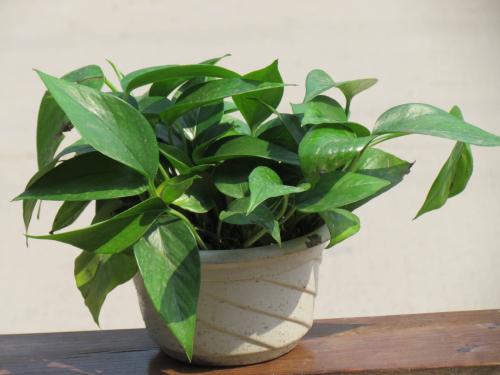
1. Purifying the air
Besides its ornamental value, the most important thing about pothos is its air-purifying effect! Just how strong is pothos at purifying the air? According to research by scientists, one pot of pothos in a room of 8-10 sq m is equivalent to an air purifier. This shows that pothos has quite a strong air-purifying ability. Growing pothos at home can save you the money you would spend on an air purifier!
2. Ventilation and air flow
In addition, pothos also helps ventilate and freshen indoor air, because pothos can absorb carbon dioxide and release oxygen. If placed by a window, pothos will block the wind when it is strong outside; when there is no wind, the respiration of pothos will release oxygen, making the space we live in feel fresher.
3. Adsorbing impurities
For people who have just renovated a new house, the many harmful gases in a new home are a real headache. Besides airing out a newly renovated home, you can also place a few pots of pothos, as pothos can absorb benzene, trichloroethylene, formaldehyde and other substances from the air, making it very suitable for placement in a newly renovated room.
Growing methods and things to watch out for
Since pothos has so many benefits and effects, how should it be grown? What should be noted during cultivation? Below we will go through the aspects needed for plant cultivation: light, temperature, soil, watering and fertilizing.
1. Soil
For the potting soil for cultivating pothos, it is best to use a culture soil evenly mixed from 3 parts leaf mold, 3 parts garden soil, 3 parts river sand and 1 part barnyard manure. The soil for pothos should be as fertile as possible, because most of the nutrients for pothos come from the soil. Try to get some soil from the field, mix some animal manure into the soil, and put some finely crushed dead leaves into the soil.
In addition, pothos likes soft soil. The dead leaves and manure serve to increase soil fertility and make it loose and airy.
2. Light
The original growing conditions of pothos are in forests shaded by towering trees, so its heliotropism is not strong. Therefore, direct sunlight should be avoided, and it should be cared for under semi-shade or scattered light. However, in the north during autumn and winter, to make up for the lack of temperature and photosynthesis, its light exposure should be increased.
Pothos can be placed year-round in a sunny spot indoors. In a dimly lit room, it should be moved every half month to a brighter environment for a period of recovery, otherwise the internodes tend to lengthen and the leaves become smaller.
3. Temperature
In the north, pothos can safely overwinter at a room temperature above 10°C, and can grow normally at a room temperature above 20°C. For an ordinary household, reaching this temperature is usually not a problem. What needs attention is avoiding too great a temperature difference, and also making sure the leaves do not get close to heating equipment.
4. Watering
Pothos likes moisture. In spring, summer and autumn, the potting soil should be kept moist; in winter, watering should be controlled, and water only after the surface of the potting soil looks dry. Conversely, watering too much and keeping the potting soil too wet will reduce its cold resistance and cause yellow leaves and root rot. In winter, the leaves can be sprayed and washed once every 3-5 days with warm water, and the amount of water should be controlled to between 1/4 and 1/2 of the original amount, so as to keep the leaves glossy and emerald green.
Generally, in spring and late autumn, water once every 2-3 days; in summer, water once a day, and frequently spray water on the leaf surfaces and the surrounding floor to increase air humidity and keep the leaves bright green.
5. Fertilizing
Pothos grows relatively fast, so topdressing should be strengthened during the growing season. Topdressing should be mainly nitrogen, applied together with nitrogen, phosphorus and potassium fertilizers. In the autumn and winter in the north, most plants grow slowly or even stop growing, so fertilizing should be reduced. Before the start of winter, mainly apply liquid inorganic fertilizer by watering or spraying; after the start of winter, fertilizing should mainly be foliar spraying, applied mainly through the stomata on the leaf surface. Fertilizer is absorbed through the stomata on the leaf surface, so the fertilizer effect can act directly on the leaves.
From spring to early summer, apply topdressing once about every 10-15 days; from summer to early autumn, apply topdressing once about every 20 days; in autumn, apply topdressing once every 10-15 days; in winter, do not apply fertilizer to the potting soil, and only spray the leaves once every 20-30 days with a 0.1%-0.2% urea solution to keep the leaves green and glossy.
Things to watch out for
(1) Leaves turn yellow and fall off, and the stems rot: this is mainly caused by watering too much, especially in winter. Pothos requires good drainage in the potting soil and hates standing water in the pot. If this situation is found, repot it promptly.
(2) Leaf tips curl and turn withered brown: this is mainly caused by the air being too dry, so the leaves should be misted frequently.
(3) Leaf margins turn brown, and withered yellow spots appear on the leaves: this is caused by insufficient watering during the growing season. Water only when the potting soil has not completely dried out. For totem-pole plants, be careful to wet the pole when watering, because some roots grow on the pole.
(4) Leaves become smaller: when pothos is cultivated as a totem pole, the top must always be kept growing upward. As soon as it bends downward, the leaves gradually become smaller; insufficient fertilizer or light can also cause this.
(5) Leaves become soft and bent, and the stems rot: this is caused by too low a temperature. Pothos is very sensitive to low temperatures below 10°C.
Pothos leaves turning yellow
During cultivation, pothos is prone to yellowing, which is closely related to improper daily care methods. Based on how the leaves are turning yellow, you can see which step in cultivation has gone wrong.
1. Leaf edges withered, dry and yellow——insufficient water
If the leaf edges of pothos are withered, dry and yellow, and some leaves fall off, but new leaves grow well, this is very likely caused by insufficient water in the pothos soil.
2. Leaf surface dark yellow and lusterless——overwatering
If the leaves are dark yellow and lusterless, or even the roots rot and new shoots shrink, it indicates overwatering. So at this point, watering should be stopped and the soil should be loosened appropriately.
3. New leaves on the yellowish side——light too dim
If pothos is placed for a long time in a dim and unventilated place, then the green leaves will tend to turn yellow due to lack of chlorophyll, especially the newly grown leaves, which will also tend to turn yellow. At this point, pothos needs to be placed in a cool place with ample light.
4. Leaves wilt——direct sunlight
Pothos grows in cool environments, so leaving pothos under strong light for a long time can easily cause the leaves to wilt and wither, and then turn yellow and fall off. At this point, pothos needs to be placed in a cool place with light, and watered appropriately.
5. Roots and leaves turn yellow——insufficient fertilizing
When pothos lacks nutrients and is underfertilized, the color of the leaf surface gradually fades and turns yellow, and especially the leaves at the roots will turn yellow first and fall off. At this point, more fertilizing is needed.
6. Leaves curl and do not spread out——overfertilizing
When pothos is overfertilized, the leaves are thick but lusterless, curl and do not spread out, and the old leaves turn yellow and fall off.