Snake Fruit (Salak) China Growing Regions, Cultivation Technical Requirements, Benefits, Uses and Eating Guide with Pictures
Snake fruit, also known as salak, gets its name because its skin looks like “snake scales.” Although its appearance does not look appetizing, snake fruit is one of the most famous fruits in Southeast Asia. Snake fruit is highly nutritious, is one of the fruits with the highest potassium content, and is rich in pectin, which is very beneficial to the human brain, so it is also known as the “fruit of memory.”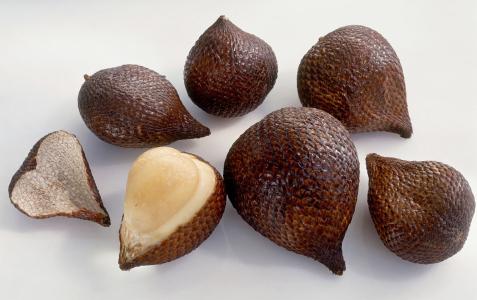
1. Temperature
Snake fruit prefers a tropical humid climate, and high temperature and high humidity are important conditions for its growth and development. The most suitable growing conditions are an average annual temperature above 22°C, an average temperature in the coldest month above 18°C, and relative humidity above 85%. It is relatively scarce in China and is mainly distributed in western Yunnan Province and various parts of South China.
2. Propagation
Sucker propagation: from the multiple suckers sprouting from the mother plant, select thick, strong suckers, insert them from the top down into a plastic container, fill it with soil or rice husk, and after 2 months, when the suckers have grown more roots, cut them off and transplant them into bamboo-woven containers to continue cultivation.
When transplanting, cut half of the leaves off the suckers, tie them tightly with nylon rope or bamboo strips, place them in bamboo-woven containers, pour on thin mud, and keep them under a shade net to continue cultivation. Sucker propagation is suitable for producing seedlings of the desired sex when the sex of the mother plant is known, such as for snake fruit varieties like Pondoh.
3. Land Selection
Snake fruit is suitable for planting on land at an altitude of 400-600 m and requires moisture year-round. Newly cultivated land especially requires shade, and it can be planted under existing cultivated tree species; both coniferous and broadleaf trees are acceptable, but the canopy layer is required to have 20%-30% light transmittance. After 2-3 years of planting, it can withstand full sunlight. The planting holes are generally 50 cm x 50 cm x 50 cm.
4. Fertilization Management
Generally, fertilize twice a year, 1-2 kg per plant each time, applying respectively in the dry season (March-August) and the rainy season. Use compound fertilizer with major elements, such as a compound fertilizer with an N:P:K ratio of 1:1:1; no fertilizer with trace elements is applied.
5. Leaf Number Control
Prune promptly to remove old leaves. For the Pondoh variety, control the number of leaves at 7-8 per plant; for the Bali variety, control the number of leaves at 14-16 per plant.
6. Pests and Diseases
Snake fruit plantations have relatively few pests and diseases. The more serious insect pest is a type of beetle that mainly feeds on the roots and can cause plant death. Rabbit urine can be used for control.
Snake Fruit Benefits and Effects
1. Supplementing Human Minerals
Snake fruit contains a variety of mineral components, among which calcium and potassium are the most abundant. Calcium is an important component for strengthening human bone density, and after people eat it, it can help prevent the occurrence of calcium deficiency symptoms and increase their own bone strength. In addition, potassium is also one of the minerals most needed by the human body. When the human body lacks potassium, it can trigger multiple diseases, and eating snake fruit can reduce the probability of disease caused by potassium deficiency.
2. Beauty Benefits
The flesh of snake fruit is quite beneficial to human skin, and local girls in Indonesia often eat it as a beauty fruit. Applying it directly to the skin can provide multiple effects such as whitening and removing wrinkles. In addition, using snake fruit to make a facial mask also has very good hydrating and moisturizing effects.
3. Dietary Taboos for Snake Fruit
Snake fruit contains relatively high calories, and patients with cough symptoms caused by deficiency heat should avoid eating it. Snake fruit is a cooling fruit, so pregnant women should not eat too much of it.
How to Eat Snake Fruit with Pictures
Because its appearance is too frightening, many people are deterred by snake fruit. In fact, eating snake fruit is not complicated. Snake fruit is usually eaten raw and does not require a knife. Tear open the pointed end of the snake fruit with your hands, then peel the skin off along the way.
If you freeze snake fruit in the refrigerator before peeling it, the skin will break into pieces, feeling a bit like peeling a chilled boiled egg. It can also be eaten pickled, or dipped in hot syrup like candied hawthorn. It can also be put into stuffed pancakes; it tastes crisp like apples and also has the flavor of pineapple.
Inside the snake fruit, there are three lobes, somewhat milky white like cream. It looks a bit like a peeled oversized garlic clove. Each lobe contains a black-brown seed, but these seeds cannot be eaten.
The flesh of snake fruit is white with a yellow tinge, but when bitten into it has a very crisp texture. However, in different places, the varieties produced differ slightly. Some inferior ones have a foul odor, while the flesh is very dry and hard, and extremely sour and astringent. Snake fruit produced in Bali, Indonesia is the best; the flesh is sweet with a hint of sourness, not bitter or astringent, and does not feel very dry and hard. The flesh is plump and crisp like an apple, the stone is relatively small, and it carries a faint, subtle fragrance.