How much does a Barred Plymouth Rock chick cost? Analysis of breeding methods and profit prospects
The Barred Plymouth Rock has a large, oval body; an adult chicken weighs at most just four or five jin. Its eggshells are mostly light brown, but whether it is the meat or the eggs, both are far more nutritious than ordinary broiler chickens, and the meat is relatively fresh, tender and tasty. The Barred Plymouth Rock is also a native chicken breed of our country, so it is quite suitable for free-range raising in rural areas.
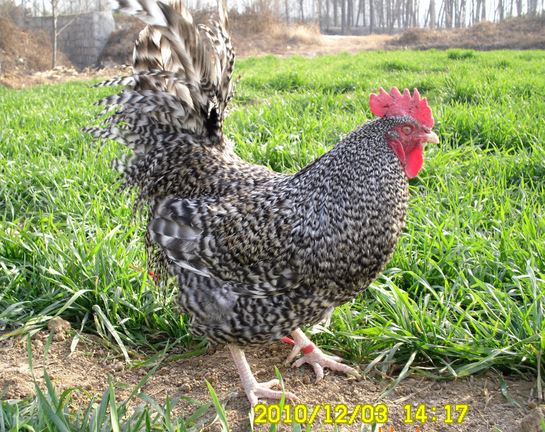
The price of Barred Plymouth Rock chicks is 12-15 yuan each, up to a maximum of 20 yuan.
Barred Plymouth Rock breeding profit analysis
Like chickens of other breeds, farmers can develop ordinary small-scale scattered raising, or they can develop large-scale raising.
◆Input (1) Breeding stock cost: at the Suzhong Luye Barred Plymouth Rock Ecological Breeding Park, one Barred Plymouth Rock chick sells for 8 yuan.
(2) Feed cost: calculated at a feed cost of 40 yuan per chicken (it may fluctuate up or down during breeding).
(3) Epidemic prevention and medical costs: about 5 yuan per chicken.
(4) Other costs (labor, water and electricity, depreciation of breeding farm assets, etc.): 10 yuan.
◆Output At present, the market price of Barred Plymouth Rock chickens averages around 60 yuan/kg. Generally, when finished chickens are ready for market, their weight is about 2 kg, so the output value can reach 120 yuan.
◆Profit After deducting input, raising 1 Barred Plymouth Rock chicken can yield a profit of 57 yuan. A box of Barred Plymouth Rock eggs costs around 80, with a quantity of 30-35 eggs. Because the prices of adult chickens and eggs are relatively high, they are generally put on the market at the Mid-Autumn Festival and Spring Festival, and the profit will only be higher.
Barred Plymouth Rock breeding prospects
As people's consumption levels and standards rise, the original meat-type chickens and some laying hens are gradually being eliminated by the market. High-quality dual-purpose breeds for both meat and eggs with a small body size, like the Barred Plymouth Rock, are increasingly favored by consumers. As a rare poultry of China, the Barred Plymouth Rock has become the first choice breed for people's dining tables, holiday gifts, high-end catering, and farmhouse restaurants. At present, chicks are in short supply, adult chickens are in tight supply, and market potential is relatively large. At the same time, the nutritional value and market selling price of eggs laid by Barred Plymouth Rock chickens are also relatively high, and the profit is very considerable.
Breeding advantages of the Barred Plymouth Rock
1. Good ecological benefits. Barred Plymouth Rock chickens eat insects in the woods, which also reduces insect pests in the woods, and their droppings increase nutrients for the trees, thus achieving circular development, effectively remedying breeding environmental pollution, with good ecological benefits.
2. From a young age, the Barred Plymouth Rock has a large amount of activity, strong climbing ability, and long flight distance. Therefore, this chicken has strong disease resistance, a well-proportioned build, and well-developed muscles. The meat of this breed is compact, fine, and chewy.
3. The Barred Plymouth Rock has a very strong homing instinct. No matter how far it roams for food during the day, at sunset it returns to the coop and perches to rest. Therefore, it is very suitable for free-range raising in different places (plains, hills, grasslands, mountainous areas, etc.).
4. The Barred Plymouth Rock has a very broad food chain. Wild grasses and flowers in the mountains, leaves and grass roots, grass seeds and tree fruits, moths and insects, fly maggots, earthworms, insects, etc. can all become food for this chicken.
Barred Plymouth Rock breeding risk warnings
The winter climate is cold, and the temperature required inside the coop differs greatly from the outside temperature. It is necessary both to ventilate and exchange air and to maintain the temperature inside the coop; this is the main problem that should be solved in winter. The droppings excreted by the flock and the damp litter should be cleaned up in time to prevent ammonia gas in the chicken coop from accumulating and its concentration from increasing, which would lead to ammonia poisoning in broiler chickens or trigger other diseases. While ventilating and exchanging air, be careful not to cause the temperature inside the coop to fluctuate sharply.
When broiler chickens are weak in constitution and their resistance declines, the occurrence of some diseases can also be complicated by respiratory diseases. For those with vaccine prevention and inoculation, preventive injections should be carried out strictly according to the immunization program. The key is to do a good job in the prevention and control of diseases such as avian influenza, Newcastle disease, infectious bursal disease, infectious bronchitis, infectious laryngotracheitis, and fowl pox.
However, because the Barred Plymouth Rock is relatively expensive, it will not sell in large volumes on ordinary people's dining tables in the short term like ordinary chickens. Therefore, raising Barred Plymouth Rock chickens mainly requires having a good sales channel. You need to find your own customer group and then make an overall plan. My suggestion is that if the scale is large, wholesale on one hand while building your own specialty stores; if small, find hotels and various farmers' markets to sell.
The growth period of the Barred Plymouth Rock is 4-6 months. The weight of a male chicken is about 2.5 kg, and the weight of a female chicken is about 2 kg.
The feeding divisions of the growth stages are divided into three stages:
(1) Brooding feeding stage, from hatching to the first twenty days. During these twenty days, the feed used is all puffed feed. Where there is no puffed feed, it is best to scald the feed until cooked, let it dry, and then feed it, so as to reduce intestinal diseases.
(2) Early growing feeding stage, from the completion of the brooding feeding stage to the following twenty days. During these twenty days of the feeding stage, 20% green feed can be added (that is, cabbage, pumpkin, carrot, celery, zucchini, etc.; vegetables that people can eat can all be used as green feed for this chicken, mixed and fed with crushed coarse grains such as cornmeal). Various vegetables contain large amounts of vitamins and various nutrients, greatly increasing the delicious edibility of the Barred Plymouth Rock and also greatly reducing production costs.
(3) Growing period feeding stage, within three months after the early growing feeding stage. During this growing period, the added amount of various green feeds can reach about 45%. Note that the moisture of the mixed feed should be well controlled; it should be just right so that it does not scatter or drip water when held in the hand. During the laying period, reducing green feed to about 35% is more scientific.
Management measures for free-range Barred Plymouth Rock chickens:
1. Age and density for release. Generally, it is 30 days of age in summer, 45 days of age in spring and autumn, and 50-60 days of age in winter. Density requirements: before 12 weeks of age, it is appropriate to release about 80 Barred Plymouth Rock chickens per mu; after 12 weeks of age, reduce it to about 40-60 per mu. Too high a density will also cause non-point source pollution and may even affect orchard production. The size of each flock of chickens should best not exceed 500.
2. Release season and precautions for the initial release period. It is best for Barred Plymouth Rock release to begin in spring and end after autumn. When starting release, choose clear, windless weather and let the chickens move around near the coop for 1-3 hours around noon. Afterwards, gradually extend the release time day by day until the chickens adapt to the orchard environment, at which point they can be released all day.
3. Feeding management for free-range Barred Plymouth Rock chickens. In the first week of release, feed once each in the morning, at noon, and in the evening; in the second week, supplement-feed once at noon and once in the evening. Afterwards, do not feed in the morning before release, to force the chickens to go out to forage; supplement-feed once at noon as appropriate; in the evening, determine the amount of feed supplement according to the fullness of the chickens' crops, so that the chickens eat their fill. Supplemental feeding generally uses various grains, bran, and artificially raised earthworms, insects, etc. Water supply: released chickens are supplied water by the free-drinking method. In addition to setting up drinkers inside the coop, scatter an appropriate number of drinkers in the release area, and the drinkers should always be kept clean and hygienic.
4. Light traps for insects and artificial insect breeding to feed chickens. In summer and autumn, at night, light bulbs can be installed in front of the chicken coop to attract insects for the chickens to catch and eat, so as to supplement the chickens' need for animal protein. Artificial insect breeding can also be used for supplemental feeding. The specific method is to dig a soil pit about 1.5 m wide, 1.8 m long, and 0.5 m deep on the ground among the orchard trees, spread a layer of rice straw at the bottom, spread a layer of okara on top of it, then spread a layer of cow dung or dry pig dung, and cover the surface with a layer of soil. Pour a basin of rice-washing water on it every day. After a week, insects will be produced; turn it over and let the chickens peck at them. After they finish eating, cover it with soil again, continue pouring rice-washing water, and insects can continue to be produced and used. This is a method that both solves the shortage of animal protein for the chickens and achieves plowing the orchard soil, increasing soil organic matter, and improving soil fertility, achieving two goals at once.
5. Reasonable fattening and timely marketing. After the Barred Plymouth Rock reaches 120 days of age, energy feed such as corn, wheat, and grain can be appropriately increased for fattening. After the Barred Plymouth Rock has grown to 150 days, when the fatness is moderate, it can be marketed in a timely manner in combination with market prices, selling roosters first and then hens. At this time, the accumulation of nutrients, aromatic substances, and umami compounds in the chicken meat has reached the content standard, and it is the best combination point of body weight, quality, and cost.
Time: 2019-05-05Clicks: