Detailed Explanation of Daylily Cultivation Techniques and Analysis of Planting Benefits
Daylily, also known as golden needle vegetable, is a herbaceous plant with effects such as stopping bleeding, reducing inflammation and clearing heat. It sells very well on the market and is easy to grow, which is why many growers cultivate it. So how exactly is it grown? The key question is whether daylily really is profitable? What are the specific benefits? Let's find out together below.
Daylily cultivation methods:
1. Site selection: Daylily has no strict requirements for soil, tolerates poor soil and has strong adaptability. Whether clay loam or sandy loam, it grows well, and it can be planted on hillsides or flat land.
2. Fertilizing: When planting, first dig holes 15-20cm deep and 20-30cm wide, apply 50kg of decomposed pig or cattle manure and 1kg of compound fertilizer per 40 holes, and after applying, mix the base fertilizer thoroughly with the soil in the holes.
3. Transplant at the right time and plant at a reasonable density: Transplanting can be done from the completion of flower bud harvest until before spring shoots emerge the following year. Dividing and transplanting right after the flower bud harvest is best, as winter shoots can emerge that same year, new roots grow and nutrients accumulate, and the following year it can bolt and go into production.
4. Harvesting: The optimal harvest time is when buds are formed and enclosed, that is, when the flower buds are plump and unopened, golden yellow in the middle, green at both ends, with a dark tip at the top, and the pointed tip is on the verge of opening but not yet open.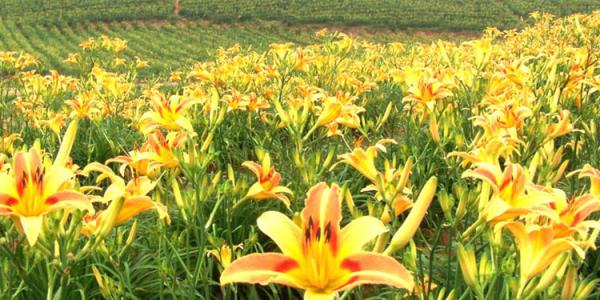
Daylily benefit analysis:
Daylily is a cash crop with strong vitality that can bring long-term benefits. After successful planting, it generally yields a harvest in the same year it is planted.
“The income from 1 mu of daylily equals that of 10 mu of corn in the past,” said a daylily grower. For this reason, low-income households are also highly motivated to plant it. As for exactly how much money is made, that depends on the individual.
Daylily Picking and Processing Techniques
Daylily processing techniques include material selection, steaming, drying and sunning, inspection and packaging, etc.
1. Daylily picking
Daylily should be picked promptly every day, with early-maturing ones picked first and late-maturing ones picked later. If picked too early, the flower buds have not fully swollen and the yield is low; if picked too late, the buds split open or bloom, which also affects yield and quality. Mature daylily buds are yellow-green, plump, with obvious longitudinal grooves on the petals, and are ready to bloom but not yet open.
2. Daylily processing techniques
2.1 Daylily material selection
Fresh daylily that is plump, with firm petals, fully developed flower buds, elastic and yellow should be selected as the raw material. Buds picked 1-2h before splitting open have high yield and good quality.
2.2 Daylily steaming processing
Steaming is a key process that determines the quality of daylily. The picked flower buds should be promptly put into the daylily steaming cabinet for steaming. Before steaming, remove any buds that have already opened. The layer should be loose, with a thickness of 6-10cm being appropriate; too thick and it steams unevenly, too thin and fuel is wasted. Leave a small hole in the middle to allow steam to rise. Before steaming, first pour clean water into the iron pot; the amount of water in the pot should be about 10cm from the lowest wooden grate. Then light the fire to bring the water to a boil, and at the same time quickly place the sieve loaded with flower buds into the steaming cabinet. The steaming time depends on the firepower, generally steaming for 8min. The standard for steaming doneness is generally 50% done, that is, the color turns from yellow to green, the flower stalk begins to soften, and rubbing the buds with the hand gives a slight rustling sound. Usually it is ready when steam rises out of the cabinet.
2.3 Daylily drying and sunning processing
After steaming, spread the flower buds thinly on a drying curtain, and place the drying curtain on a flower drying rack so it is elevated, to help moisture disperse to the surroundings. After sunning for half a day, if the buds turn white, it indicates good steaming. Generally 2.5-3d of sunning is needed. During sunning, turn them frequently; you can use an empty curtain of the same size to flip them once, so the buds dry evenly. During sunning, prevent rain from soaking them. If using a cement drying yard or hillside rocks to sun the flowers, then often because the temperature is too high, the product color is not as good as with elevated sunning.
Drying There are two methods for drying by baking.
Small-scale direct warm water baking method. That is, place the baking basket on a wood stove or coal stove, and burn charcoal or coal below for baking. In this method, the fire temperature should be high at the start of baking, so that the moisture in the buds evaporates quickly. When the buds are baked to 60-70% dryness, the firepower must be reduced. Baking time is about 6-8h. The finished product rate is low, and the quality is also poor.
Indirect fire drying method. This method is carried out in a drying room, that is, keeping the steamed flower buds evenly at 50-70°C, baking until half dry, then taking them out to spread and air, and baking again the next day. Because drying all at once will produce green stiff strips, affecting quality. Usually baking until 70-80% dry is enough; at this point storage will not mold or deteriorate, and then choose clear weather to sun them until dry. The indirect fire drying method both saves fuel and maintains good color.
2.4 Daylily inspection
Those that are golden yellow and thick are top grade; those that are yellow with brown, and not very uniform in thickness, are medium grade; those that are dark yellow with thin, shrunken and uneven strips are low grade. When pressing daylily firmly by hand, if it feels soft with some hardness inside, and quickly loosens after release, it indicates moderate dryness; if it does not loosen for a long time, it indicates excessive moisture content. Those with a fresh fragrance are of the best quality.
2.5 Packaging and grading
Pack in double-thread hemp bags or plastic film food bags, and pack firmly to prevent moisture and insect damage. Quality requirements: Grade one products must be dry, golden yellow, uniform in thickness, aromatic, free of insect damage, free of mold and rot, free of stems and impurities, with no green strips and no more than 2% open flowers. Grade two products must be dry, yellow, uniform in thickness, good in flavor, free of insect damage, free of mold and rot, free of stems and impurities, with no more than 6% open flowers. Grade three products must be dry, yellow with dark brown, uneven in thickness, free of off-flavors, free of insect damage, free of mold and rot, free of impurities, with no more than 12% open flowers.
If large-scale mountain and forest development is carried out in the growing area to replace daylily plots, there are still many restricting factors:
1. Manpower
At present, production areas mainly rely on accumulating small amounts into a large total, with each household producing more than 1 ton, and two middle-aged couples can manage it well. The young people in the village have all gone out, so if manpower is needed, it must be hired from elsewhere. Daylily work is done in scorching hot weather, more tiring than the work of a mason's porter. It is very difficult to find manpower that is diligent, highly efficient and low-cost.
2. Competition
If daylily grown in contiguous plots is processed the same way as ordinary villagers do, then direct competition is created.
The output of farmers is unchanged, and the input is also fixed. But large-scale planting requires considering many factors. These include management and others, all of which require experience.
3. Quality control
For group-based operations, the daylily produced of course needs a quality advantage, which requires investment in production and processing equipment. This is also a very large initial investment.
4. Sales channels
Farmers sell through village and township buyers who come to purchase on site. Group-based operations must find the right sales outlets. This includes processing and transportation channels for daylily, and in rural areas there is not yet good experience to draw on.
Overall, daylily production areas need to open their minds, vigorously introduce production and processing experience from home and abroad, and expand their thinking to raise the potential value of daylily. The goal is not to make the production area a national specialty zone, but to strive to make China the world's main daylily production area.