Are Sika deer easy to raise? A detailed guide to introduction methods and farming conditions
Sika deer farming has now become an emerging industry, but many people still dare not try it, afraid that Sika deer are hard to raise? They also do not know how to introduce Sika deer? And they know even less about what conditions are needed to farm Sika deer? For this reason, the editor has put together these related questions for everyone.
Are Sika deer easy to raise?
Sika deer have been artificially domesticated for more than three hundred years. The key point is that Sika deer are very easy to raise. Just provide enough forage and feed, and not much manual management is needed.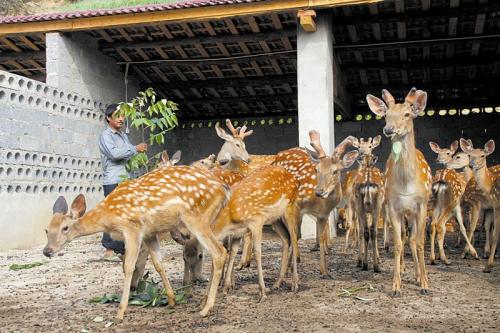
How are Sika deer introduced?
Introduction is the key to farming Sika deer and determines the success or failure of the entire farming operation, so introduction must be done at a formal deer farm: look at scale, look at service, look at reputation.
Introduction generally means bringing in breeding deer from a deer farm. Breeding deer should have a glossy coat, a compact and well-proportioned body, full muscles, large and slightly protruding bright eyes, a clear dorsal line, deep mouth corners, a broad and deep chest, a large but not sagging abdominal girth, and good antler and offspring production performance with stable heredity.
Male deer are required to have large antlers, fast growth, good quality and high yield, with a proper base of the antler and antler shape, a thick and large antler base at the pedicle, wide spacing between antlers, a long body, straight limbs, a broad forebody, and well-developed scrotum and testicles. Female deer should have normal udder and vulva development. Breeding deer are best at 3 to 8 years old.
What conditions are needed for Sika deer farming?
1. Site: choose a place with relatively dry terrain, sufficient water sources and convenient transportation. At the same time, electricity must be sufficient and close to a power source.
2. Feed: this is the main condition for choosing a site. It is best to choose a place where forage grows abundantly throughout the year, environmental protection is good, pollution is low and noise is low.
3. Social conditions: a Sika deer farm should not be chosen near industrial and mining areas or public facilities, and should not be built on land polluted by infectious diseases of cattle and sheep or on livestock farms. Attention should also be paid to resource conditions near the site, such as whether building materials are convenient and whether labor is sufficient.
Preliminary preparation work for investing in a Sika deer project
A. Site preparation:
Deer farm construction: choose a place with high and dry terrain, facing away from the wind and toward the sun, good drainage and convenient water sources to build the deer farm. Deer have a relatively large amount of activity, so the deer shed area is 2 to 3 sq m per animal, and the exercise yard is 8 to 10 sq m. Use stone slabs, smooth wooden boards or cement boards for flooring so that manure and other waste are easy to clean. Set up railings around the deer farm, 2.5 to 3 m high, to prevent the deer from escaping because they are good at jumping. It should not be chosen near industrial and mining areas or public facilities, and the farm should not be built on land polluted by infectious diseases of cattle and sheep or on the old site of a livestock farm.
B. Facility preparation:
Deer sheds, concentrate and roughage storage rooms, feed processing and preparation rooms, silage pits (trenches), processing rooms for velvet antler and other deer products, veterinary rooms, and buildings for other sideline production.
C. Technical preparation:
Deer-raising techniques mainly need to be learned on your own from books, newspapers and magazines, and can also be learned from columns such as this website's electronic publication "Deer Raising Technology Collection", so as to continuously improve and enrich feeding and management techniques.
D. Feed preparation:
A deer farm must have enough feed land or a reliable base for supplying various feeds. Fully confined Sika deer need an average of 350 to 400 kg of concentrate feed and 1,200 to 1,500 kg of roughage per animal per year.
E. Epidemic prevention preparation:
F. Sika deer have strong resistance and a low incidence rate. Under artificial rearing, they become ill less often, but sometimes they can still get infectious diseases such as Japanese encephalitis, rabies, anthrax and colibacillosis, so prevention and control must also be paid attention to during artificial farming.