What does salak look like? Pictures and prices, is it easy to grow? Introduction to cultivation techniques
How does salak grow?
Salak, also known as sala, is a famous fruit of Southeast Asia. It grows on trees, pointed at the top and round at the bottom, with a reddish-brown skin, about the size of a chicken egg, similar to an avocado.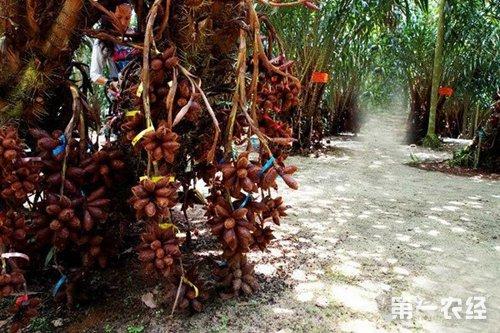
How much is salak per jin?
The price of salak varies from place to place; on Taobao it is generally around 22-28 per jin.
Salak cultivation techniques:
1. Seedling raising: There are two methods of raising salak seedlings: suckering shoot seedlings and seed seedlings.
2. Afforestation: First choose a piece of woodland suitable for salak, then carry out planting.
3. Management: Below an altitude of 600 m, irrigation is basically unnecessary, and there are no problems with low-temperature freezing damage. Generally, fertilizer is applied twice a year, 1-2 kg per plant each time, applied respectively in the dry season (March-August) and the rainy season.
4. Pest and disease control: Salak plantations have few pests and diseases. The relatively serious insect pest is a type of beetle, which mainly feeds on the roots and can cause the plants to die. Rabbit urine can be used for control.
The salak plant is relatively small, usually dioecious, growing in clumps, with a short stem or no stem, and spiny; the leaves are pinnately parted, the pinnae lanceolate or linear-lanceolate, S-shaped or sickle-shaped; the inflorescences grow in the leaf axils, the male and female inflorescences are of different types, the male inflorescence has branches, bearing several catkin-like cylindrical branched inflorescences, the main peduncle and branches enclosed in a persistent spathe, the male flowers borne in pairs in the axils of small spathes (bracts), usually accompanied by hairy bracteoles;
The calyx and corolla are tubular, 3-lobed; there are 6 stamens, borne at the mouth of the corolla tube, with short filaments that broaden at the base; the female inflorescence has fewer branches than the male inflorescence but is larger; the female flowers are borne in pairs or singly, larger than the male flowers; there are 2 bracts; neutral flowers accompany the female flowers and have only 1 bract; the base of the calyx is tubular, with the upper part 3-lobed; the corolla is about equal to or slightly longer than the calyx, with the upper part 3-lobed; there are 6 staminodes; the ovary has 3 carpels, 3 ovules, incompletely 3-locular, covered with flat, smooth or upright scales tipped with prickles, the style is short, and there are 3 stigmas.
The fruit is spherical, turbinate or ovoid, with a remnant stigma at the tip, the exocarp thin, covered with imbricate recurved scales, the scale tips smooth or prickly, the mesocarp thin, the endocarp not obvious; there are 1-3 seeds, oblong, spherical or bluntly triangular, the fleshy seed coat thick, sour or sweet in taste, the endosperm uniform and hard, with a seed coat that deeply invades from the apical cavity, the embryo basal.
Salak prefers a tropical humid climate, and high temperature and high humidity are important for its growth and development
conditions. The most suitable conditions for growth are an average annual temperature above 22°C, an average temperature in the coldest month above 18°C, and relative humidity above 85%.
There are about 14 species worldwide, distributed in tropical Asia, including India, Indochina and the Malay Archipelago. Indonesia is the country most successful in salak germplasm resources, cultivation techniques and local market development. In China, it is distributed in western Yunnan Province, and there is a history of more than 50 years of sporadic introduction and planting of salak in various parts of South China.