What is the difference between the Partridge chicken and the domestic chicken? Price and farming prospect analysis
The Partridge chicken is a high-quality chicken, with a large oval body, a single comb, and black-and-white mottled feathers; in roosters the white bars are wider than the black, while in hens the bars are uniform in width.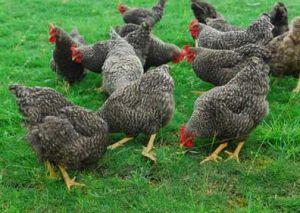
What is the difference from the domestic chicken
The two differ in appearance: the Partridge chicken's feathers are black-and-white mottled, and apart from outward features, the two also differ in living habits. The Partridge chicken has a high activity level from a young age, strong climbing ability, and long flight distance. It is very suitable for free-range rearing in different regions (plains, hills, grasslands, mountains, etc.). The Partridge chicken also lays more eggs than the domestic chicken.
Partridge chicken price
It is reported that Partridge chicken prices vary greatly; in some places one Partridge chicken costs 200 yuan, while in others one sells for 40 yuan. This is mainly because the purity of the Partridge chicken breed differs, so the prices differ as well.
Partridge chicken market prospect
As people's consumption levels and standards rise, the original meat-type chickens and some layer chickens are gradually being eliminated by the market, and high-quality small-bodied dual-purpose meat-and-egg breeds like the Partridge chicken are increasingly favored by consumers. As a rare poultry of China, the Partridge chicken has become the first choice for people's dining tables, holiday gifts, high-end catering, and farmhouse restaurants. At present, chicks are in short supply and adult chickens are scarce, so market potential is relatively large. At the same time, the eggs laid by Partridge chickens have relatively high nutritional value and market selling price, and the profit is very considerable. Therefore, farming Partridge chickens still has very good market prospects.
The Partridge chicken is a dual-purpose egg-and-meat chicken breed. This chicken has a uniform body type, an upright and slightly proud neck, a slightly narrow forequarter, a long and straight back, a broad and full hindquarter, relatively long legs, and high-cocked tail feathers, with a body shape like an “ingot”. Barred plumage is the basic feature of this chicken's appearance. Most of the feathers over the whole body show black-and-white barred patterns of uniform width.
The head and neck feather edges of hens are inlaid with orange-red or earth-yellow, and the feathers are tight. The neck feathers and saddle feathers of roosters are mostly red, and the tail feathers are black with a green gloss. Single combs are the most common, while pea combs, rose combs, cushion combs and strawberry combs are less common. The base of the beak is black, and the edges and tip are white. The iris is orange-red. The shank color is mainly white.
The claws are mostly white, and the skin is white. Adult chicken body weight: male 1400 g, female 1260 g. Slaughter rate at 180 days of age: semi-eviscerated, male 81.2%, female 80.0%; eviscerated, male 71.2%, female 68.9%. Age at first egg 150-180 days; under ordinary rural feeding and management conditions, annual egg production is 130-150; under better feeding conditions, egg production is 180-200. Egg weight 45 g, and the eggshell is mostly light brown.
Biological habits
Habit 1: The Partridge chicken has a very broad food chain; wild grasses and flowers in the mountains, leaves and grass roots, grass seeds and tree fruits, moths and insects, fly maggots, earthworms, insects and so on can all become part of this chicken's food chain.
Habit 2: The Partridge chicken has a high activity level from a young age, strong climbing ability, and long flight distance. Therefore, this chicken has strong disease resistance, a well-proportioned build and well-developed muscles, and the meat of this breed is compact, fine and chewy.
Habit 3: The Partridge chicken has a very strong homing instinct; no matter how far it roams for food during the day, when the sun sets in the west it returns to the nest and roosts on the perch to rest. Therefore, it is very suitable for free-range rearing in different regions (plains, hills, grasslands, mountains, etc.).