What conditions are needed for sika deer farming, and can artificially farmed ones be slaughtered?
The sika deer is a rare animal in the world, and it has high medicinal value, especially the expensive deer antler, which has become a precious health product for strengthening the body and prolonging life. In recent years, with the state's support for rural farming projects, more and more farmers have taken up the farming industry, and the sika deer is something many farmer friends consider.
The sika deer is a rare animal in the world, and it has high medicinal value, especially the expensive deer antler, which has become a precious health product for strengthening the body and prolonging life. In recent years, with the state's support for rural farming projects, more and more farmers have taken up the farming industry, and the sika deer is something many farmer friends consider. However, in our country, farming the protected animal the sika deer requires certain procedures before it can be carried out, so can farmed sika deer be slaughtered? What conditions are needed for sika deer farming? Let's take a look below!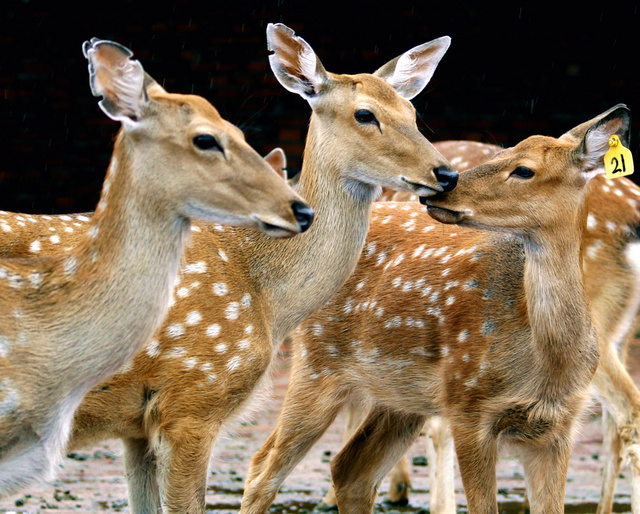
Everyone should know that the wild sika deer is a first-class protected animal in our country, and it is already a highly endangered animal in China, with a total number of less than 1000. Wild sika deer cannot be kept in captivity without authorization. If you want to engage in sika deer farming, you should first submit a farming application to the local police station or forestry department, and only after approval by the relevant state units and the issuance of certificates can you privately farm sika deer.
Can farmed sika deer be slaughtered?
It should be noted that slaughtering sika deer you have farmed yourself must also be reported and approved by the State Forestry Administration before slaughter is allowed, and the number slaughtered is also limited.
The living habits of the sika deer
The sika deer lives in mountainous areas of mixed coniferous and broad-leaved forests, forest edges and mountain grassland areas, not in dense forests or thickets, which is conducive to running quickly. There are obvious differences between its daytime and nighttime habitats. During the day, it mostly chooses sunny slopes with relatively deep and dense thatch grass, and places basically similar to its body color, to rest; at night, it rests in the middle or upper middle part of slopes, with no fixed slope aspect, but still mostly on sunny slopes, and the thatch grass where it rests is relatively low and sparse, so that it can discover enemies earlier and escape quickly.
So what conditions are needed for farming sika deer?
1. Choose a place with convenient transportation and developed electricity, which is conducive to feed supply or the transport of farming equipment, is relatively close to a power source, and has sufficient electricity.
2. Farming sika deer requires choosing a sandy or slightly rocky site with relatively dry terrain and sunny slopes. Farming friends in mountainous areas should choose a site that is not threatened by mountain floods, is sheltered from the wind, and has good wind direction and drainage, with no pollution and noise, so as to avoid disturbing the deer herd or spreading disease due to various complex environments.
3. It is best to choose a place with clean water sources far from industrial areas, and the standard should be that it can meet the water needs for growth and daily life during the dry season. It would be best to have abundant pasture all year round, as this can save a lot of feed costs.
Extended knowledge
Reproduction of the sika deer
During the breeding period, the male's food intake decreases significantly, and its temperament becomes rough and fierce. In order to compete for mates, horn duels often occur, and the two horns on its head become weapons for attacking each other. This kind of "horn duel" is a very common phenomenon among deer species. A strong male can usually have more than 10 females. In one breeding season, a female can come into estrus multiple times, with an estrus cycle of 5 days, and once pregnant, it will no longer come into estrus. The gestation period is about 230 days, and it gives birth in May-June of the following year. Generally, only 1 fawn is born per litter, with a few having 2. The fur of the newborn fawn is yellowish brown, also with white spots, and it can stand up within a few hours, and can run with the female the next day. When the female forages, it first looks around outside the forest, and only after confirming there is no danger does it bring the fawn out. If it detects danger, it will make a startled cry and take the fawn into the dense forest.
The lactation period of the sika deer is 2-3 months, and after 4 months the fawn can grow to about 10 kg. It reaches sexual maturity at 1.5-3 years old, and its lifespan is about 20 years.
Population status
Historically, due to excessive capture and hunting, the number of wild sika deer is extremely small, and it is already a highly endangered animal in China, with a total number of less than 1000. The North China subspecies and the Shanxi subspecies are already extinct. The South China subspecies has about 200 individuals on the border of Anhui, Zhejiang and Jiangxi, and fewer than 100 in Guangxi. The Sichuan subspecies has about 500 individuals in northern Sichuan and southern Gansu. The Northeast subspecies may already be extinct. The Taiwan subspecies was originally already extinct, but later captive-bred populations were rewilded and released, and there are now about 200 individuals.
The sika deer is already extinct in South Korea and Vietnam, and may already be extinct in North Korea. There are about 9000 in eastern Russia, while Japan has about 300,000. The Japanese sika deer was once on the verge of extinction, but good protection and the extinction of the Japanese wolf led to the recovery of the population. Now, because there are no natural enemies to control them, the excessive number of sika deer has caused damage to forests and farmland.
Time: 2019-05-05Clicks: