What to Do If Your Anthurium Only Grows Leaves and Won't Bloom? Four Causes and Four Solutions
Growing anthuriums is not difficult, but growing a truly beautiful pot of anthuriums takes some skill. I believe many plant lovers have noticed, when caring for anthuriums, that they only grow leaves and won't bloom. There are many reasons anthuriums fail to bloom. Below, Huacaole summarizes the four major causes.
What to Do If Your Anthurium Only Grows Leaves and Won't Bloom: Four Causes, Four Solutions
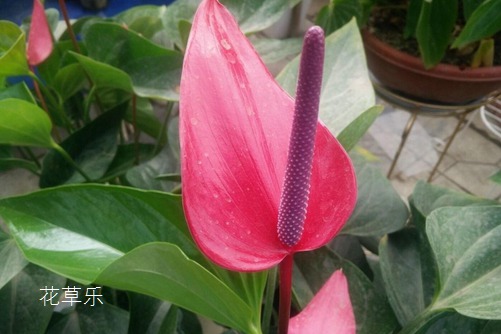
1. Long-term indoor growing with insufficient light
The flower spike of an anthurium forms in the axil of each leaf. This means the number of flowers should match the number of leaves. If the difference is too great, the most important factor is light. If there is too little light, under the influence of photosynthesis, the plant also produces very few assimilates. There are fewer leaves, so there are fewer flowers.
Improvement measures: In spring, autumn and winter, you can place it near a south-facing balcony to increase light. In summer, keep it appropriately away from the balcony; after all, with high temperatures and scorching sun, flowers and plants are all prone to sunburn.
2. Insufficient fertilizer supply
The principle of fertilizing anthuriums is two waterings, one fertilizing. Anthuriums like acidic conditions, with a pH generally between 5.5-6.5.
Improvement measures: For home care, the best fertilizer is a special anthurium nutrient solution bought from a flower market and used for watering. Generally, applying it to the roots works well; foliar spraying is not absorbed well.
3. Poor control of temperature and humidity
The suitable daytime temperature for anthurium growth is 25-30°C, and the nighttime temperature is 20-30°C. The highest temperature it can tolerate is 35°C, and the low temperature it can tolerate is 14°C.
Improvement measures: In the high-temperature summer season, mist in the morning to retain moisture, and humidity should reach 70-80%. In spring and autumn, the temperature is hard to get right; low temperatures with high humidity easily trigger disease. In northern homes with winter heating, room temperature can be adequate, but it is very dry, so use a spray bottle often to mist the leaves. In the high-temperature, high-humidity summer season, misting may not be needed; just make sure ventilation is good. Avoid excessive water causing root rot.
4. Never repotting or changing the soil during cultivation
For potted flowers and plants, it is recommended to turn out the pot each spring and autumn, change in fresh soil, and move it to a pot one size larger. Use peat soil, perlite and vermiculite mixed at 3:1:1. Trim the roots a little to encourage more new roots.
5. Notes on growing anthuriums
1. The soil for growing anthuriums is very important; use fertile soil, and you can mix in some sand and peat soil. Plant it in a ceramic or plastic pot.
2. Anthuriums like a shady, cool environment and need a certain level of humidity. In dry weather, water moderately; do not water too often or too much.
3. Fertilize appropriately, and control fertilizing in winter.
4. Prune and clean up in time; there will be some rotting leaves at the base.
5. Anthuriums like a shady, damp environment. The growing soil should not be too compact. Plant a layer of moss on top of the growing soil, which helps retain moisture.
Summary
That is all for the four solutions to the problem of anthuriums only growing leaves and not blooming. You can try them according to your situation.