Symptoms and Control Methods of Crape Myrtle Flower Pests and Diseases
“Enchanting as if drunk with beauty, still fair; weighed down by dew, battered by wind, leaning all the more. Who says no flower stays red for a hundred days? The crape myrtle blooms on for half a year.” - Yang Wanli
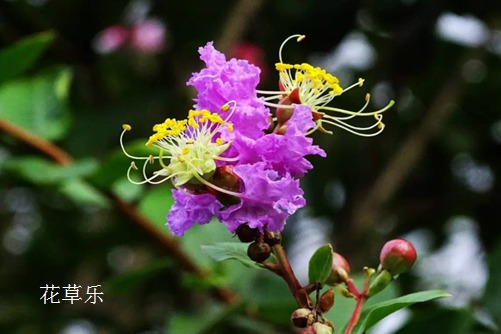
The “crape myrtle flower,” also known as “Hundred-Day Red,” has been a favorite of writers and scholars since ancient times. The crape myrtle in Yang Wanli's verse is vividly lifelike, painting for us a lively and beautiful picture. However, crape myrtle is easily attacked by pests and diseases. How should crape myrtle be grown to better prevent and control pests and diseases? Next, Huacaole will share with you the symptoms and control methods of crape myrtle flower pests and diseases.
Erkang, come quickly and see your Ziwei - Symptoms and Control Methods of Crape Myrtle Flower Pests and Diseases
I. Crape Myrtle Powdery Mildew
Crape myrtle powdery mildew occurs commonly in every province and city in China where crape myrtle is planted. In the early stage of the disease, small white powdery spots appear on the leaves; after they enlarge, they become round or irregularly shaped faded patches covered with a layer of white powdery mold, and in the later stage the white powdery mold layer turns gray. After the flowers are infected, their surface is covered with a white powdery layer, and the flower spikes become deformed, losing their ornamental value. Plants affected by powdery mildew become stunted, with tender leaves twisted, deformed, and withered, leaves not unfolding and becoming smaller, and branches deformed; in severe cases the entire plant dies. After the disease occurs, it often causes crape myrtle leaves to turn yellow and drop, directly affecting tree vigor and ornamental effect.
Control methods: (1) Before spring bud break, spray with 3-4 °Be lime sulfur mixture; (2) During the growing season when the disease occurs, spray with 80% zineb wettable powder at 500 times dilution, or 70% thiophanate-methyl at 1000 times dilution, or 20% triadimefon emulsifiable concentrate at 1500 times dilution, or 50% carbendazim wettable powder at 800 times dilution for control.
II. Crape Myrtle Brown Spot
Brown spot is a disease that often occurs during the growing season of crape myrtle. In the early stage of the disease, the spots are round or nearly round and of varying sizes, with a few being irregular in shape. The spots are purplish black to black, with lighter-colored edges; afterward the spots darken, appearing black or dark black, with a clear boundary from the healthy parts. In the later stage, the center of the spot fades in color and bears small grayish-black mold spots. When the disease is severe, the spots join together into patches, and the entire leaf rapidly turns yellow and drops prematurely. When brown spot occurs severely, it often causes a large number of leaves to wither and drop, affecting ornamentation and flowering.
Control methods: (1) In the early stage of the disease, spray with 50% carbendazim wettable powder at 500 times dilution, or 65% zineb wettable powder at 1000 times dilution, or 75% chlorothalonil wettable powder at 800 times dilution for control.
III. Crape Myrtle Sooty Mold
Sooty mold, also known as sooty blotch, attacks crape myrtle mainly after it has been harmed by the crape myrtle felt scale and the crape myrtle long-spotted aphid, that is, using the sticky liquid they excrete as nutrients, which induces massive reproduction of the sooty mold pathogen. After the disease occurs, the leaf surface of the affected plant is covered with a black mold layer, which not only affects the ornamental value of the crape myrtle but also affects the photosynthesis of the leaves, causing the plant to grow weak and drop leaves prematurely.
Control methods: Timely control aphids, scale insects, whiteflies, and others, because the secretions of these insects are precisely the basis for the existence of the sooty mold pathogen. Commonly used agents are lime sulfur mixture: in winter use 3 °Be lime sulfur mixture, and in summer and autumn use 0.3 °Be lime sulfur mixture. Trithion and litsea cubeba leaf juice can also be used for control. Alternatively, spray 50% carbendazim wettable powder at 500-800 times dilution, 70% thiophanate-methyl at 500 times dilution, and so on.
IV. Aphids
In northern China, 5-8 generations occur each year, overwintering as eggs near buds and shoot tips. May is the early stage of the outbreak, and June is the peak period. Nymphs and adults gather to harm the tender leaves of crape myrtle, piercing and sucking the sap, affecting growth and development.
Control methods: Strengthen cultivation management measures to reduce sources of the disease. When aphid numbers are large, spray 40% omethoate, 40% acephate at 1000-1500 times dilution, or spray derris extract at 1000-2000 times dilution, but be careful to avoid phytotoxicity.
V. Felt Scale
Felt scale females and nymphs suck sap on bud axils, leaves, and branches, causing branches and leaves to turn black and leaves to drop, seriously affecting tree growth and development. Their excrement can induce sooty mold, and it is one of the main insect pests harming crape myrtle.
Control methods: In winter, spray 10-15 times diluted rosin mixture or 40-50 times diluted machine oil emulsion 1-3 times to eliminate overwintering females. Before bud break, spray 3-5 °Be lime sulfur mixture or 3%-5% diesel oil emulsion to eliminate overwintering nymphs.
VI. Large Bagworm Moth
The large bagworm moth is also one of the insect pests attacking crape myrtle. Its larvae chew leaves, tender shoots within their protective bags, or strip and feed on the bark of branches and the skin of fruits, causing localized defoliation of the tree clusters.
Control methods: Remove the protective bags. When the newly hatched larvae appear in early May to June, spray with 90% trichlorfon at 1000 times dilution to kill them, with very good results.
VII. Twenty-Eight-Spotted Ladybird Beetle
The potato ladybird beetle, also called the large twenty-eight-spotted ladybird beetle, produces 1-2 generations per year. When the spring temperature rises to 15-16℃, adults can be seen causing damage and laying eggs to reproduce until the potato harvest. Because generations overlap, it is actually difficult to identify a clear peak of occurrence; controlling the insect population in the middle and late stages is the key to managing this pest.
Control methods:
(1) During the adult egg-laying period, manually remove egg masses. Taking advantage of this insect's feigning-death behavior, tap the plants in the morning and evening to collect the fallen adults and larvae.
(2) After harvest, promptly dispose of the crape myrtle flowers to eliminate the remaining insect sources within the residual plants.
(3) Carry out chemical control during the peak period of adult migration or larval hatching. For every 667 sq m, use 25-50 g of 50% padan soluble powder, or 30-60 ml of 5% chlorfluazuron emulsifiable concentrate, or 20-40 ml of 2.5% cyhalothrin emulsifiable concentrate, or 25-50 ml of 40% phoxim-methyl emulsifiable concentrate, diluted with water and sprayed for control.
Summary:
Crape myrtle is a popular ornamental flowering tree that can be planted in home courtyards, and small plants can also be grown in pots to decorate and beautify the home. It is ornamental and can also purify the air, making it a great helper for a beautiful home environment. Legend says that if crape myrtle flowers bloom all around your home, the crape myrtle fairy will favor you and give you a lifetime of happiness. Huacaole wishes you happiness throughout your life.