How to treat moss rose infested with scale insects without pesticides? Seven clever tricks to help you eliminate them
Moss rose (Portulaca grandiflora) is a perennial flower of the purslane family, Portulacaceae, genus Portulaca, and an annual succulent herbaceous plant. The plant grows 10-15 cm tall. The petals are brightly colored, in white, deep yellow, red, purple and other colors. There are many horticultural varieties, divided into single-petaled, semi-double-petaled and double-petaled types. It likes a warm, sunny and dry environment; its flowers open in sunlight and close in the morning, evening and on cloudy days, hence the names "sun flower" and "noon flower". How do you treat moss rose infected with scale insects during cultivation? Below, Huacaole shares with you seven methods to eliminate scale insects without pesticides.
How to treat moss rose infected with scale insects: seven clever tricks to eliminate scale insects without pesticides
I. Growing moss rose
It likes a warm, sunny and dry environment, is extremely tolerant of poor soil, adapts to ordinary soil, and can self-sow and reproduce. The most suitable growing temperature is 21-24°C. Although moss rose likes warmth and sun, in hot summer you should frequently check the bottom saucer of the flower pot and check the pot's breathability; water daily if breathability is good, or every other day if breathability is average. It does not need much fertilizer; applying fertilizer once every two weeks is enough. There are many varieties of moss rose, usually in colors such as imperial red, harvest red, bright red, deep red, purple-red, white, snow blue, pale yellow and deep yellow.
II. Scale insect control on moss rose
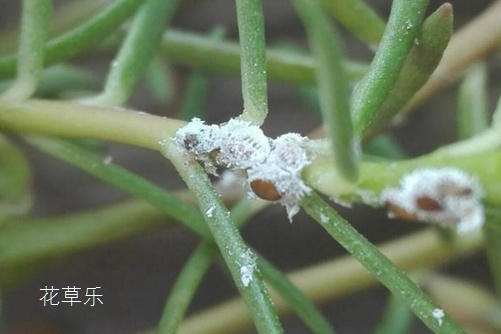
Moss rose has strong vitality and generally has no pest problems. When planting, you only need to do preventive spraying before germination to control pests and diseases. The most common pest is the scale insect. There are many kinds of scale insects, and their surface has a waxy layer, so ordinary pesticides cannot easily penetrate and kill them. They also have strong reproductive capacity, producing multiple generations a year. The pesticides used for control are generally highly toxic; professional cultivation often uses Guoguang Jiebizhi or Jiekeling for treatment, and control is relatively difficult. Even when pesticides are applied, they will not be completely eliminated. They will continue to reproduce and occur, and are not easy to clean out completely. For moss rose grown in home gardens, manual treatment is recommended. The specific control methods are as follows:
1. Use a needle to pierce each scale insect, then use a cotton swab dipped in alcohol to wipe the leaves and flower stems.
2. Use a wet paper towel to wipe every leaf and flower stem.
3. Use a strong spray of water to wash the scale insects off the leaves.
4. Find a basin of clean water and use a soft-bristled toothbrush to scrub them off one by one.
5. Find a thin bamboo strip and gently scrape them off.
6. Cut off the branches with many pests and destroy them in a concentrated way.
7. Cut the plant back hard and regrow it, re-cuttings the branches and stems that were not infected.
Note that scale insects on moss rose will recur after a period of time, so check and repeat manual treatment several times. In autumn, change to new, pathogen-free soil and replant. After cleaning up, strengthen fertilizer and water management for the plant; when the plant grows vigorously, pests and diseases are relatively fewer. In daily care, maintain a certain humidity and apply one-thousandth potassium dihydrogen phosphate once every half month, and you can achieve the goal of large flowers, bright colors and continuous blooming.
III. Moss rose picture appreciation
Summary:
Potted moss rose can beautify the home balcony and windowsill. Its stems and hanging growth trail outside the pot. It opens toward the sun, like brocade and embroidery, most abundant at noon, each flower straining to open and fully enjoying the warmth given by the sun, adding infinite charm to the home and having a unique style. What is the flower language of such a beautiful moss rose? The flower language meanings of silent love, light, passion, loyalty, sunshine and positivity are quite fitting, aren't they?