How do you care for a Calathea makoyana? Keep this care guide handy.
Calathea makoyana is also known as five-color arrowroot. The Calathea makoyana has a neat, compact form, and its leaves are covered with wonderfully delicate markings and a unique metallic sheen; the brown patches look like a peacock displaying its tail, and its colors are fresh, gorgeous, and soft. Calathea makoyana likes semi-shade and a hot, humid environment, is not cold-tolerant, and its optimum growing temperature is 20-30°C. Above 35°C or below 7°C, growth is poor either way. The overwintering temperature must not be too low, otherwise the leaves tend to curl. It requires loose soil rich in humus and with good drainage. How do you care for a Calathea makoyana? Below, Huacaole shares its care methods with you.
How to care for Calathea makoyana: care methods for Calathea makoyana
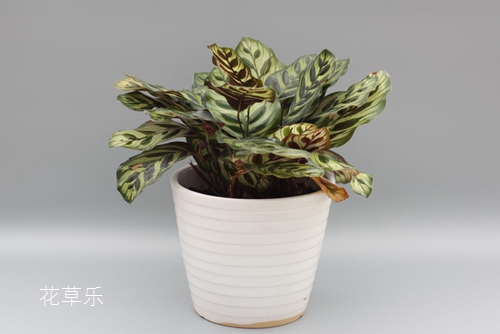
Calathea makoyana has tubers at its base and grows 30-50 cm tall. The leaves are ovate-elliptic, basal, entire, 20-30 cm long and about 10 cm wide, deep purple, with white down; because the dense filamentous markings on both sides of the main vein on the leaf surface extend from the central vein to the leaf margin and are arranged in a feather-like pattern, with obvious small veins between the lateral veins resembling peacock tail feathers, it is named Calathea makoyana; the ornamental markings on the underside of the leaf are light purple, and the petiole is deep purple. The leaves have a “sleep movement”, that is, at night their leaves fold up from the leaf sheath upward to the leaf blade in an egg-embracing shape, and then unfold again the next morning when sunlight shines on them. Is Calathea makoyana toxic......[View details]
I. Care methods for Calathea makoyana
1. Calathea makoyana likes a hot, humid, and semi-shaded environment and is not cold-tolerant. The optimum growing temperature is 18-25°C, the overwintering temperature is 5°C, and above 35°C or below 10°C is unfavorable for growth or survival; the air humidity requirement is 70%-80%.
2. For potted Calathea makoyana, use loose, well-drained, slightly acidic loam rich in humus. Generally, a mix of equal parts leaf mold, peat soil, and river sand with a small amount of decomposed base fertilizer can be used as the growing medium.
3. During the growing season, give sufficient water. Especially in summer and autumn, in addition to keeping the potting soil moist at all times, you must also frequently spray water on the leaves to cool and moisturize; after late autumn, water should be controlled to help it resist cold and survive the winter.
4. During the vigorous growth period, apply a dilute liquid fertilizer once every two weeks, but nitrogen fertilizer should not be too much.
5. In the growing season from May to September, it should be placed in a shaded or semi-shaded place. Too strong light or dry air can easily cause the leaf margins and leaf tips to scorch and the leaf markings to become dull and lusterless; but the light should not be too weak either. If it is kept in a dark room for a long time, its growth will also weaken, which is unfavorable for leaf color development, and it will lose the unique metallic sheen of the leaf surface.
6. Calathea makoyana has relatively few pests and diseases, but if ventilation is poor and the air is dry, scale insects can still occur, and a 1500-fold dimethoate spray should be used for control.
Calathea makoyana has strong adaptability and can be grown for a relatively long time in a weak-light indoor environment. It is often planted in small and medium pots and used as decoration in places such as home studies, bedrooms, and living rooms.