How to Grow Phalaenopsis Orchids? A Detailed Guide to Growing Methods
Phalaenopsis, also known as the moth orchid. It is one of the most widely and commonly cultivated species in the orchid family. Its flowers are full and graceful, with vivid colors, and the blooming period can last for several months. It grows vigorously and is easy to cultivate. There are many color varieties, including pure white, purple, white flowers with red lips, yellow base with red spots, white base with red spots, white base with red stripes, and more. Flowers of different colors have different symbolic meanings and flower-language meanings for Phalaenopsis. Many people find Phalaenopsis difficult to care for, so how do you grow Phalaenopsis? Below, Huacaole shares with you the growing methods and precautions for Phalaenopsis.
How to Grow Phalaenopsis Orchids? Growing Methods for Phalaenopsis
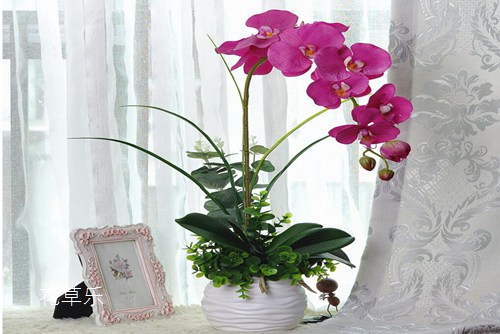
Growing Methods for Phalaenopsis
1. Light: Phalaenopsis prefers shade. Place it indoors in a spot with scattered light and avoid direct sunlight. But before and after the blooming period, appropriate light can encourage Phalaenopsis to bloom, making the flowers more colorful and long-lasting.
2. Soil: Phalaenopsis has relatively high requirements for soil and needs something breathable, rot-resistant, slightly acidic, and well-draining. Generally, materials such as pine needles, peanut shells, bark strips, and clay balls are chosen as the growing medium for Phalaenopsis. Phalaenopsis likes a breathable growing environment. When choosing a flower pot, it is recommended to choose a porous shallow pot; a plastic or ceramic pot whose height is less than its diameter is best.
3. Temperature: The daytime temperature is best kept between 25-28 degrees, and the nighttime temperature between 18-20 degrees. When the summer temperature is above 32 degrees or below 15 degrees, Phalaenopsis will directly enter a semi-dormant state, so high and low temperatures must be prevented.
4. Watering: Phalaenopsis can be watered with a spray bottle. Just water until water flows out from the bottom of the pot, and avoid watering too much. During the growing period of Phalaenopsis, once frequent water shortage occurs, it will cause the leaves to turn yellow, and it is very difficult to recover. When watering, do not let water accumulate in the heart of the orchid leaves. In winter, do not splash water on the leaves either. Generally, watering should be done on a clear, sunny morning, and the water temperature should be close to room temperature. When the indoor air is dry, you can use a sprayer to spray directly onto the leaf surface, but during the blooming period, do not spray water mist onto the flowers.
5. Ventilation and shading: Phalaenopsis is delicate, and choosing a ventilated environment will be more conducive to its growth. A stuffy and hot environment is also unsuitable for growing Phalaenopsis, especially in the summer in the south, where attention must be paid to shading Phalaenopsis. Phalaenopsis is an epiphytic orchid and likes semi-shade. In winter, when the temperature is low, use the noon period to ventilate it, but do not let the draft blow directly onto the orchid plant. In spring and autumn, pay attention to protecting the orchid from light.
6. Fertilizing: The principle should be to apply less fertilizer and apply dilute fertilizer. June to September is the growing period of the orchid plant, and the orchid plant needs to be fertilized once a week. Fertilizers suitable for Phalaenopsis: foliar fertilizer, monopotassium phosphate, water-added fermented cake fertilizer, special orchid fertilizer, etc. During the growing period, foliar fertilizer and monopotassium phosphate can be used alternately to fertilize Phalaenopsis. Or use water-added fermented cake fertilizer to irrigate with fertilizer water. In summer, when the temperature is relatively high, stop fertilizing the orchid plant. In autumn, begin to reduce the frequency of fertilizing.
7. Care: When growing Phalaenopsis indoors, due to factors such as temperature and humidity, the leaves of the orchid plant grow only 1-2 leaves in a year's time. When growing Phalaenopsis at home, due to limitations of temperature and humidity, it grows singly at the top, and the flower bud grows between two leaves. When the orchid plant grows a flower bud, control the indoor temperature at 18 degrees to 20 degrees, and after about 120 more days of care, the Phalaenopsis will bloom. You can set up a support in the flower pot in advance for the flower stem that is about to emerge to prevent the flower stem from falling over. During the growth process of the flower stem, it needs to be fixed multiple times to prevent the flower stem from breaking. When each flower bud in the pot has grown well, do not change the direction in which the pot is placed, so as to avoid the Phalaenopsis flowers blooming unevenly and affecting the ornamental value. During the blooming period, which lasts as long as 4 months, maintain indoor ventilation and temperature and keep the temperature controlled between 15-18 degrees. Around the Spring Festival is the full blooming period; appropriately lowering the temperature can extend the viewing time. When blooming, the nighttime temperature is best kept between 13°C-16°C, but it must not be lower than 13°C. During the blooming period, watch out for gray spot disease, which is mainly caused by not paying attention to water droplets on the petals, or other diseases, and which detracts from the ornamental value of the flowers. Therefore, never spray fertilizer water onto the petals.
8. Repotting: Repot Phalaenopsis once every year in late spring and early summer. This can prevent the growing medium from rotting, which causes poor growth of Phalaenopsis and leads to death. Phalaenopsis likes soil with strong air permeability.