How do you grow a honeysuckle bonsai so it has short branches and abundant flowers?
Honeysuckle, also known as Japanese honeysuckle. It is also called “gold-and-silver vine” and “mandarin duck vine”. Honeysuckle blooms in March, with five petals, a faint fragrance, and a reddish base; the flower is white when it first opens, and after one or two days it turns yellow, hence the name honeysuckle. Since ancient times, honeysuckle has been praised as a good medicine for clearing heat and detoxifying. It is sweet in nature, cold in energy, and aromatic; being sweet and cold, it clears heat without harming the stomach, and its aroma penetrates and can also dispel pathogenic factors. To make a honeysuckle bonsai highly ornamental, it needs a good shape; most importantly, when it blooms it cannot be as casual as when grown in the ground, but rather its flowers must be concentrated and bloom profusely. How do you grow a honeysuckle bonsai? Huacaole shares with you below.
How do you grow a honeysuckle bonsai? Only then can honeysuckle have short branches and abundant flowers
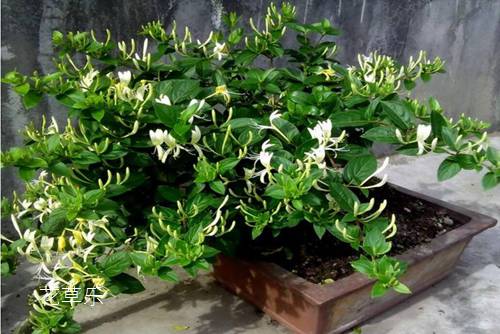
1. Water control
Honeysuckle is a vine; without interference, its branches grow fast and long. In a pot, we can break the usual routine: when it sprouts in spring, do not water at night, water in the morning; do not water heavily, water lightly; this makes its physiological water use unable to meet the needs of vigorous growth, causing new branches to become shorter and to age. Once branches age, they tend to bloom, and shortening reduces the distance between nodes, so the flowers become concentrated and lush.
2. Fertilizer restriction
Before honeysuckle flower buds form, do not apply nitrogen fertilizer or apply as little as possible, and apply relatively more phosphorus and potassium fertilizer. Once the flower buds have basically formed and shoot growth has basically ended, then apply some nitrogen fertilizer in moderation, so as to create a situation of many flowers and large flowers.
3. Repotting
Honeysuckle is generally repotted only once every 3-4 years. The purpose is simply not to let it sprout more new roots; with fewer new roots, its absorption capacity is poorer, and together with the aging of the potting soil, it becomes very difficult for it to grow vigorously, thereby achieving the goals of controlling tree vigor, limiting branches, and making the flowers bloom densely.
4. Pruning
For honeysuckle, cut off vigorous buds, shorten long branches, and cut the long while keeping the short. Then place it in a spot with plenty of sunlight (half shade and half sun in summer), to prevent vigorous growth caused by insufficient light. From the time it is potted, honeysuckle undergoes dwarfing and shaping pruning, training it into thick trunks and short branches. During the growing season, remove vigorous-growing buds, and pinch the tips of strong branches early; when pruning, cut the long while keeping the short. Through shaping and pruning, it is encouraged to change from a vine-like twining type into a short-branched, short-trunk, evenly branched, densely planted, clearly layered dwarf shrub-type stump bonsai.