How to grow orange jasmine? A complete guide to cultivation methods and bonsai making
Orange jasmine, also known as: shi la jiao, jiu qiu xiang, jiu shu xiang, qi li xiang, qian li xiang, wan li xiang, guo shan xiang, huang jin gui, shan huang pi, qian zhi yan, yue ju. It has a graceful form, elegant foliage and branches, and a rich floral fragrance. The chemical components contained in its roots, stems and leaves are similar to those of qian li xiang. It is commonly found in thickets on flat land, gentle slopes and small hills not far from the coast. It prefers to grow in sandy soil and sunny places. The orange jasmine tree has an elegant posture, sturdy branches, is evergreen all year round, blooms with pure white and fragrant flowers, and bears bright red fruits; it is excellent material for making orange jasmine bonsai. Below, Huacao Le shares with you how to grow orange jasmine, with a comprehensive introduction covering its morphology, care and propagation, orange jasmine bonsai making, pest and disease control, and medicinal value.
How to grow orange jasmine, a complete introduction to its cultivation and bonsai making
I. How to grow orange jasmine, an introduction to its cultivation methods
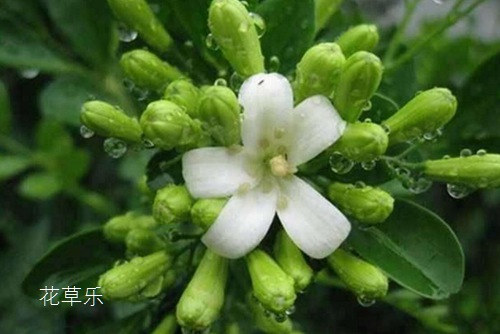
Orange jasmine, also called qian li xiang, is an evergreen shrub or small tree in the Rutaceae family. Its leaves are small and dense, dark green and glossy. Although its flowers are not startlingly showy, they are pure white and elegantly understated, with a rich fragrance that greets the nose. Every autumn, small white flowers cover the branches, their fresh fragrance assailing people, very elegant. Moreover, it is extremely long-lived and can be trained into artistic bonsai, with twisted and interlaced branches, sturdy and antique-looking, possessing a distinctive charm; it is an ideal potted flower for decorating halls and guest rooms. The lovable orange jasmine also has a very beautiful flower meaning: captive of love.
The fruit of orange jasmine is orange-yellow to vermilion, broadly ovate or elliptic, with a short pointed tip, slightly skewed, sometimes spherical, 8—12 mm long and 6—10 mm in transverse diameter; the flesh contains a sticky gelatinous liquid, and the seeds have short cottony hairs. The flowering period is April—August, and it also blooms after autumn; the fruiting period is September—December.
1. Growing environment of orange jasmine
Orange jasmine is native to tropical and subtropical regions of Asia, and is also distributed in southern and southwestern China, while in northern regions it can only be grown as a potted ornamental. It likes a warm climate and a sunny environment, and can also tolerate shade and drought, but not cold; in northern regions it needs to overwinter indoors at 10°C or above. It is suitable for growing in slightly acidic sandy loam rich in humus. Orange jasmine is not demanding about soil, and it is best to choose a sandy soil that is rich in humus, loose and fertile. Newly planted or repotted orange jasmine should be watered thoroughly, first placed in a shaded spot for about 10 days, and then placed in a sunny, well-ventilated spot for growing.
2. Propagation methods of orange jasmine
Orange jasmine is commonly propagated by seed and by cuttings, and can also be propagated by air layering.
(1) Cutting propagation: In spring and autumn, select one- or two-year-old branches as cuttings. The cuttings are about 10-15 cm long, with 2-3 buds retained at the top; dip the base in 1000-2000 mg/kg naphthaleneacetic acid for 3-5 seconds, then insert into a prepared seedbed. Insert to a depth of 3-5 cm. Fine sand and vermiculite can be used as the cutting medium. After insertion, water thoroughly, cover with a small arched shed, and shade appropriately, keeping the soil moist; roots form after about 2 months.
(2) Seed propagation: After the seeds mature each December, sow them immediately or store them in sand until spring sowing the following year. Sow orange jasmine on the seedbed, preferably sparsely rather than densely, which can speed up seedling growth; after sowing, cover with 0.5-1 cm of soil. Keep the soil moist, at a temperature of about 15°C; germination takes about 20 to 30 days.
(3) Air layering propagation: Carried out from May to August, select thick, sturdy branches, wound them below a node, wrap with moss and other moisture-retaining materials, and they will heal and root in 2 months.
3. Care and management of orange jasmine
1. For potted orange jasmine, choose a well-drained sandy loam, and apply a slow-release organic fertilizer rich in phosphorus and potassium at the bottom of the pot as a base fertilizer. The growing medium can be made by mixing 7 parts sandy loam, 1 part fine cinder, and 2 parts cake fertilizer residue (the residue left from cake fertilizer water), or 5 parts pond mud, 4 parts peat, and 1 part river sand.
2. May is the growing season for orange jasmine, so move the plants outdoors to a sunny spot for care. Because the outdoor sunlight is strong and the climate is relatively dry, water evaporates fairly quickly, so watering should be increased accordingly, once every 1-2 days, and topdressing should also be increased to once every 10 days. Summer is the season for plant growth and flower bud formation, and the weather is hot, so water demand is high; water thoroughly once a day, and at noon and in the evening also sprinkle some water on the leaves and the surrounding ground frequently to increase air humidity and reduce water evaporation.
3. During the growth period of orange jasmine, apply a mixed fertilizer of nitrogen, phosphorus and potassium; do not apply nitrogen fertilizer alone. Before flowering and bud formation, apply more phosphorus and potassium fertilizer. If nitrogen fertilizer is excessive and phosphorus and potassium fertilizer is lacking, the branches and leaves tend to grow leggy without forming buds or blooming. During bud formation, water appropriately less to favor bud development. During the growing period of orange jasmine, water with cake fertilizer water once a month; watering generally has no strict requirements, and it is enough to water when the potting soil looks dry; do not water too much, as overly wet soil easily causes leaf drop. During the flowering period, watering must be timely and moderate to ensure abundant and fragrant blooms.
4. In winter, prevent the orange jasmine plants from suffering cold damage; the indoor minimum temperature should be maintained above 10°C, and watering must also be strictly controlled, so that you do not water unless the potting soil is dry, keeping it slightly dry as appropriate. Orange jasmine can be repotted every one or two years; the potting soil is made by mixing 5 parts coniferous leaf mold, 2 parts garden soil, 2 parts fine yellow sand, and 1 part compost soil, all sifted and thoroughly mixed. Repotting can be done in spring in April or May, and when repotting, also apply plenty of rotted base fertilizer at the bottom of the pot.