Introduction to Boxwood, One of China's Top Ten Famous Trees, and Its Care Methods
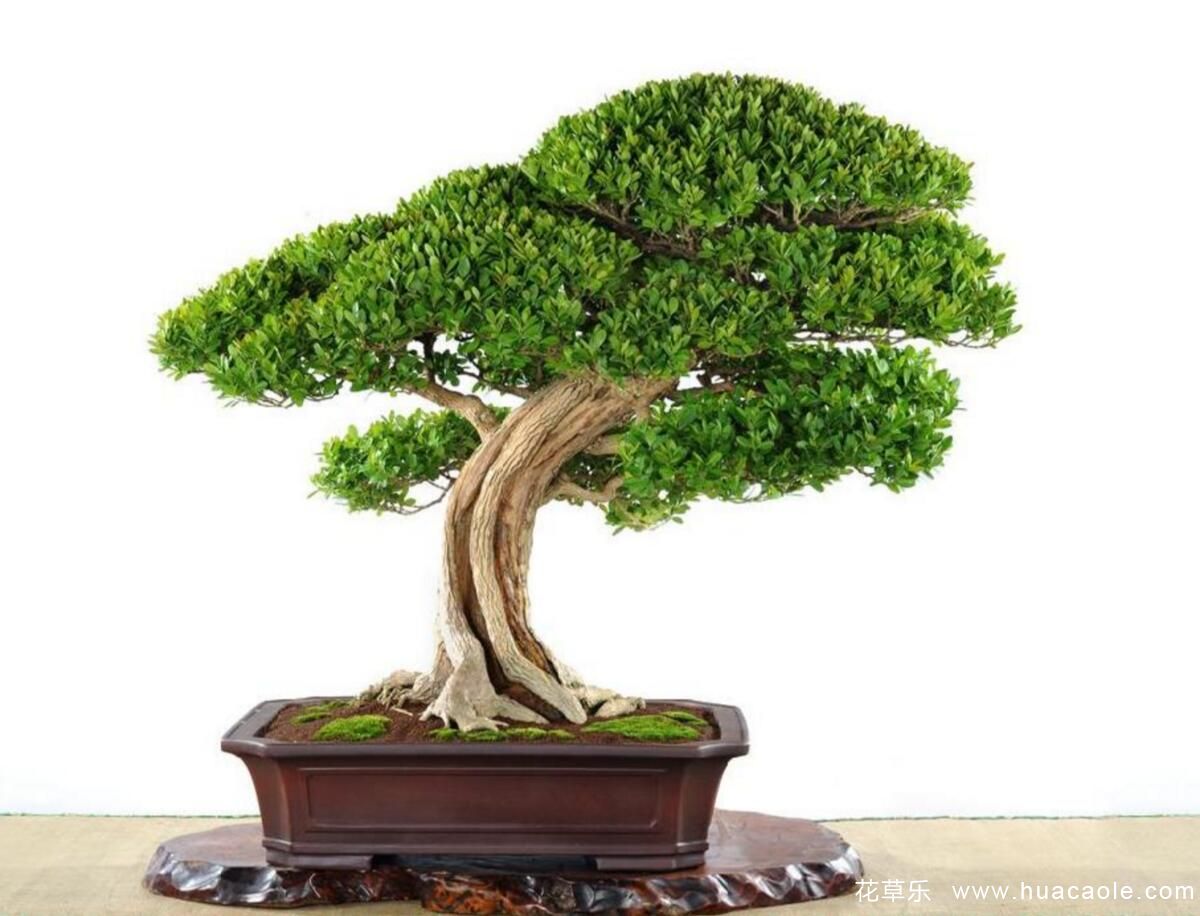
Boxwood bonsai has a graceful tree form, with leaves as small as broad bean petals, thick and glossy, evergreen all year round, and can be enjoyed throughout the year. In the Yang-style boxwood bonsai, the branches and leaves are pruned and trained into “cloud layers”, flat and thin as if shaved, and further decorated with mountain stones, elegant and beautiful as a painting. In spring, when the tender leaves of boxwood first emerge, the whole tree is fresh green, very pleasing to the eye. An ancient poem praising boxwood: a boxwood tree just a foot away, with layered and spreading branches, leaves as deep green as jade, and gnarled roots like a coiled dragon. It depicts the charm of boxwood, which is an excellent material for cultivating bonsai at home. Huacao Le shares with you below the morphological characteristics of boxwood, its cultivation and care, pest and disease control, value, boxwood legends, and other knowledge.
I. Morphological Characteristics of Boxwood
Boxwood: a shrub or small tree, 1-6 m tall; branches cylindrical, with longitudinal ridges, grayish white; branchlets four-angled, entirely covered with short pubescence or hairless on the outer opposite two sides. Leaves leathery, broadly elliptic, broadly obovate, ovate-elliptic, or oblong, glossy on the surface, midrib prominent, often with fine hairs on the lower half. Inflorescences axillary, head-like, flowers dense, male flowers about 10, sessile, outer sepals ovate-elliptic, inner sepals nearly circular, 2.5-3 mm long, hairless, stamens including anthers 4 mm long, sterile pistil with a club-shaped stalk, enlarged at the tip; female flower sepals 3 mm long, ovary slightly longer than the style, hairless. Capsule nearly spherical. Flowering period March, fruiting period May-June. Mostly grows in valleys, by streams, and under forests, at an altitude of 1200-2600 m. Produced in many provinces and regions of China, with some belonging to cultivation. Boxwood varieties include lingonberry-leaved boxwood; small-leaved boxwood; large-leaved boxwood; and pointed-leaved boxwood.
II. Growth Habits of Boxwood
Boxwood prefers fertile, loose loam soil, can adapt to slightly acidic soil or slightly alkaline soil, and can also grow in calcareous soil. For pot cultivation, matured garden soil or leaf mold mixed with an appropriate amount of rice husk ash can be used. It is shade-tolerant and light-loving, and can maintain good growth under general indoor and outdoor conditions. In a long-term shaded environment, although the leaves can remain emerald green, it easily causes branches to grow leggy or become weak. It likes moisture and can tolerate continuous rainy weather for about one month, but dislikes long-term waterlogging. It is drought-tolerant; as long as the surface soil or potting soil does not completely dry out, there will be no abnormal performance. It is heat-tolerant and cold-tolerant, can withstand summer sun exposure and severe cold of about minus 20 degrees Celsius, but in summer high temperature and humidity, it should be given more ventilation and light. It is not strict about soil requirements, with loose and fertile sandy loam being best; for pot cultivation, vermiculite, peat, or soil can also be used in combination, and it has strong alkalinity tolerance. It has very strong tillering ability, is tolerant of pruning, and is easy to shape. After sufficient autumn light and entering dormancy, the leaves can turn red.
III. Introduction to Boxwood Cultivation Methods
1. Watering Boxwood
Boxwood trees relatively like water, and in watering, the principle of “better wet than dry” should be mastered. Irrigation time: each watering is best done in the morning and evening, not at noon when the temperature is highest.
2. Topdressing Boxwood
It can timely supplement the large demand for nutrients by seedlings during the period of vigorous growth and development, promote seedling growth and development, and improve quality. Nitrogen fertilizer should be applied in spring and summer, and the last application of nitrogen fertilizer must not be later than “Start of Autumn”. This is to prevent seedlings from growing leggy and reduce the overwintering ability of boxwood seedlings. In August-September, nitrogen fertilizer must be stopped, and fertilization should mainly use phosphorus and potassium fertilizers. This promotes lignification of boxwood seedlings and root growth, and improves the cold resistance of seedlings.
3. Shaping Boxwood
During the growing period, prune away leggy branches, overlapping branches, and excess branches that affect the tree shape at any time. Boxwood sprouts relatively quickly; generally after new shoots emerge, cut off the first 1-2 nodes at the tip to prevent leggy growth. After boxwood fruits, remove them promptly to avoid consuming nutrients and affecting tree vigor growth.
4. Repotting Boxwood
Generally carried out once every 2-3 years, preferably before spring sprouting. When repotting, cut off some old roots and overly long or dense root systems, replace 1/2 of the old soil, and fill with fertile, loose culture soil to facilitate root development.
5. Pest and Disease Control
The main pests of boxwood include scale insects and boxwood looper caterpillars. Scale insects can be killed by manual brushing, or sprayed with 80% dichlorvos at 1500 times dilution; boxwood loopers can be sprayed with 80% trichlorfon wettable powder, or with 40% omethoate at 1000-2000 times dilution. The main disease is sooty mold, which can cause leaf drop. The key to control is to remove scale insects and frequently spray water on the leaf surface to wash off dust so that it grows well.
IV. Making Boxwood Bonsai
1. Material Selection for Boxwood Bonsai
Seedlings propagated by sowing or cuttings can be transplanted into pots for processing after several years of cultivation. Old stumps can also be selected from mountain fields; after digging them up, trim overly long roots and dense branches, first grow the material in the open ground for 1-2 years, then pot and process. When selecting plants, pay attention to protecting the surrounding soil, dig the root ball as large as possible, and maintain sufficient room for root trimming. The root ball should be 1-2 cm smaller than the inner diameter of the planting pot.
1> Pot Selection
Boxwood is oily green all year round, so purple clay pottery pots are suitable, with purple or light yellow being good pot colors. The pot shape depends on the styling form. For cliff style, a deep cylindrical pot is suitable; for slanting style or curved-trunk style, an oval or rectangular pot is used.
2> Soil Use
The soil for bonsai should be matured garden soil or leaf mold mixed with an appropriate amount of rice husk ash as culture soil. It should be fertile and loose, with loam that has good aeration and water permeability being best. When potting old stumps, it is best to keep some native soil.
3> Planting
Boxwood is relatively cold-tolerant and can be planted before spring sprouting. When planting, trim overly long and dense root systems, and do not let the roots curl up in the pot. Newly planted boxwood should be placed in a semi-shaded place.
2. Boxwood Styling
Boxwood has strong sprouting ability. Before styling, the main trunk can be cut back to let new shoots sprout around or below the cut surface, and then according to the requirements of artistic styling, train and bind the branches and trunk; binding with palm fiber in spring is best. Coarse binding and fine pruning can also be used to make cloud-layer or steamed-bun shapes, or process into a natural tree form. The main trunk follows its natural tendency to make a slanting-trunk style or prostrate style. If the boxwood stump is decorated with elegant stones, it becomes “boxwood bowing”. Boxwood is very tolerant of pruning and has strong sprouting ability; to maintain a graceful tree shape, it must be processed and shaped frequently.
V. Boxwood Pest and Disease Control
1. Powdery Mildew
Large-leaved boxwood powdery mildew is also called powdery mold disease. It often infects the leaves, stems, and other parts of large-leaved boxwood. When the disease occurs, a layer of white powder appears on the surface of the affected area, and when severe, the leaves of large-leaved boxwood wither. This disease often occurs in muggy, humid, and unventilated environments.
Control method: spray lime sulfur mixture with a density of 1.0035 (0.5 degree Baume) or thiophanate-methyl, carbendazim, and other agents.
2. Boxwood Southern Blight
When large-leaved boxwood southern blight occurs, the base near the soil turns brown and rots, and the mycelium is white and silky, initially white then turning yellow to brown like rapeseed. This disease mostly occurs in the hot midsummer season with moist soil and frequent rain.
Control method: disinfect the potting soil before use, also pay attention to environmental ventilation, avoid overly dense cultivation, and prune diseased branches. Before the disease occurs, regularly spray 50% carbendazim wettable powder at 500 times dilution.
3. Boxwood Leaf Spot
Large-leaved boxwood leaf spot is also called black spot or brown spot. Its symptom is black spots appearing in the middle of the leaves. Then the leaves turn yellow and fall off. This disease is mostly caused by a non-ventilated and humid environment.
Control method: pay attention to improving environmental conditions; in the early stage of the disease, remove diseased leaves and burn them in a centralized manner, and spray 1% Bordeaux mixture 4-5 times, once every 7 days.
VI. Main Value of Boxwood
Boxwood bonsai has a graceful tree form, with leaves as small as broad bean petals, thick and glossy, evergreen all year round, and can be enjoyed throughout the year. The wood is hard and fine-grained, and is a superior material for carving crafts. The roots and leaves can be used as medicine. Functions and indications include dispelling wind and dampness, and promoting qi and blood circulation.
VII. Boxwood Plant Culture
Boxwood grows slowly. The wood of boxwood is extremely fine, and pores cannot be seen with the naked eye. However, because boxwood grows slowly, it is difficult to obtain large material, and it is mostly used for inlay with high-grade mahogany or processed into extremely fine carving works. No large pieces have been seen. Precisely because of this, boxwood carving works are often mistaken by beginners for ivory. It can be said that making large furniture from boxwood is extremely difficult; if it appears, it must be a rare treasure.
The aroma of boxwood is very light, very faint, elegant but not gaudy, the kind of scent that can be fully described as delicate fragrance, and it can repel mosquitoes. In addition, boxwood also has the effects of sterilization, anti-inflammation, and stopping bleeding. Among the mountain people in areas where boxwood grows, there is a custom of collecting boxwood leaves for use as a hemostatic medicine and placing boxwood branches to repel mosquitoes and flies.