How to grow azaleas? Detailed guide to cultivation methods and precautions
In late March of early spring, the 2 azalea tree stumps bought last year were potted up, and the potted azaleas bloomed, one pot of pink and one of peach blossom. Although there are only bare branches and flowers, lacking a bit of green leaf contrast, there is still a unique charm. How to grow azaleas? Below I summarize my cultivation methods and precautions for caring for azaleas over the past two years as follows, for everyone to share.
How to grow azaleas: cultivation methods and precautions for azaleas
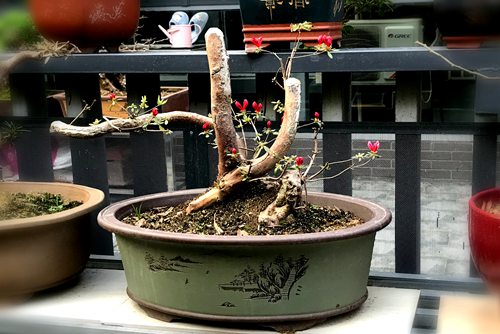
I. Cultivation methods for azaleas
1. Azaleas like cool conditions and dislike intense summer heat; they like half shade and dislike blazing sun; they like moisture and dislike dryness; they like acidic soil and dislike alkaline soil; they like light-textured soil and dislike heavy clay soil; they like good drainage and dislike waterlogging. Azaleas like acidic (pH 4.5-5.5), loose, well-drained soil. Avoid alkaline soil containing lime, and avoid clayey soil. Reference formula: commonly use 6 parts leaf mold, 2 parts peat soil, 2 parts river sand mixed evenly, or use pine needle soil.
2. After summer begins, place the azaleas in a ventilated, shady spot. In the hot summer, shade with a shade net, and open the curtain before 8 a.m. and after 5-6 p.m. Since azaleas are semi-shade-loving flowering plants, the tender leaves are easily scorched under blazing sun. If kept under strong direct light for a long time in summer, the branches and leaves will turn yellow and growth will stall; in severe cases the whole plant dies.
3. In autumn the sunlight intensity gradually softens. Before 9 a.m. and after 5 p.m., let the azaleas get more sunlight, and in late autumn place them in a sunny spot to promote flower bud differentiation. Azaleas are not cold-tolerant; around the time between Cold Dew and Frost's Descent they should be moved indoors and placed in a sunny spot. In the early period after moving indoors, be careful to open the windows and doors for ventilation. If kept in a shady spot for a long time, they easily drop their buds.
4. In winter the indoor temperature should preferably be around 10°C. For most varieties the indoor temperature should not be below 5°C, but Western azaleas are sensitive to cold, and the overwintering indoor temperature must not be below 8°C. If the winter indoor temperature is too high, metabolism increases, consuming nutrients, which is unfavorable for growth and development the following year.
5. For watering, I have always used water from the rockery pond. Do not water if the soil is not dry; do not let it get too dry either, as the leaves will wilt if it is too dry. Winter and summer are different. During the flowering period, do not water too much; too much easily causes bud drop and early withering. In spring and autumn, when it is windy and the air is dry, sufficient water must be ensured. Be careful to spray the leaf surfaces and the ground to maintain a certain humidity. During the azalea growth period, generally apply alum fertilizer water once every 10-15 days, or alternately spray the leaves with a 0.1%-0.2% potassium dihydrogen phosphate solution.
II. Precautions for growing azaleas
1. Azalea roots are as fine as hair strands, with very few thick roots, so they fear both dryness and wetness, and especially fear heavy fertilizer. If watered too much, the roots sit in water. If not watered and left too dry, the branches and leaves shrivel and the leaves fall off; as for applying heavy fertilizer, that can endanger their lives.
2. After azaleas finish blooming, the faded flowers must be cut off immediately. After new branches sprout, in combination with a shaping plan, thin out the branches appropriately.
3. Potted azaleas should generally be placed facing the southeast, and they need ventilation. Without ventilation they easily suffer from black spot disease and drop leaves in large numbers.
4. In summer, avoid direct light for azaleas. In the hot summer, shade with a shade net.
5. Thin buds and leaves in time, preserve air circulation, and remove part of the flower buds and leaves that grow too numerous and too dense, so that nutrients are concentrated in the flower buds. After the flower buds form, increase nutrition and apply a suitable amount of extra phosphorus and potassium fertilizer, otherwise the flower buds will turn into leaf buds.
6. Repot and change the soil once every 2 to 3 years, damaging the roots as little as possible. The time should be after the flowers fade or in autumn, and at the same time spray thiophanate to prevent diseases.
7. The main insect pests of azaleas are the azalea lace bug, the top bud leaf roller, red spider mites, aphids, etc. They can be sprayed with fenvalerate and similar products, with good results; if they are not dead after three days, spray again. For the azalea lace bug (also known as the crowned lace bug), during the damage period spray a 40% dimethoate 1500-fold solution, once every 7 days, for 3 consecutive times. The main control method for the top bud leaf roller is manual capture and killing; the larvae or pupae can also be sprayed with a 40% dimethoate emulsifiable concentrate 2000-fold solution or a dichlorvos 1500-fold solution.