How to grow Serissa japonica: no yellowing or dropping leaves, with white and gold flowers like snow
Serissa japonica, also known as "mantianxing" (thousand stars), is an evergreen shrub that blooms in June with flowers as white as snow all over the tree. Its dense, tiny appearance looks very similar to snowflakes. The branches of Serissa japonica are soft and easy to shape, and the stems have strong sprouting ability. It is mostly grown as bonsai with exposed roots attached to stones. It is one of the classic bonsai materials of southern Fujian, and is also known as one of the "Eighteen Scholars" of stump bonsai. Serissa japonica bonsai is also exported to other countries. Since it is such a beautiful potted plant, let us take a look at how to grow Serissa japonica.
How to grow Serissa japonica
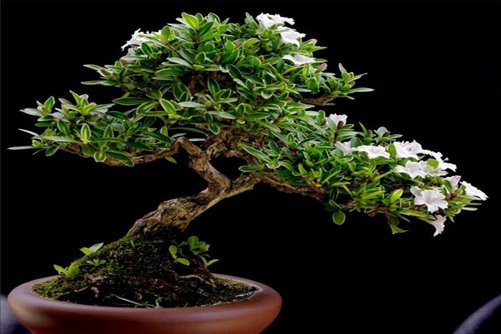
1. Serissa japonica likes a sunny, warm, humid, and well-ventilated environment. March to August is its growing season. It dislikes strong direct sunlight, so it should be placed where it cannot receive direct sunlight, but it should not be too shady either, otherwise its spots tend to fade. Its growing temperature is around 20 degrees, and when the temperature drops below 10 degrees in winter, it should be moved indoors for care.
2. In spring and summer, keep the potting soil moist. In winter, just water when dry and let it dry out between waterings. In summer, spray water on the leaves 1 to 2 times every morning and evening. During the winter dormant period, control watering and keep the potting soil moist but slightly on the dry side to prevent root rot. The key point is that the potting soil must not become waterlogged.
3. Serissa japonica likes fertilizer, so during the growing season, apply fertilizer once a month, using organic fertilizer mainly based on "nitrogen and phosphorus" to supplement nutrients, such as decomposed animal manure, cake fertilizer plus bone meal for flowers, in appropriate amounts. Follow the principle of "light fertilizer applied frequently." You can also use "monopotassium phosphate" once a month to supplement foliar fertilizer on the leaves.
4. Serissa japonica does not have high requirements for potting soil. Mixing half leaf mold and half coarse sand is enough. The potting soil should be loose, breathable, and not waterlogged. When potting, a layer of organic fertilizer needs to be buried at the bottom of the flower pot. Repot once every 2 years, generally in spring and autumn. When repotting, prune it, remove dead roots, and replace 2/3 of the old soil.
5. If Serissa japonica bonsai is placed in a poorly ventilated place for a long time, it is prone to scale insects. When scale insects are found, spray with a 50% dichlorvos 1000 times solution to kill them.
II. Varieties of Serissa japonica
Serissa japonica 'Yinmu'
Serissa japonica 'Jinbian' (golden-edged Serissa)
Serissa japonica 'Huaye' (variegated Serissa)
Serissa japonica 'Fuban' (double-petaled Serissa)