What to Do When Crape Myrtle Leaves Turn Yellow? Causes and Control Methods
Compared with other potted plants, crape myrtle is relatively easy to grow; it is quite adaptable and has a very high survival rate. But have you noticed that some crape myrtles show yellowing, withered conditions? Is it improper care, or is it lacking “vitamins” just like a person? Next, Huacaole introduces the causes and control methods for this situation.
What to Do When Crape Myrtle Leaves Turn Yellow? Causes of Leaf Yellowing and Control
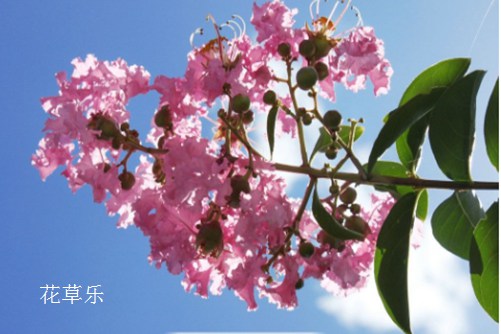
I. Causes of Crape Myrtle Leaf Yellowing
(1) Aging of life
Just like people, crape myrtle also goes through birth, aging, illness and death and natural metabolism. During this process, the plant itself will have leaves that gradually turn yellow and drop due to the natural consumption of nutrients. This is a normal natural phenomenon in the growth process of crape myrtle.
(2) Lack of water or excess water
People have basic physiological needs such as eating, drinking, playing and having fun, and crape myrtle is the same. When crape myrtle lacks water supply, its leaves will slowly wither and turn yellow. Crape myrtle has relatively strong drought resistance; when there is excess water, the soil becomes soggy, making it difficult for the roots to absorb enough oxygen, so they weaken or rot, which means nutrients cannot be transported to the leaves, causing the leaves to wither and turn yellow.
(3) Lack of fertilizer
Nitrogen deficiency: The crape myrtle plant becomes thin and weak, the branches become slender and hard, the leaves are very small and the flowers are also small. The leaf color changes from deep green to pale, appears red-purple, and then withers and falls off; in severe cases, the whole plant has no green left.
Phosphorus deficiency: The leaf color changes from dark green to purple-bronze, and the petioles turn yellow with a purple tinge. Flower buds are very difficult to form, flowering is sparse, the color is pale, causing poor plant development, early withering and falling.
Potassium deficiency: The plant is short and small, and the stems lean in all directions and cannot stand upright. The leaves are wrinkled, and the old leaves develop dark brown spots from the leaf tip along the leaf margin; the area around the leaf begins to turn yellow, while the center and veins remain green.
Calcium deficiency: The young leaves are wrinkled as if they cannot open, the leaf margins curl upward and have white streaks, and the new leaves are diseased, distorted or unable to open.
Magnesium deficiency: The plant does not grow vigorously. The old leaves lose green color from the bottom upward, from the leaf margin to the center of the leaf, gradually turning white; various spots also appear on the veins, and finally all the leaves turn yellow.
Sulfur deficiency: The young leaves slowly become chlorotic starting from the veins, until the leaves of the whole plant turn yellow, and root development is also abnormal.
Iron deficiency: Starting from the young leaves that emerge, all the leaves slowly become chlorotic.
II. Control Methods for Crape Myrtle Leaf Yellowing
(1) Aging of life
When this happens, there is no need to worry at all; just continue to carry out normal and reasonable care and management of the crape myrtle and it will safely pass through this natural process.
(2) Lack of water or excess water
Stick to the watering principle of “do not water if not dry”; during the rainy season, effective drainage measures must be taken to avoid waterlogging that causes root rot.
(3) Lack of fertilizer
Nitrogen deficiency: Apply supplementary decomposed human manure and urine, cake fertilizer, barnyard manure, or fertilizers such as ammonium sulfate, urea and ammonium nitrate; it must be well-rotted fertilizer.
Phosphorus deficiency: Apply supplementary bone meal, fish meal, chicken and cow manure, or use superphosphate, ammonium phosphate and potassium phosphate fertilizers. Generally, a water solution of about 0.10% used as a foliar top dressing gives very good results.
Potassium deficiency: Apply supplementary plant ash, a 1% to 2% potassium chloride water solution (note that it cannot be used on bulbous and tuberous flowers), and a 0.30% to 0.50% potassium nitrate water solution as a foliar top dressing, or inorganic fertilizers such as potassium phosphate work just as well.
Calcium deficiency: Half a month before sowing or potting, add an appropriate amount of calcium chloride to the soil; this can increase calcium and also has a disinfecting effect (note that it cannot be used on acid-loving flowers), or using calcium nitrate as a top dressing also works very well.
Magnesium deficiency: Spray continuously 3 to 4 times with a 0.20% to 0.40% magnesium sulfate water solution, with an interval of 7 to 10 days before repeating the cycle. For soil severely deficient in magnesium, use 5 to 10 kg magnesium sulfate per mu, mixed into the base fertilizer in autumn or winter and applied to the soil.
Sulfur deficiency: Spray with a 0.30% ferrous sulfate water solution, continuously 3 times, with an interval of 7 days each time; when spraying, the mist droplets must be fine and even. At the same time, a 0.20% urea-iron water solution can also be used for foliar top dressing, and the effect is also very good.
Summary:
I believe everyone now has some understanding of the causes of leaf yellowing, so please treat the symptoms accordingly. Wishing your home a garden full of blooms and blossoming prosperity.