How to grow azaleas to prevent leaf drop and yellowing leaves
Although azaleas are beautiful, improper care can easily lead to the situation of “flowers in the first year, yellowing in the second year, and all leaves falling off in the third year.” The care of azaleas can be summarized in the experience mnemonic of “seven likes and seven fears,” as follows: 1. Likes acid, fears alkali. 2. Likes moisture, fears waterlogging. 3. Likes coolness, fears heat. 4. Likes partial shade, fears strong light. 5. Likes gentle breezes, fears strong winds. 6. Likes humidity, fears dryness. 7. Likes fertility, fears excessive fertilizer. How should azaleas be grown to prevent leaf drop or yellowing leaves? Below, Huacaole shares prevention and treatment knowledge with you.
How to grow azaleas: preventing leaf drop and yellowing leaves in azaleas
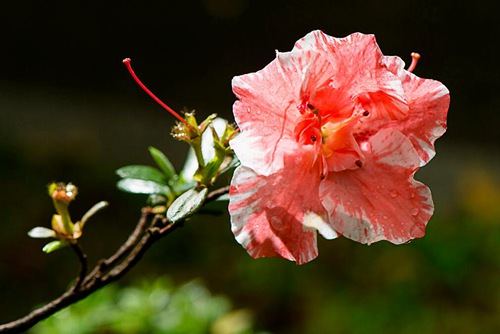
1. Leaf drop due to inability to adapt to environmental change
Most azaleas purchased from flower markets are cultivated in greenhouses. After being brought home and having their growing environment changed, they cannot adapt at once, and leaf drop or even death often occurs.
Solution: For newly purchased azaleas, try to maintain air humidity, provide appropriate shading, keep the potting soil moist, ensure air circulation but avoid direct cold wind, and do not rush to repot or fertilize. Try to help them safely pass through the adaptation period. In winter, give sufficient light. When caring for them indoors, place them under a south-facing window as much as possible, and the ambient temperature must not be lower than 5 degrees. Do not change their location casually, so as to avoid sudden temperature changes.
2. Leaf drop due to unsuitable potting soil
Solution: Azaleas like slightly acidic, loose soil. If the potting soil is alkaline or if alkaline water is used for watering over a long period, it will inevitably affect the roots' absorption of elements such as nitrogen and iron, causing iron deficiency and leading to leaf yellowing. To prevent chlorosis caused by iron deficiency, you can water daily with 0.2% ferrous sulfate solution, and the leaves will not turn yellow or even dry up and fall off. In addition, adding a few drops of edible rice vinegar to the water used for watering flowers can also increase the acidity of the soil.
3. Improper watering and fertilizing
Solution: The root system of azaleas is delicate and weak. They fear drought, waterlogging, and excessive fertilizer. If watering is insufficient or missed, it will cause the leaves to wilt and droop, and in severe cases the leaf tips will scorch, with leaves and flower buds falling off in large numbers. If watered too much, the soil will remain overly wet for a long time, causing the roots to suffocate and rot, which can easily lead to yellowing and falling of the lower old leaves; in severe cases, the leaves may almost completely fall off. Applying fertilizer that is too concentrated or using unrotted raw fertilizer will cause fertilizer damage to the plant. In mild cases, the leaves turn yellow, the leaf tips scorch, the branch tips shrink and dry, and a large number of leaves fall; in severe cases, the entire plant dies. Once fertilizer damage occurs, increase watering so that the fertilizer flows out through the drainage holes. If necessary, repot and change the soil.
4. Yellowing due to nutrient deficiency
Solution: When the plant lacks iron or magnesium, it will cause interveinal chlorosis in azalea leaves, but the veins remain green; when it lacks sulfur, it will also cause young leaves to turn yellow, and in severe cases turn white and spread to old leaves. Leaf analysis and soil analysis can be used to determine which element is deficient, and then supplement the corresponding element. Usually, iron deficiency is the most common, and whenever leaves turn yellow it is assumed to be caused by iron deficiency, but sometimes this is not the case.
5. Poor root absorption
Solution: When summer temperatures are high, azalea leaf yellowing is especially obvious, and after the weather turns cool in autumn, most cases improve or return to green. Although the symptoms resemble iron deficiency, supplementing iron has no effect on them. For this type of yellowing phenomenon, measures to protect and care for the roots should be taken. In winter, maintain a relatively high temperature; in summer during high temperatures, provide shade and spray water around the environment to lower the temperature, maintain good ventilation, and promote healthy growth and development of the plant's root system.
6. Light
Azaleas like light but fear scorching sun; they like ventilation but fear strong winds. Placing them under scorching sun in summer, or in drafty openings in spring (especially early spring) and autumn, will cause a large number of leaves to fall.
Solution: Take care to place azaleas in a spot with morning and evening sunlight and shelter from the wind.
7. Physiological leaf drop
Solution: If flowering is too dense, if nutrients are not supplied in time, or when new leaves are sprouting, old leaves will also fall off. This is a normal condition and can be solved through normal repotting and supplementary fertilizing. Home-grown azaleas generally bloom and sprout new leaves from April to June, and old leaves will fall off. After flowering, carry out one pruning and shaping, cutting off overly dense branches, crossing branches, weak branches, drooping branches, leggy branches, and diseased and pest-infested branches. This not only helps ventilation and light penetration and promotes strong branches, but also reduces leaf drop.