Sageretia is one of the Seven Sages of bonsai, yet it is hard to keep alive? Teach you how to improve the survival rate
Since ancient times, Sageretia has been an important material for making bonsai, and has long been known as one of the “Seven Sages” of bonsai. In gardens, Sageretia can be used as a hedge or vertical greening material, and is also suitable for planting among rocks. Sageretia belongs to the Rhamnaceae family; its roots and trunk are naturally peculiar, and its tree form is vigorous and ancient-elegant. It is one of the main tree species for Chinese stump bonsai, one of the five famous trees of Lingnan bonsai, and one of the bonsai plants exported to the United States after China's entry into the WTO. The cultivation of Sageretia bonsai has special requirements compared with other tree species. Improper care and cultivation can cause already surviving, or even already formed, stump bonsai to die. Below, Huacaole shares with you several aspects to note during the cultivation of wild-collected Sageretia stumps.
It is said that Sageretia, one of the “Seven Sages” of bonsai, is hard to keep alive. How can the survival rate of Sageretia bonsai be improved?
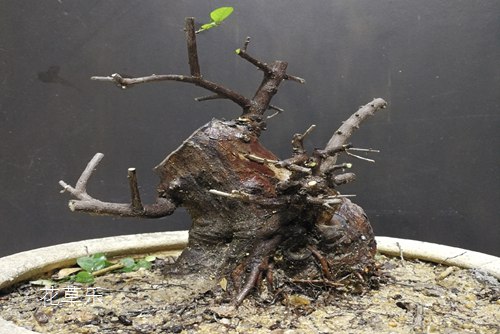
How can the survival rate of wild-collected Sageretia stumps be improved?
1. Selection of the stump: the stump is required to be fresh with few cut surfaces. The method for judging whether a stump is fresh is relatively simple: scrape it with a fingernail; if it appears pink or greenish and has a moist feeling, it proves to be a fresh stump that was dug out not long ago; otherwise, it has severely lost water. The main parts of the stump must have robust buds, with clearly protruding ones being the best. Such buds have strong sprouting ability and grow quickly and robustly. It is best not to keep buds that are not obvious; under normal circumstances, even if they sprout, their growth will be weak.
2. The stump must have a certain number of lateral roots and fine roots. Residual roots, broken roots and overly long roots should be pruned in time, so that after potting it can easily grip closely to the soil and its survival rate can be improved.
3. Timing of planting the stump: generally carried out during the dormant period. In the south, the best time is from January to March; in the north it is slightly later. Generally, after Qingming the survival rate drops greatly, so at this time do not plant wild-collected Sageretia stumps.
4. Selection and mixing of soil: loose, well-drained plain soil is best. In the south, pond mud or garden soil is often mixed with river sand; in the north, it is selected and mixed according to local soil. During the stage of growing the stump, never use soil with excessive binding force. Generally, river sand should account for 70%-80%. Only after it has survived can you combine repotting with adding loose, fermented farmyard manure such as poultry manure.
5. Water supply has a great influence on the survival rate of the stump. At initial planting, water thoroughly once, then just keep the potting soil moist. Do not water excessively, otherwise excessive water will cause root rot and death. Persist in spraying water on the stump; this is the key to the stump surviving. If you stop spraying water on the stump as soon as you see sprouting, you will often waste all your previous efforts and fall short at the last step.
As long as you persist in doing the above points, the survival rate of Sageretia bonsai stumps will certainly be greatly improved. After wild-collected Sageretia stumps survive, they are extremely adaptable and not strict about soil quality; they can adapt to acidic, neutral and calcareous soil, and are drought-tolerant, tolerant of waterlogging, and tolerant of poor soil. In terms of daily care......[View details]
The Four Great Masters, Seven Sages, Eighteen Scholars, and Four Elegants of Flowers and Plants among bonsai plants. Which are they respectively?
During the Ming and Qing dynasties, the custom of appreciating and playing with bonsai in our country was already very flourishing, and the plant varieties used were also very rich. At the same time, many works on bonsai appeared one after another during this period. During the Jiaqing period of the Qing dynasty, Su Ling of Wuxi wrote the two-volume “Casual Record of Bonsai”, which divided bonsai plants into the Four Great Masters, Seven Sages, Eighteen Scholars, and Four Elegants of Flowers and Plants.
Four Great Masters: Caragana sinica, boxwood, winter jasmine, and Chinese juniper.
Seven Sages: Huangshan pine, Chinese weeping cypress, elm, maple, holly, ginkgo, and Sageretia.
Eighteen Scholars: plum, peach, tiger thorn, jijqing, goji, rhododendron, Cuibai cypress, papaya, wintersweet, nandina, camellia, Buddhist pine, Malus micromalus, phoenix-tail bamboo, crape myrtle, pomegranate, Serissa japonica, and gardenia.
Four Elegants of Flowers and Plants: orchid, chrysanthemum, narcissus, and Acorus calamus.