Japanese honeysuckle (Lonicera japonica) blooms beautifully; what technical requirements are there for making it into a bonsai?
Japanese honeysuckle is naturally vigorous and sturdy, so when made into a bonsai, its management is relatively extensive. But to make it bear many fragrant flowers with bright colors, note that the flowers are white when they first open and turn yellow after one or two days, hence the name Japanese honeysuckle. The flowering season of Japanese honeysuckle is very beautiful; what technical requirements are there for cultivating and making Japanese honeysuckle bonsai? Below, Huacaole shares with you knowledge on Japanese honeysuckle bonsai care.
The flowering season of Japanese honeysuckle is very beautiful; what technical requirements are there for making Japanese honeysuckle bonsai
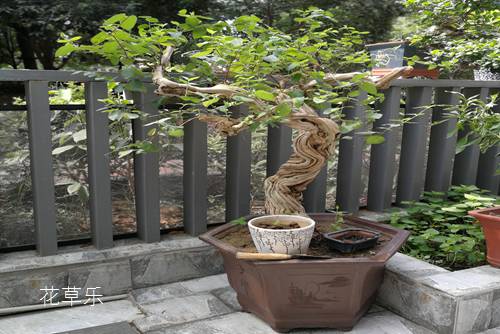
1. Watering
The principles of watering a Japanese honeysuckle tree-stump bonsai are the same as for watering potted flowers: more water is needed during the growing period and flowering period, and less water during the dormant period and flower bud differentiation period. On sunny days, dry days, and hot days, water more, and spray water on the tree stump, branches, and leaves more often; on cloudy days, rainy days, and cold days, water less or not at all, and after heavy rain and during the plum rain season, guard against water accumulating in the pot.
2. Fertilizing
Japanese honeysuckle bonsai is a flowering-type bonsai, so abundant flowers and bright colors are especially important. Fertilizer should follow the principle of light fertilizer applied frequently, with organic fertilizer cake liquid as the commonly used fertilizer. From January to March, to control the height of spring shoots, in principle no fertilizer is applied, but once buds have formed under the leaf axils, one topdressing should be applied. From April to September, apply fertilizer liquid once a month on a sunny evening. Fertilizing is not advisable in winter.
3. Light
During the growing period, it should be placed in a place with ample sunlight and good ventilation; during the flowering period, move it indoors for viewing, and after flowering, move it back outdoors to a place with ample sunlight. In winter, move it indoors or into a warm shed, keeping it above zero degrees for safe overwintering.
4. Pruning
Japanese honeysuckle has strong sprouting ability and is also a vine plant; to inhibit its climbing nature, it should be pruned in a timely manner, with shaping and pruning carried out before bud break in early spring. After bud break, when the buds grow to 10 cm, focus on pinching, to encourage more branching and promote flower bud differentiation, resulting in many flowers and lush leaves. After flowering, cut off the flowering branches and apply heavy topdressing; when new buds grow to 10 cm, again focus on pinching, to encourage more branches and bloom again. After flowering, the flowering branches should likewise be cut off and topdressing applied once.
5. Repotting
Japanese honeysuckle bonsai should be repotted once every 2 to 3 years, with early spring being the suitable time.
Since ancient times, Japanese honeysuckle has been widely famous for its medicinal value. Its main effects are clearing heat and detoxifying, and it mainly treats warm-disease fever, heat-toxin bloody dysentery, carbuncles, boils, and toxic sores, etc. Japanese honeysuckle preparations include “Yinqiao Jiedu Tablets”, “Yinhuang Tablets”, “Yinhuang Injection”, etc. Drinks include “Japanese honeysuckle dew” and Japanese honeysuckle tea, etc.