How do you shape and dwarf the fronds of a sago palm bonsai?
The sago palm, also known as the iron tree or phoenix-tail palm, belongs to the genus Cycas in the palm family and is an evergreen shrub. Its trunk is thick and hard as iron, single-stemmed and unbranched, with large pinnate compound fronds clustered at the top of a shortened stem, shaped like a phoenix tail; the leaflets are linear, stiff and needle-like, dark green and glossy. Because of its unique leaf shape and attractive plant form, it is a foliage plant much loved by people. It is suitable for garden flower beds, courtyards and lawns as a specimen, in groups, in masses or in rows, and can also be grown as a potted plant at home to adorn doorways, meeting rooms and offices. In China there are Cycas szechuanensis, Cycas guanheensis, Cycas panzhihuaensis and others. Shaping and dwarfing the fronds of the sago palm and preventing yellow leaves can further enhance its ornamental beauty. Below, Huacaole shares with you the methods for shaping and dwarfing the fronds when making a sago palm bonsai.
How should the fronds of a sago palm bonsai be shaped? How are the fronds dwarfed?
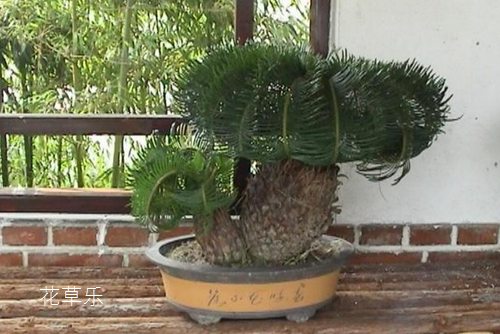
I. Frond shaping
This means bending the fronds inward (downward) to form a small, delicate and attractive "ram's horn style" sago palm bonsai. The best time for frond shaping is before the new pinnate compound fronds have fully unfurled. At this time the new fronds are relatively soft (not yet lignified) and easy to set in shape. For the shaping method, use fine copper wire, aluminum wire, or nylon line that is strong and not easy to break; fix one end at the tip of the young frond and bend the frond downward to the appropriate degree, then fix the other end of the line at the base of the leaf stalk, working frond by frond from bottom to top. After about 1 month, when all the new pinnate compound fronds have fully unfurled and lignified and the bend has set, gradually remove the lines. During the operation, be careful to bend moderately and keep the upper and lower parts consistent, and do not use too much force, so as to avoid damaging or breaking the fronds and spoiling the beauty of the tree's form.
II. Dwarfing treatment
If sago palm fronds grow naturally, they stand upright and reach more than 1 m in length, which spoils the beauty of the bonsai. To achieve the "ram's horn style" shape, dwarfing treatment must be combined with it.
1. Regulation of fertilizer and water. When the sago palm is potted and planted, apply plenty of organic fertilizer as the main base fertilizer; during the growing period, fertilize mainly with phosphorus and potassium fertilizer, control nitrogen fertilizer to promote steady growth. Water so that the potting soil is slightly moist; in particular, never water or fertilize in the evening, to prevent the fronds from growing leggy. During continuous rainy weather, move it indoors or cover it to keep off the rain.
2. Regulation with growth inhibitors. During the budding and growing period of new fronds, spray or drench the roots with 0.19% chlormequat or 0.07-0.19% paclobutrazol once a week, using it continuously 3 times to effectively inhibit the elongation growth of the fronds
3. Regulation of light. During the growth period of new fronds, keep sunlight ample and air circulating, and control a certain humidity, increase ultraviolet light, and prevent the fronds from growing leggy. To prevent the fronds from growing lopsidedly, turn the pot once every 3-5 days, and apply more potassium fertilizer, so that the fronds stay tough and do not deform, and grow evenly with a proper, upright and attractive shape.
III. Preventing yellow leaves
If the sago palm suffers from poor fertilizer and water management, poor potting soil structure, or unsuitable temperatures, it is prone to yellowing and withered leaves, which lowers its ornamental value. Measures to prevent the fronds from withering and yellowing:
(1) Repot at the right time, renew the growing medium, improve the soil structure, and prevent compaction and alkalization. Potted sago palms are generally repotted once every 2-3 years; as the plant grows and the soil ages, move it from a small pot to a larger one and replace old soil with new soil. Cut off dead and aged roots to stimulate new roots and promote healthy growth.
(2) Apply cake fertilizer and supplement with ferrous phosphate (black alum at 1% concentration) to adjust the pH, improve nutrient supply, and prevent yellow leaves caused by nutrient deficiency.
(3) After autumn, wrap the trunk with straw rope to prevent damage from low-temperature freezing.
(4) Water appropriately and avoid overwatering, so that water does not accumulate in the pot and cause root yellowing and leaf yellowing.
(5) Cut off aged fronds at the base to prevent the plant from becoming shaded, promote good light and ventilation, and increase chlorophyll synthesis to prevent chlorosis and yellowing.
(6) Prevent and control damage from scale insects and other pests and diseases to ensure normal growth and development.
The iron tree symbolizes unyielding integrity, firmness, longevity, wealth and honor, and good fortune; the iron tree implies strength, can supplement a home's qi and blood, and is a fairly ideal feng shui plant for bringing prosperity into the home, and can be placed on the balcony and in the living room. However, households with people born in the zodiac years of the dragon, dog or rabbit should not grow it.