How to grow winter jasmine? Detailed introduction to bonsai-making methods
The winter jasmine (Jasminum nudiflorum) has elegant and beautiful flower colors, an extraordinary temperament, and it fears no cold, is not picky about soil and climate, and has strong adaptability. Among all flowers, winter jasmine blooms the earliest; its tender green branches sway in the wind, and its yellow buds burst into bloom, like little golden stars dotting the branches, truly endearing. The several winter jasmine pictures below illustrate this. It is named winter jasmine because right after it blooms, spring arrives with all flowers blooming together. The characteristics of winter jasmine are shown in its well-developed root system, strong sprouting ability, tolerance to pruning, rapid growth, and soft branches; with golden flowers and green calyxes, it is brilliant and delightful, making it an excellent and beautiful material for making winter jasmine bonsai. The old stumps of winter jasmine have rugged, vigorous branches, and the base has exposed roots and claws, making them suitable for making bonsai styles such as curved-trunk style, lying-trunk style, cliff style, waterside style, wind-blown style, rock-attached style, and exposed-root style. How do you grow winter jasmine bonsai? Below, Huacaole shares with you the making of winter jasmine bonsai, the later care methods, and an appreciation of winter jasmine pictures.
How to grow winter jasmine bonsai: Introduction to making winter jasmine bonsai
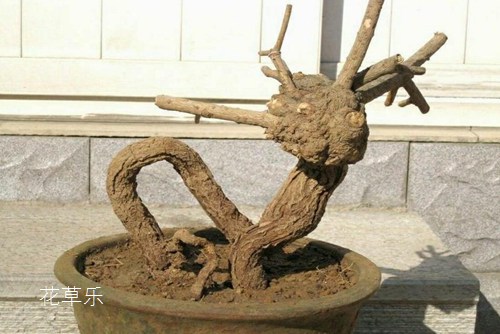
I. Making winter jasmine bonsai
1. To make a bonsai, besides having a good pot, the most important thing is having good tree stump material.
Choose plants that have grown for many years and whose roots are simple and vigorous, usually transplanting them in early spring or winter. If the stump material is a collected wild stump, then first of all the priority is protecting the roots, keeping the root system intact, removing damaged and dead roots, straightening out the roots, and first cultivating the rough material either in the ground or in a clay pot. Before planting, prune and shape the plant once, cutting off branches and root trunks not needed for the design, and shortening excessively long branches. Leave the main root that will replace the trunk, burying two-thirds of it in the potting soil and leaving one-third exposed above the soil surface as the trunk. After potting, press the soil firm and water thoroughly. Place it in a shaded place for about 10 days, then move it to a half-shaded, half-sunny place; care for it for one week, then place it in a sunny, well-ventilated, relatively moist place for care. After budding, water with dilute fertilizer solution once a month, pay attention to promptly removing excess buds, and when new branches grow to a certain thickness, prune and wire them into shape. In the second year after potting, wash the potting soil with water to let the trunk buried in the soil slowly become exposed above the soil and stones. Washing should be done in multiple sessions; with each washing, promptly cut away the fibrous roots beside the main trunk until the desired effect is achieved, turning the main root into the bonsai trunk. After two to three years of pruning, wiring, and cultivation, a bonsai with an old, varied appearance using roots in place of a trunk is presented before your eyes. Root exposure should be carried out gradually and must not be completed all at once, otherwise too many fine roots of the plant will be exposed, causing the stump to sprout back, and in severe cases even causing the plant to die. After the shape is fixed, every year excess branches and leaves must be thinned out to keep the tree shape unchanged.
2. Design the bonsai shape according to the material, then carry out targeted shaping and pruning.
The characteristics of winter jasmine are a well-developed root system, vigorous and simple-aged appearance, and a smooth trunk epidermis that looks slightly immature, so people often use the roots in place of the trunk, and the bonsai made this way has high ornamental value. The branches of winter jasmine droop naturally like willow branches, and the roots have distinctive features, making it suitable for processing into weeping-branch style and exposed-root style.
In making winter jasmine bonsai, the roots are usually coiled and exposed, while the trunk is made into lying-trunk style or curved-trunk style, with small branches drooping, giving it a unique charm. The shaping of its roots and trunk should vary according to the tree, and different forms such as single-trunk style, double-trunk style, slanting-trunk style, curved-trunk style, bridge style, and exposed-root style can be used.
The crown mostly adopts weeping-branch type, plum-stump type, and large-tree type.
2.1 Weeping-branch type Based on its branches drooping naturally in a waterfall shape, pruning is used to make the branches well-spaced and the flowering uniform; this form is the most common.
2.2 Plum-stump type Cut off the curved, drooping parts of the branches. If newly sprouted side branches also curve and droop, cut them off again. In this way, all branches can be made straight, and when flowering it resembles a plum blossom with sparse shadows slanting across.
2.3 Large-tree type Choose a plant with twisted, old, vigorous form and clearly distinguished trunk, main branches, and side branches, and wire and prune the branches into clusters. During the growing season it looks like a large tree, but in fact the tree's “leaves” are composed of dense fine branches. Because good material is hard to find, this form is the rarest.
3. Root cultivation
Besides using collected wild stumps with strange, old shapes, winter jasmine can also have its root system cultivated by yourself. The method is: when potting winter jasmine, you can put more gravel and plant ash in the pot; these will obstruct the winter jasmine root system during growth, forming varied root shapes. The plant ash in the soil contains potassium fertilizer, which also speeds up root growth. In this way, a strong and varied root system is formed, laying the foundation for future bonsai using roots in place of a trunk. When winter jasmine has grown for four to five years and the main root is as thick as a thumb, it can be potted and shaped.
II. Care of winter jasmine bonsai
1. Pruning Winter jasmine branches have strong sprouting ability and tolerate pruning. Generally after flowering, a shortening cut should be carried out once. During the dormant period, leggy branches and various branches affecting the tree shape can also be cut off. At the turn of spring and summer, during the vigorous growth period, appropriate pinching of the growing tips can be done to promote flower bud formation and keep the tree shape attractive. During the growing season, pinch frequently to promote branch thickening and increase branching, which is beneficial for shaping. Branches affecting the tree shape should be cut off promptly to keep the bonsai attractive. Other management is basically the same as for potted winter jasmine.
2. Shaping The winter jasmine bonsai can be shaped for the first time before flowering. Prune in late January after flower buds appear. At this time, shaping focuses mainly on the overall form of the bonsai, mainly to make the main body or overall beauty of the bonsai stand out neatly when flowering, so enough flower buds for next year's blooming should be kept to help show beauty after flowering. The second shaping is after flowering, generally following the last level of branches of the tree shape, leaving 1~2 buds to ensure that after sprouting it will not greatly affect the overall tree shape. During the growing season, unwanted sprouting branches can also be cut off at any time.
3. Pinching Winter jasmine has strong sprouting ability, so during the growing period it should be pinched frequently. Generally, at the first sprouting in spring, when it grows to 3~5 pairs of leaves, leave 1~2 pairs of leaves and pinch; after growing for a period, leave 2~3 pairs of leaves and pinch; for those growing well, pinch once more in the same way, and then they can generally be allowed to grow freely. Entering July, pinching is needed again to promote autumn flower bud differentiation, but note that not all should be pinched. For positions where more flowers are needed for viewing, pinch earlier, and pinch the rest last, to prevent sprouting again after pinching and consuming nutrients; pinching in batches can also balance growth.
4. Repotting Winter jasmine is generally repotted once every two years, preferably in spring or after leaf fall in autumn. When repotting, root pruning can be combined with it, cutting off dead roots and excessively long roots to benefit fibrous root development. Soybean cake crumbs can also be placed at the bottom of the pot as base fertilizer. For winter jasmine that needs root exposure, the roots can be lifted appropriately when planting, and soil mounded around the roots; later, with watering and rain, the roots will naturally become exposed.