How to grow a winter jasmine bonsai? Detailed explanation of care and management methods
Winter jasmine (Jasminum nudiflorum) is dignified and elegant, with lightly fragrant golden-yellow flowers that have a red tinge on the outer edge. Its blooming period is from February to April, and it is the earliest among all flowers to bloom, after which it welcomes the blooming of the hundred flowers, greeting the arrival of spring. Flower-loving friends who enjoy growing plants all like to keep a winter jasmine bonsai at home to welcome the arrival of spring during the days of ringing out the old and ushering in the new. Friends who do not grow winter jasmine can go to the flower market or search for winter jasmine pictures to admire it and experience the first touch of spring color that winter jasmine brings. How do you grow winter jasmine? Below, Huacaole shares with you the knowledge of caring for and managing a winter jasmine bonsai.
How do you grow winter jasmine? Care and management of a winter jasmine bonsai
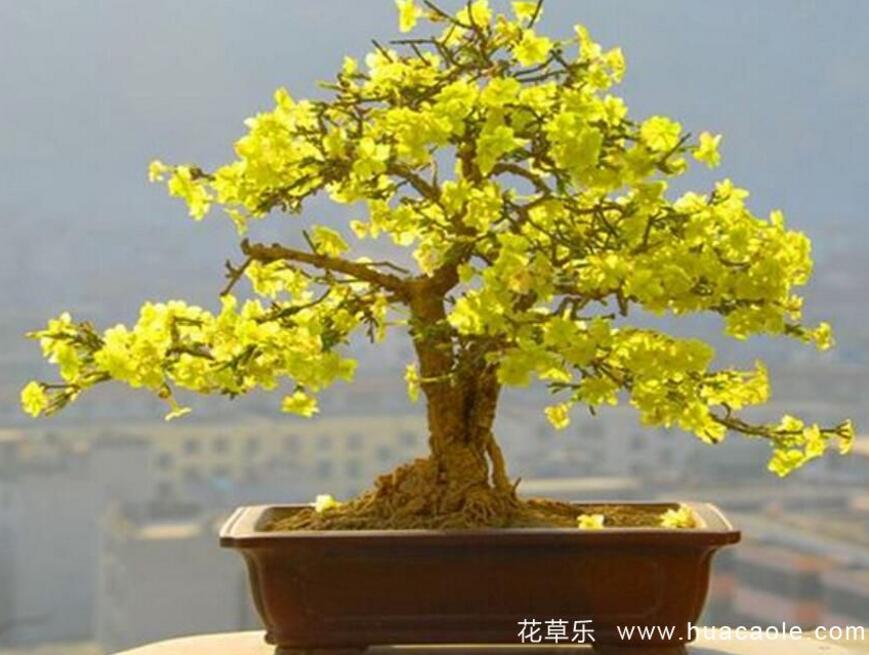
Winter jasmine has strong sprouting ability and tolerates pruning well; the base of the tree easily sends up tillers, and the trunk does not thicken easily. Therefore, it is only suitable for making miniature or small bonsai. You can choose an old tree stump that has grown for many years, with coiled and exposed roots, an ancient-looking trunk, and naturally curving branches, to make a bonsai.
1. Pruning. Flower buds begin to differentiate in early October, so pinch the tips in good time to keep the tree form graceful. At this time, stop pruning. In early November, carry out 1 pruning before flowering; also promptly prune vigorous water sprouts, overly long branches, parallel branches, crossing branches, and messy branches, and thin out branches that are too densely packed, so that nutrients are concentrated, the flower buds are plump, and early spring brings blooms all over the branches. After flowering, shaping and pruning should be done according to the needs of the design, with moderate wiring.
2. Soil. For winter jasmine, sandy loam with good drainage is suitable for the potting soil, and applying enough base fertilizer is sufficient. When repotting and changing the soil, replace it with loose, fertile new soil. When repotting, remove the soil from the roots, coil and wire the roots, and use pruning as the main method and wiring as a supplement for shaping, often forming the raised-root style or the cascade style. Raise the roots so that the tree gradually develops the form of hanging claws with exposed roots.
3. Pot selection. The choice of pot should match the styled tree body, with an appropriate size. Generally, pair it with a round, drum-shaped, square, or polygonal shallow pot; for the cascade style, plant it in a tall cylinder or a high-footed pot.
4. Fertilizing. During the growing season, apply a nitrogen-phosphorus-potassium compound fertilizer or decomposed organic fertilizer. When flower buds are forming, strengthen water and fertilizer management, that is, apply 1 liquid fertilizer rich in phosphorus and potassium every 10 days to promote bright flowers and green leaves, which is good for viewing. However, when flower buds are forming, apply less nitrogen fertilizer to avoid leggy branches, excessive side shoots, and overly vigorous growth, which can lead to few or no flowers. During the flowering period, apply more diluted fertilizer accordingly to prolong the flowering period.
5. Watering. In summer, water 1 time in the morning and evening; in spring and autumn, water 1 time a day; in winter, water less and just keep the potting soil moist. Normally, place the bonsai in a sunny spot on a balcony, and when it blooms, you can move it indoors to admire.
6. Pest control. The main pests of winter jasmine are the large bagworm moth and aphids. Control method for the large bagworm moth: check the potted plant often, promptly remove and destroy any larval cases found; if parasitic bees are found nearby, protect them; spray and kill with a 1000-fold dilution of 50% phoxim emulsifiable concentrate. Aphid control: when there are few aphids, you can directly scrape them off with a bamboo strip. When aphids break out, spray with aphid-mite clear emulsifiable concentrate or aphid-whitefly net to kill them. Note that different pesticides should be chosen each year for control, because aphids have strong resistance to pesticides, and long-term use of a single pesticide causes aphids to develop antibodies.