How to grow a honeysuckle bonsai? A detailed guide to care and management methods
Honeysuckle loves light, but it also tolerates shade and cold, and tolerates drought and moisture. It is not demanding about soil and can grow in both acidic and alkaline soil, but it grows best in moist, fertile, loose, deep sandy loam potting soil. Its root system is well developed and its sprouting ability is strong. As long as you manage water and fertilizer well, provide plenty of light, and prune and shape it properly, you can cultivate a beautiful tree form with a light posture, an ancient-looking old trunk, brilliant flowers on spreading branches, and lush leaves on a vigorous root system. Honeysuckle has slender stems, and its tree shape is generally difficult to control, making it prone to long internodes and few flowers. Therefore, to create a spectacular honeysuckle bonsai with many flowers, dwarfing measures must be taken. It is also called “gold and silver vine” and “mandarin duck vine”. How to grow a honeysuckle bonsai? What should be noted in honeysuckle planting and management? Please share with Huacaole.
How to grow honeysuckle? Care and management of honeysuckle bonsai
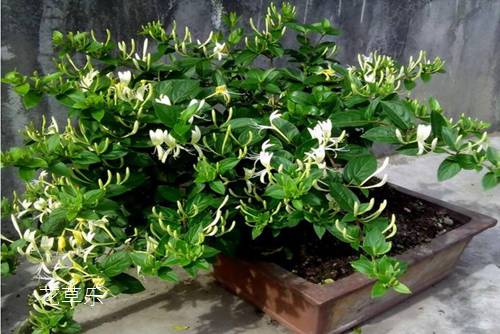
I. Potting a honeysuckle bonsai
Select an old honeysuckle specimen with a thick base trunk, an ancient-looking form, and beautiful posture. Use the method of trunk cutting and branch storage, cut off the main trunk, and prune the roots appropriately, then it can be potted directly. There are no strict requirements for potting soil; soil that is not prone to compaction and is loose and fertile is sufficient.
Choose what kind of pot to use based on the honeysuckle's form and the decided honeysuckle styling form. For cascade style and trailing-branch style, use a tall pot or a medium-deep pot or a tall cylinder; for curved-trunk style, use a rectangular or round medium-deep pot.
For shaping, the natural style is mostly used, with the side branches on the main trunk in a drooping state, and the branches are mostly formed by pruning and pinching.
II. Dwarfing, shaping, and pruning of honeysuckle
Dwarfing, shaping, and pruning of honeysuckle begin from the time it is potted and planted, cultivating thick trunks and short branches. During the growing season, remove vigorously growing buds, pinch the tips of strong branches early, and when pruning, cut the long and keep the short. Through shaping and pruning, promote the transition from a twining vine type to a short-branched, dwarf-trunk shrub bonsai with evenly dense branches and obvious layering. Long-day treatment: Honeysuckle is a light-loving long-day plant. If the environment has poor ventilation and light transmission, and is dark and damp, the stems and vines will grow leggy, the branches will be thin and weak, the leaves will easily turn yellow and fall off, and there will be few flowers. Therefore, a honeysuckle bonsai should be placed in a place with plenty of sunlight, preferably with direct sunlight all day, to promote thick and short branches, lush leaves and abundant flowers, and prolong the flowering period.
Because its branches and trunk are relatively large, although the trunk form is vigorous and ancient-looking, the branches and trunk are extremely brittle and easily broken or rotted. For larger branches and trunks, do not easily change their shape and angle, and even more, do not twist the shape and angle of the main trunk and main branches as you would when making other miscellaneous wood bonsai.
Growth inhibitor chemicals can be used to control shoots. When honeysuckle branches have sprouted about 5 cm, spray or drench with 700 to 1000 ppm paclobutrazol, or 2000 to 4000 ppm B9, or 1000 to 2000 ppm chlormequat, several times in succession, to inhibit vigorous stem and vine growth and dwarf the tree shape.
III. Fertilization and pest control for honeysuckle
Usually keep the potting soil moist, apply a thin fertilizer once a month, and do not fertilize in winter. When spring shoots sprout, do not fertilize, to avoid rapid branch growth. When flower buds appear, apply a phosphorus-potassium fertilizer once every 10 days to make the flowers larger and more brilliantly colored.
During the growth of honeysuckle, if the branches and leaves are too dense, prune promptly to maintain air permeability; otherwise yellow leaves will appear and pests will occur.
The main pest of honeysuckle is aphids, which can be killed by spraying with a 800-fold dilution of 40% dimethoate.