How do you grow crape myrtle so it blooms for a hundred days? The rotation pruning method is key
The common name for crape myrtle (Lagerstroemia indica) is "hundred-day red." It has a graceful tree form and brilliant flower colors, and its flowering period can exceed a hundred days. To make a potted crape myrtle bloom abundantly, vividly, and repeatedly, besides choosing dwarf varieties, what other care and management measures can increase the number of bloom cycles, extend the flowering time, and improve the flower-viewing effect? Below, the Huacaole editor shares with you that using rotation pruning techniques on crape myrtle bonsai can make the crape myrtle bonsai bloom for a hundred days.
How do you grow crape myrtle so it blooms for a hundred days? Using the rotation pruning method can achieve this
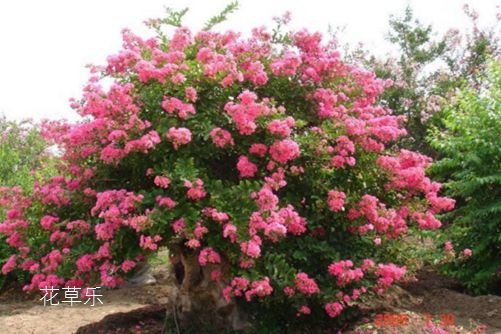
Before winter arrives, crape myrtle bonsai should undergo one heavy pruning. In this way, after budding in April of the following year, growth will be faster. By early May, when new shoots grow to about 15cm, the new shoots also need to be pruned and pinched, keeping the new branches at about 3cm. This encourages the growth of forked branches, preparing branches for later rotation flowering. At the same time, prune away parallel branches, overlapping branches, inner-canopy branches, and leggy branches. By early June, prune away one of the two forked branches. In late June, the crape myrtle blooms for the first time. After flowering, promptly cut off the spent flowers to promote axillary buds to grow new branches. This cyclical pruning will certainly promote multiple flower bud differentiations and blooms within one year, and the flowering can last more than a hundred days.
To make crape myrtle bloom for a hundred days with vivid flower colors, you must master the following three aspects of crape myrtle care and management techniques:
1. Find the right timing and prune promptly
After the crape myrtle flowers, the spent flowers must be pruned off promptly; do not wait until the flowers have completely withered before pruning.
2. Sufficient and timely fertilizer and water supply
When repotting and changing the soil in spring, apply sufficient base fertilizer. Use decomposed cake meal powder or decomposed chicken and duck manure placed at the bottom or along the edge of the pot as base fertilizer. During the growing season, apply organic liquid fertilizer once every half month. When entering the flower bud differentiation period, in July to September or during the peak flowering period, the nutrients in the pot become fewer and fewer, so the fertilizer concentration should be increased. To make the flowers bloom more abundantly and vividly, foliar feeding should be used, spraying the leaves with 0.2% potassium dihydrogen phosphate every 10-15 days.
Crape myrtle likes water. In summer and autumn when it blooms, the sunshine is long, the light is strong, and the temperature is high, so water must be sufficient. Water once in the morning and once in the evening every day; otherwise the branches and flower buds will wilt, and during prolonged high-temperature periods the flower buds will find it very hard to open.
3. Prevent pests and diseases
Crape myrtle has few diseases and not many pests. Pest and disease control should focus on prevention. Place the bonsai in an environment with sufficient light and good ventilation for care, and provide sufficient fertilizer and water to improve disease resistance and reduce the occurrence of pests and diseases. The main pests harming crape myrtle are aphids and scale insects. During the growing season, spray carbendazim once every half month for prevention.
Summary
The flowering period of crape myrtle is from June to September, and the fruiting period is from October to November. The older the trunk, the smoother it becomes; when touched by hand, the whole plant trembles slightly. Crape myrtle is drought-tolerant and afraid of waterlogging, likes warmth and moisture, likes light, and likes fertilizer. It has strong resistance to sulfur dioxide, hydrogen fluoride, and nitrogen, and can absorb harmful gases. Neutral soil or slightly acidic soil is better. Growing a crape myrtle bonsai lets children on summer vacation tickle the crape myrtle tree.