Why is cuttings propagation called plant cloning?
One playfully sticks out its tongue in greeting to the camera, while the other sits obediently with its round mouth open. These are two extraordinary monkeys, "Zhongzhong" and "Huahua." After 5 years of unremitting efforts by Chinese scientists, the two cloned monkeys "Zhongzhong" and "Huahua" were born in China, in good developmental condition. This is the world's first somatic cell cloned monkey. Today, the achievement was published in the top biology academic journal Cell.
Cloning can be understood as copying, duplication. It refers to genetically uniform groups of organisms produced through asexual reproduction. It refers to asexually propagated materials at different levels such as individuals, cells and genes.
In the asexual propagation of plants, groups of individuals grown from the same individual through asexual reproduction, such as plant sprouts and cuttings, are all regarded as clones. Tissue culture methods can be used to make plant cell cultures develop into complete individuals (callus), and the groups of individuals with identical genotypes obtained by this method are also called clones.
Today, we teach you how to do proper cuttings propagation to clone plants.
Selection of cutting material
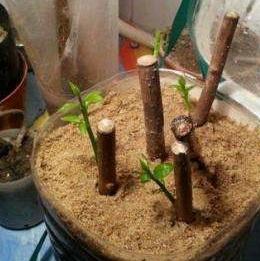
Generally speaking, for cuttings, you should choose robust, well-developed shoots with solid tissue. Among branches from the same mother plant, one-year-old branches are better than perennial branches, lateral branches are better than terminal branches, and sun-facing branches are better than shaded branches. Some plants are just the opposite, such as rose. Terminal branches root more easily.
Selection of cutting medium
The cutting medium has a great influence on the rooting of cuttings. According to different cutting media, it can be divided into soil cutting (medium cutting), water cutting and mist cutting (air cutting).
Soil cutting, also called medium cutting, is the most widely used cutting method. Its cutting media mainly include perlite, peat, vermiculite, sand and other materials, and some horticultural companies use furnace slag. The ratio of perlite, peat and yellow sand is generally 1:1:1. Peat can retain moisture, and at the same time, peat contains a large amount of humic acid, which can promote plant rooting. It is best to choose semi-humified, relatively coarse peat together with coarse sand and large-particle perlite; this is good for aeration and drainage, and also good for root formation.
Water cutting uses water as the cutting medium, inserting the base of the cutting about 1-2cm into the water. The water must be kept clean and needs to be changed frequently. The adventitious roots produced by water cutting are brittle; when they grow to 2-3 cm, they can be transplanted or potted. Plants commonly used for water cutting include gardenia, mint and so on.
Mist cutting (air cutting) is also called inorganic medium cutting. It is suitable for plants of the bark-rooting type. The method is to fix lignified or semi-lignified branches on a rack and mist the cuttings at regular intervals.
Cutting methods
1. Stem cutting
Use plant branches or stem segments as cutting material. According to the degree of lignification of the cutting material, it can be divided into softwood cutting and hardwood cutting. Hardwood cutting is generally carried out in spring before the trees bud; the shoots are collected in autumn, and after cutting they are stored at low temperature with moisture retention, then cut in the following spring. You can choose thick, plump-budded branches and cut them into 15-20 cm long stem segments. Some with a small section of old wood or side branches with a small section of main branch shaped like a horse's hoof, that is, heel cuttings, root more easily. After the cuttings are cut, lightly score several wounds along the direction of the branch at the base of the cutting with pruning shears to increase the area of callus tissue and facilitate rooting. In regions with relatively warm winter, such as Jiangsu, Zhejiang and Anhui provinces, cuttings can also be taken in autumn and winter, covered with a shed for warmth, and they can root in early spring. Softwood cutting is generally carried out when new shoots are semi-lignified. It roots faster than hardwood cutting and is easier to survive (most herbaceous flowers use softwood cutting). The cutting length is 10-15cm; single-bud cutting, also called leaf-bud cutting, can also be used, that is, one leaf and one bud with a length of 2-5cm, and herbaceous plants can be slightly shorter. Compared with hardwood cutting, softwood cutting is more difficult to manage.
2. Leaf cutting
Leaf cutting uses the leaves of plants whose leaf veins or petioles easily form adventitious roots for cuttings. Such plants include begonias, sedums, sansevierias, lilies (scale cutting), gloxinia and African violets and other plants with thick leaves. When cutting, place the whole leaf or leaf sections straight, obliquely or flat on the medium; when placed flat, also cover the leaf base with a small amount of medium. As with softwood cutting, strengthen temperature and humidity management, and roots and shoots will quickly emerge from the leaf veins or petioles to form new plants.
3. Root cutting
Plants mainly suitable for root cutting include yellowhorn, kiwifruit, poplars, fig, North American trumpet creeper, tree of heaven and other plants. The method is to cut roots 0.5-1cm thick into 6-15cm lengths. When cutting the root sections, place their top ends in the same direction to prevent upside-down insertion during cutting. Root cutting sometimes loses flower and leaf traits. Generally, root sections are cut in late autumn and cut in the following spring.
Management after cutting
The main things are humidity, light and temperature control. Provide appropriate shading according to the shade tolerance of the plants, and carry out cutting in zones and shading in zones according to the plants' response to light. Generally speaking, hardwood cutting is carried out in spring when buds have not yet sprouted and the temperature is relatively mild, which is good for rooting; except in a few high-temperature regions, the temperature during softwood cutting can be adjusted by choosing the cutting period, or by using mist cooling or water-curtain fan cooling. High temperature and high humidity easily cause plant disease. When the temperature is high and humidity is too great, cuttings are prone to disease and rot; when humidity is too low, cuttings will dry out and die. Therefore, when adjusting misting, first ensure the leaves are moist and not wilting, and at the same time pay special attention to checking the water content of the medium. The simplest method is to grab a handful of medium, squeeze it tightly; if no water drips from between the fingers, and after releasing the hand the medium does not fall apart or only has slight cracks, it indicates the medium's water content is suitable; if water drips from between the fingers when squeezed tightly, the water content is too high and misting should be controlled; if the medium falls apart, the water content is too low and misting should be used to replenish water. Different plants have different adaptability to humidity. When cutting, cuttings should be taken in zones according to the plants' humidity requirements.