How to grow potted Cycas debaoensis? Care management and answers to common questions
Cycas debaoensis Y.C.Zhong et C.J.Chen is a species endemic to China, a national* first-class protected species, with extremely* high research and ornamental value. It was discovered in 1996 by researcher Zhong Yecong of the Guangxi Forestry Survey and Design Institute in Debao County, Guangxi. Cycads are the oldest extant seed plants; they were once distributed across the globe during the Mesozoic and are precious "living fossils." When discovered in 1997, they caused a sensation because of their peculiar leaves and extremely high horticultural ornamental value.
China has more than 20 species of cycads. The ordinary species often seen on the streets has the scientific name Cycas taiwaniana. Among Chinese cycads, the rarest are none other than Cycas debaoensis and Cycas multipinnata, these 2 species with forked leaves. They are very beautiful and are the ancestors of modern sago palms.
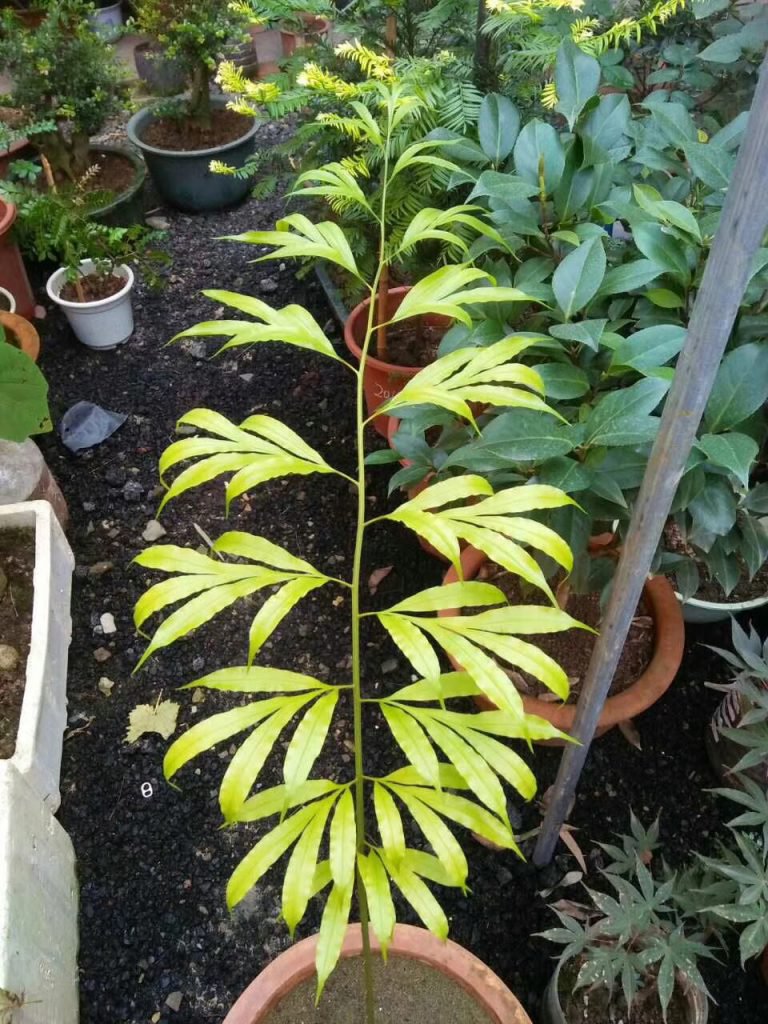
Sago palms can be said to be among the easiest plants to keep alive. Leave it alone for a month and it will not dry out and die just because you had no time to water it. Rare varieties have habits completely the same as ordinary sago palms, and they are suitable for planting all over the country.
Soil: Sago palms like sandy soil. If you do not have any, ordinary soil mixed with half fine sand also works, as long as it is airy, does not hold water, and does not become compacted.
The cycad caudex itself stores a large amount of water, so everyone need not worry that the cycad will dry out and die during transport. For example, for one with a caudex 5 cm thick, even if the roots are broken off and it is not planted for half a month, there is no problem.
Rare cycad varieties have habits similar to ordinary sago palms, with only one point: cycads with thick, strong roots, such as Cycas debaoensis and Cycas multipinnata, have relatively large wound areas after the roots are broken. For winter transplanting, it is best to air-dry them in a ventilated, shady place for 1–2 weeks until the roots are dry, which can improve the survival rate. If the roots have not been dried, you can also trim off the excess roots yourself. Sago palms are caudex fleshy-root plants, not woody fibrous-root plants. The old roots retained during transplanting do not serve much purpose; new roots are sent out anew.
Here I have compiled some problems often encountered in cycad cultivation, and will keep updating them:
Cycads generally send out new leaves 2 times a year, once in spring and once in autumn. As they grow, they have more and more leaves, and you can prune the leaves yourself according to your own preferences.
Cycads are very cold-tolerant and can be planted all over the country. A flower enthusiast in Northeast China did an experiment: in winter when it was 20 degrees below 0, he put the cycad outdoors, kept the soil dry, did not water, and it overwintered safely.
Watering question: when the growing environment temperature is above 0 degrees, water thoroughly only after the soil is almost completely dry; below 0 degrees, cut off water completely.
Cycads are evergreen plants and do not shed leaves in winter. Generally, newly emerged leaves will naturally turn yellow after 3-4 years.
Sago palms can be grown both indoors and outdoors.
You can plant one or several together, and different varieties can also be planted together with no effect on growth at all.
After transplanting, they can immediately be put in the sun without shading, because cycads are caudex fleshy-root plants, not woody fibrous-root plants, and the caudex itself stores a great deal of water.
In the first year after transplanting, bury the caudex 2/3 into the soil as much as possible [seedlings should be buried completely]. The principle is the deeper the better, and leaves emerge faster, because the caudex also assists in absorbing water. But many flower enthusiasts like to view the caudex, so you can use the method of shallow planting with deep mounding: plant it shallower and mound the soil deeper, then after the sago palm has fully grown well, wash the soil away with water to expose the roots.
Pot question: generally the diameter of the pot only needs to be 2 times larger than the diameter of the caudex to meet the growth needs. Of course, the bigger the pot the better. Pot depth: as long as it is not lower than the height of the caudex, it is fine.
Fertilization question: newly transplanted cycads are suited to slightly poorer soil and must not be fertilized. Too much fertilizer easily burns the roots and also easily attracts insects. The nutrients in the soil are enough for growth. After four or five years, you can switch to a larger pot. If you do not change the pot, you can change some of the soil, and you can also apply some ferrous sulfate. It is sold in flower markets, very cheap, just a few yuan.
How to judge whether a sago palm is dead: if the sago palm is dead, the caudex will have rotted into something very soft, or into an empty shell. It falls apart with a pinch of the hand. If the caudex is hard, it is alive.
The leaf height of a sago palm can all be controlled by yourself. For example, for leaves that normally grow to 1 m tall, when new leaves are emerging, do not water, keep the soil dry, and give more sun, and they will only grow to 40–50 cm tall. If you water more and give less sun, they may reach 2 m tall.
In the first year after transplanting, spray pesticide 2 times in spring and autumn. Thiophanate-methyl and carbendazim, these 2, are fungicides; phoxim is an insecticide. The 3 can be mixed together and used, by spraying or drenching. For specific methods, you can consult the sales staff at your local pesticide store.
Do not put iron nails in the pot. Some flower enthusiasts have heard that putting iron nails in the soil can make sago palms grow better. This is wrong. First, sago palms only absorb divalent iron, that is, ferrous iron. You can buy ferrous sulfate at flower markets, a special sago palm fertilizer. The most, most important point is: when changing the soil later, if you accidentally get pricked by the iron nails in the soil, then it will be trouble; in serious cases it can cause tetanus.
Do not use plain sand to cover the roots. It is not suitable for rare varieties.
Yellow leaves on sago palms: there are many reasons for yellow leaves on sago palms, such as too much water causing root rot, old leaves naturally turning yellow, mold infection, sunburn, insect chewing, poor ventilation causing leaves to become stuffy and yellow, cold damage, iron deficiency, yellow spot disease, and so on. They must be ruled out one by one and treated according to the cause. But in general, as long as the caudex is hard and not rotted, you only need to cut off the old leaves. If the new leaves that emerge are still yellowing, then treatment is needed.
Cycad blue butterfly
Cycad blue butterfly, Chilades pandava, belongs to Lepidoptera, Lycaenidae, genus Chilades, and is the main pest of cycads. As cycad cultivation has gradually increased, the occurrence of the cycad blue butterfly has also worsened year by year. In Beijing, individual flower nurseries once had the phenomenon of all the new leaves of that year being eaten completely, causing serious economic losses.
Distribution and harm: This insect is mostly distributed in Nanjing, Guangdong, Fujian and other places in China. Shortly after the larvae hatch, they hide in tender buds and leaves and cause damage. Along with the purchase of southern flowers in the north, it is gradually becoming established in the north.
Morphological characteristics
Adult body length 12 to 13 mm, wingspan 26 to 35 mm, body covered with gray-black or gray-brown scales, antennae as long as 2/3 of the leading edge of the forewing, club-shaped, compound eyes brown-black, frons and labial palps white, ventral surface white, a black band protruding at the tornus of the hindwing. Females are slightly larger, wings gray-brown, but the posterior margin of the hindwing is gray-white; the female forewing is red at 1/4 from the base, the rest gray-black-brown, the hindwing base and leading edge both black and brown, the rest red, the dorsal surface of the abdomen red, the rest white to gray-white. Larva body length 0.1 to 1.1 cm, head small and shiny purple-black, body stout and slightly flattened, body dorsum with fine hairs, with a longitudinal stripe in the center darker than the body color, and on each side also a ring-like longitudinal stripe darker than the body color. Body color is divided into two types, pale yellow and jujube red. Smaller larvae are paler in color, even white and shiny, with slender bodies and obvious heads; larger ones are darker in color, stout and flattened, with the head often retracted, and the upper cut surfaces of the head and tail forming about a 45 degree slant with the longitudinal axis of the body.
3 Life habits
This insect can occur from May to November. It often gathers in the crown center at the top of the sago palm and in nearby bud scales, or is scattered attached to the front or back of relatively tender leaves. It mainly gnaws and eats the young tender leaves, petioles and leaflets that have already grown or have not yet grown. On the larger new leaves that have already grown and on older leaves, it mainly gnaws and eats the leaf backs. The eaten leaf parts often leave only the upper epidermis. Affected plants often show no new leaves on the whole plant, tender leaves wilting and drying up and dying, or leaflets partially or completely shriveling and curling upward; in severe cases only the main leaf veins, or even part of them, remain. When the insect population is relatively large, within three to five days the whole plant may suddenly show phenomena such as young leaflets drying up and curling upward. This insect is very stubborn and relatively hidden before causing damage. Although one application of pesticide can kill a large number of larvae, because it cannot kill the eggs, it often breaks out in large numbers again after a week.
4 Control methods
At the end of April, use any one of 21% fenpropathrin emulsion 1000 to 1500 times dilution, 20% fenvalerate emulsion 800 to 1000 times dilution, or 40% trichlorfon-dimethoate mixture emulsion 1000 to 1500 times dilution to spray the leaves and crown center, then once every 20 days until mid-November.
When pest damage occurs, you can use the above agents sprayed at the lower dilution multiples, once every 10 days for a total of three times, and afterward just do prevention well.
In addition, for home-grown cycads you can also use cigarette butt soak liquid (30 to 50 cigarette butts) per kg of water, or Sophora flavescens decoction (30 g to 50 g added to 1.5 kg of water and boiled) for drenching control.