Appreciation Highlights and Care Management Methods of Cycas sexseminifera
Cycas sexseminifera is a rare cycad species endemic to China, also known as mountain pineapple, few-spined cycad, immortal rice, rusty-haired cycad, etc. It is distributed in low-altitude limestone mountainous areas in Fusui County, Longzhou County, Pingxiang City, Ningming County, Wuming District of Nanning City, Tianyang County, Jiangzhou District of Chongzuo City and other places in Guangxi, often growing in limestone crevices, forming clumped or small patchy distribution.
Cycas sexseminifera is an evergreen palm-like woody plant of the family Cycadaceae and the genus Cycas. Cycads are what people commonly call iron trees, and are one of the oldest tree species in the world. As of now, more than 17 species of cycads native to China have been discovered (the 8 species mentioned in encyclopedias is outdated information), and all of them are national first-class protected plants, mostly distributed in provinces such as South China and Southwest China.
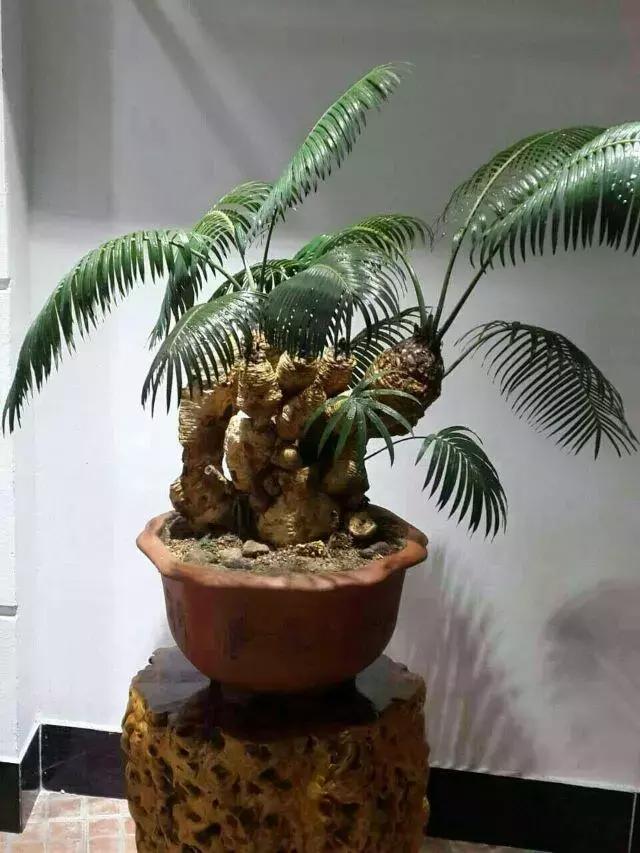
The ecological characteristics of Cycas sexseminifera (scientific name Cycas sexseminifera, synonym Cycas miquelii) are as follows: the trunk is usually not obvious, sometimes swollen into a gourd shape, or spindle-shaped, or disc-shaped, or cylindrical, up to 50 cm tall, up to 25 cm in diameter, with a swollen spherical base, gray to grayish brown, leaf scars persistent, often falling off later to become smooth, without tomentum at the stem apex; scale leaves lanceolate, 4.5-8.5 cm long, 1.5-2.5 cm wide, dark brown, densely covered with short tomentum on the back; fronds (30) 50-170 cm long, petioles 5-63 cm long, with 3-35 pairs of short spines on both sides of the upper part, spines 0.1-0.4 cm long, spaced 0.6-2.2 cm apart, leaflets 40-81 pairs, horizontally spreading, leathery, linear leaflets, middle leaflets 7.5-28 (40) cm long, 0.5-1.2 cm wide, apex acuminate, with a short mucro, base asymmetrical, decurrent on the lower side, midrib flat or slightly raised above, distinctly raised below, upper surface dark green, glossy, lower surface pale green, leaf margins flat or sometimes revolute, rachis, petiole and leaf underside densely covered with rusty-colored soft hairs. Seeds relatively small, 1.7-2.7 cm long, yellow to orange-red when mature.
Cycas sexseminifera is an outstanding member of the genus Cycas, with ornamental value unmatched by other cycad plants, and is especially more suitable for bonsai cultivation. Cycas sexseminifera is generally not tall, growing slowly, rarely exceeding 50 cm. The stem of Cycas sexseminifera is hard as iron, not speckled like fish scales as in other cycads, but smooth and delicate, with shapes some like a gourd, some like a spindle, or cylindrical, the latter being flat and round, with varied shapes, either sturdy and cute, or rugged and simple, very much worth appreciating; the leaves of Cycas sexseminifera are short, small and emerald green, lanceolate like feathers, oily green and glossy, evergreen in all four seasons, verdant and spirited; if Cycas sexseminifera is planted in a plain-colored purple clay pot, paired with ornamental stones and green moss, the ornamental effect is excellent, making it an excellent bonsai variety for homes and offices.
After years of careful cultivation by some research institutions, the cultivation and propagation techniques of Cycas sexseminifera have advanced by leaps and bounds. Occasionally there are Cycas sexseminifera bonsai sold on the market, and fellow enthusiasts have the opportunity to purchase them. Below, Huamu Jun will introduce the care management of Cycas sexseminifera to everyone.
Regarding the acidity and alkalinity of the soil in the growing environment of Cycas sexseminifera, quite a few research institutes have conducted comprehensive studies, but the data is not commonly seen, and many people are not very clear about the true growing environment of Cycas sexseminifera in its native habitat. Cycas sexseminifera is produced in several areas of Guangxi, belonging to a subtropical warm and dry climate, with limestone soil. On-site measurement of soil pH is around 7.5, so it should belong to a medium slightly alkaline soil, and is rich in trace elements, such as relatively high content of iron, magnesium, zinc, manganese and other elements.
Most soils in the south are acidic, and most flowers are suitable for growing in weakly acidic soil, so people take this for granted. Many sources, when introducing the environment of Cycas sexseminifera, say it is weakly acidic, which should be a mistake (or a misunderstanding). However, from the cultivation experience of some botanical research institutes that have introduced Cycas sexseminifera for more than 20 years, Cycas sexseminifera adapts fairly well in weakly acidic soil and can grow completely normally. However, when cultivating Cycas sexseminifera, attention must be paid to trace elements. If trace elements cannot be guaranteed, acidic soil will also cause yellowing of leaves and even death of Cycas sexseminifera.
[Soil] The soil for planting Cycas sexseminifera is preferably fertile, weakly acidic sandy loam. If soil from the native habitat combined with humus soil is used, that is of course the best. If not available, leaf mold soil and sand can be mixed in a 3:1 ratio, adding a small amount of 0.5% ferrous sulfate or plant ash mixed in, or a few pieces of horse hoof pieces as base fertilizer. Since cycads are iron-loving plants, a small amount of iron filings or rusty iron nails can be mixed into the prepared potting soil to supplement iron, making the leaves firm and emerald green.
[Flower Pot] Breathable clay pots and purple clay pots are preferable, especially plain-colored purple clay pots, which paired with Cycas sexseminifera can both allow air and water permeability and set off the elegance of Cycas sexseminifera, very beautiful. Absolutely avoid porcelain pots. If you see cycads decorated in porcelain pots at the flower market and buy them to take home, you must repot them, remember this.
[Temperature and Humidity] Cycas sexseminifera likes moisture and tolerates drought, and dislikes waterlogging. The suitable temperature is 15-20°C. Cycas sexseminifera is relatively cold-tolerant, but it is best not to go below 5°C. Humidity is best at 50%-70%. You can frequently spray the leaves with water to maintain humidity.
[Light] Cycas sexseminifera is a sun-loving plant, suitable for growing in direct sunlight or bright diffused light. It can receive full light in spring, autumn and winter, and is best given half shade in summer. Cycas sexseminifera should not be placed indoors in living rooms for too long; lacking light, the leaves become thin and long and the leaves fade in color.
[Watering] Cycas sexseminifera likes moisture and tolerates drought, and dislikes waterlogging. Especially if the cultivation soil is too clayey and wet, its fleshy roots are prone to fungal rot or suffocation and death. Therefore, water control and supply must be done well. The watering principle is "do not water if not dry, water thoroughly when watering," and "better to be on the dry side than constantly wet." During the period of vigorous leaf growth in spring and summer, especially in the high-temperature and dry climate of summer, water more, once in the morning and once in the evening, and spray the leaf surface to keep the leaves fresh and emerald green. After autumn begins, water once every 2 to 5 days, keeping the soil on the dry side. In winter, the watering interval should be longer, and it is better to keep it dry; low temperature plus dampness easily causes root rot. Also note that each year when the tomentum at the stem apex of the cycad opens and new leaves are about to emerge, watering and fertilizing should be stopped, and sufficient light should be ensured. Only after the leaves have fully expanded and the petioles have all emerged can watering begin. During this period, prevent rainwater from entering the new leaves.
[Fertilizing] The limestone environment in which Cycas sexseminifera lives determines the need to supplement trace elements, especially iron, which must be supplemented frequently so as to keep the leaves emerald green and grow healthily. The fertilizing principle is "light fertilizer applied frequently." If there is slow-release fertilizer, slow-release fertilizer can be applied. If not, during the peak growing season, about every half month in spring and autumn, apply dilute decomposed cake fertilizer water (with ferrous sulfate added). At least once or twice a year apply potassium dihydrogen phosphate. In summer, when the temperature is too high and too humid, do not fertilize. In winter, if maintained indoors and the growing temperature and humidity are suitable, apply cake fertilizer water once.
[Pests and Diseases] The most common pest and disease of Cycas sexseminifera is scale insects, which can be sprayed with 0% omethoate emulsifiable concentrate or 50% monocrotophos or 80% dichlorvos emulsifiable concentrate at 1000 times dilution. Lime sulfur mixture or ammonium fluoroacetate can also be used for control. When the temperature is high and air humidity is great, leaf spot disease and sooty mold disease are prone to occur, and 50% carbendazim wettable powder or 70% thiophanate wettable powder diluted 1000 times with water can be used to spray diseased plants in the early morning for control.
[Repotting] Repotting is needed in two situations: the first is normal repotting, and the second is repotting when disease is discovered. Normal repotting is carried out in early spring before budding. Small pots are repotted once every 1 to 2 years, and large pots once every 3 to 4 years. When repotting, first tap the edge of the flower pot with your hand, then hold the leaves with your hand and tip the flower pot sideways to remove it together with the soil, being careful not to break the leaves. Peel off the soil at the edge and top of the root ball, retaining 1/3 of the old soil, and appropriately prune old roots, fibrous roots and old leaves to keep the leaves emerald green and upright, then plant into new soil. After watering to settle the roots, place in a cool place for half a month, and then normal management can be carried out. If Cycas sexseminifera is found not to produce new leaves for 2-3 years or the leaves turn yellow and wilt, and medication treatment is not effective, then promptly check whether the root system is rotten. At this time repotting is needed to investigate the cause, cut off diseased roots, replace the soil, and cultivate the roots with plain sand. Wait until it returns to normal before normal care.
[Propagation] Cycas sexseminifera is generally propagated by seeds and by division, and can also be propagated by stem segment cuttings.
[Pruning] After new leaves grow each year, Cycas sexseminifera should have yellow leaves and deformed, shriveled leaves pruned off, as well as some leaves with pests and diseases and old leaves, which should also be pruned off. In addition, some overly dense areas should also be pruned, which can increase ornamental value. After pruning, in order to prevent gum bleeding and bacterial infection, plant ash or carbendazim powder should be applied to the cut surfaces promptly.