What are the flowering and daily care precautions for Tillandsia?
Tillandsia blooms in early spring, with the flowering period concentrated from January to March, and the ornamental period is very long, reaching 70-80 days. Tillandsia has purple bracts on it, but these are not the flowers; its flowers are dark purple and relatively small, extending out from the bracts.
During the flowering period of Tillandsia, it should be placed indoors in a spot with diffused light for care, the temperature should not be too high, and the soil should be kept dry; this can extend the ornamental period of the Tillandsia. After the inflorescence loses its ornamental value, move it to a sunny spot for care. After Tillandsia blooms, it needs to be handled promptly.
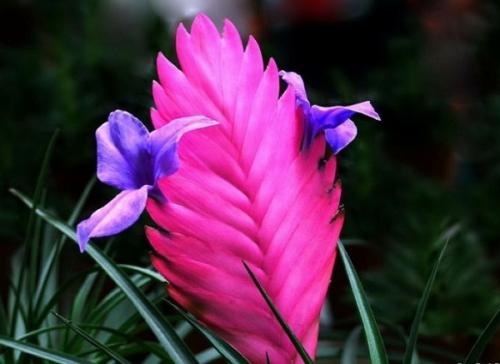
Tillandsia growing methods and precautions
If you have never grown a Tillandsia, hearing its name you might think it certainly is not very beautiful, but quite the opposite: the Tillandsia flower is strikingly beautiful. Although the Tillandsia flower's colors are vivid, it also has a touch of soft, graceful charm, and the shape of the flower is like a work of art, making people marvel at the wonders of nature.
Tillandsia growing methods
Temperature
Tillandsia must grow in an environment above 16°C, regardless of spring, summer, autumn or winter. In winter it can be moved to a greenhouse or indoors, but the minimum nighttime temperature must not be lower than 10°C.
Water
Tillandsia needs a large amount of water during its growth period, so sufficient moisture must be maintained. In summer's high temperatures, water twice a day. In winter, just keep the potting soil moist.
Fertilizing
Fertilize once a month, using a standard liquid fertilizer at half concentration. Pay special attention that some varieties of Tillandsia do not need fertilizing.
Propagation method
Propagation is generally done by the method of separating basal offsets; when the basal offset grows to 8 cm long, detach it and plant it.
Placement
Tillandsia likes a bright, semi-shaded, warm and fairly humid environment. It should be placed in a spot with bright light but no direct sunlight.
Precautions
The temperature in winter must not be too low; pay attention to temperature changes.
In summer, avoid direct sunlight, but do not place it in a dark corner; pay attention to preventing pests and diseases.