Lavender planting time and care methods, easily grow a romantic and beautiful sea of flowers
Lavender (Latin botanical name: Lavandula angustifolia Mill.), also known as perfume plant, fragrant herb, vanilla, yellow fragrant herb, lavender. It belongs to the genus Lavandula in the family Lamiaceae, and is a small shrub. The stems are upright, covered with stellate hairs, and the old branches are grayish brown with strip-like peeling bark. The leaves are linear or lanceolate-linear, covered with sparse or dense gray stellate hairs, grayish white or olive green when dry, with entire margins that roll outward.
The verticillasters gather at the top of the branches into interrupted or nearly continuous spikes; the bracts are rhombic-ovate, and the bracteoles are inconspicuous; the calyx is ovate-tubular or nearly tubular; the corolla is about twice as long as the calyx, with a straight tube, and the inside of the throat is covered with glandular hairs. The nutlets are elliptical and smooth. It is native to the Mediterranean coast, various parts of Europe, and the islands of Oceania, and was later widely planted in the United Kingdom and Yugoslavia. Its leaf shape and flower color are elegant and graceful, and its blue-purple inflorescence is slender and beautiful. It is a new perennial cold-resistant flower in courtyards, suitable for clump planting or row planting along flower borders, and can also be grown in pots for ornamental purposes.
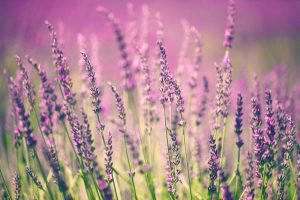
Cultivation environment: Lavender prefers a warm climate, is cold-resistant, drought-resistant, light-loving, and afraid of waterlogging. It is not strict about soil requirements and tolerates poor soil, preferring loose, well-drained neutral to slightly alkaline soil. Because it is not tolerant of waterlogging, lavender is somewhat difficult to grow in the ground in southern regions, but as an aromatic plant, it is an excellent potted flower.
Sowing: Lavender seeds are small, so it is best to raise seedlings and transplant them. In warm regions, sowing and seedling raising can be done at any time throughout the year, while in cold regions it is best to sow in spring. Before sowing, first level and refine the soil, water it thoroughly, and after the water has seeped down, sow the seeds evenly, then cover with a layer of fine soil at a thickness 2-3 times that of the seeds, and cover with grass or plastic film to preserve moisture.
Watering: Lavender prefers a dry environment and is not tolerant of moisture. When grown at home, never water it frequently. Water must not accumulate in the pot soil or on the ground, and ventilation should be maintained. After potting, water thoroughly once, and after the plant survives, the principle for watering is "water when dry, stop when wet." When watering, be careful not to pour water directly onto the leaves, and do not let mud splash onto the branches and leaves, so as to avoid disease. You can also spread a layer of small stones on the surface of the pot soil, which is both attractive and disease-preventive. If using tap water, it is best to first let the tap water sit in sunlight for two days before use.
Sunlight: Lavender is a long-day plant. Light plays an extremely important role in its development and the formation of aromatic oils. Excessive shading will cause leggy growth and also make it susceptible to disease, but during extreme summer heat it is best to provide some shading treatment to avoid direct exposure to the scorching sun.
Fertilizing: Lavender does not have high fertilizer requirements. In its rapid growth period in spring (March-May), a nitrogen, phosphorus, and potassium compound fertilizer can be applied monthly as a topdressing, prepared as a solution for irrigation, with a concentration of 1%. Too much nitrogen fertilizer easily causes leggy growth.
Pruning: After flowering, cut at the first node below the flower, and at the same time trim the plant into a hemispherical shape. Usually, cut off dried and withered branches at any time. To control plant height or obtain a better plant shape, prune appropriately and heavily in late summer and early autumn to promote new branch growth. When the seedlings are too dense, thin them appropriately, and when the seedlings are about 10 cm tall, they can be transplanted. They grow rapidly and need to be repotted once a year.
Pest and disease control: There are few insect pests. The main disease is root rot, with the highest incidence under high temperature and waterlogged conditions. Control method: irrigate the roots with an 800-times solution of carbendazim or chlorothalonil, once a month, especially from June to October. Pay attention to preventing water accumulation and keeping the air dry.