Anthurium: How to Grow Anthurium - The Most Detailed Care Experience
Anthurium generally refers to Anthurium (an ornamental plant of the Araceae family). Anthurium (Anthurium andraeanum Linden) is a perennial evergreen herbaceous plant of the Araceae family. The stem nodes are short; the leaves grow from the base, are green, leathery, entire, and oblong-cordate or ovate-cordate. The petioles are slender, the spathe is held flat, leathery and waxy-glossy, orange-red or scarlet; the spadix is yellow, and it can bloom continuously throughout the year.
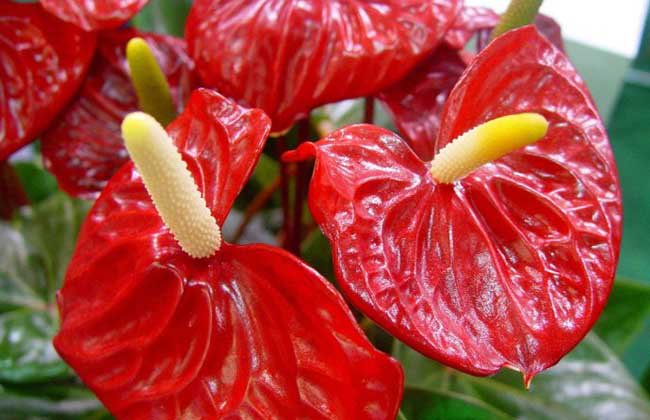
Anthurium is native to tropical rainforest regions such as Costa Rica and Colombia. It often grows epiphytically on trees, sometimes on rocks, or directly on the ground. It originated in the humid, semi-shaded ravine areas of the tropical rainforests of South America. Through introduction, improvement, and greenhouse cultivation with light, temperature, and water regulation systems, it is now widely cultivated in Europe, Asia, and Africa.
How to Grow Anthurium
1. Pot specifications: Potted anthurium has different pot size requirements at different growth stages from seedling to mature plant. The seedling stage is generally completed at the seedling company. The anthurium seedlings we purchase are all medium seedlings (about 15 cm) or larger, so when potting, a 160 x 150 mm red straight-sided plastic pot can be used for planting in one step.
2. Growing medium: The growing medium must have strong water- and fertilizer-retention capacity, good permeability, no water accumulation, contain no toxic substances, and be able to hold the plant in place. Before planting, the medium must also undergo thorough disinfection treatment to kill pests and diseases and maintain normal growth.
3. Potting: Anthurium is a shade-loving plant. When planting, a shade net with 75% shading capacity is needed to prevent overly strong light. Planting two plants per pot is better than planting a single plant. A very important point when potting is to expose the growth point at the center of the plant above the medium surface, and at the same time try to avoid the plant being contaminated by the medium. When potting, first fill the lower part of the pot with 4 to 5 cm of granular crushed stone or similar material as a drainage layer, then add 2 to 3 cm of growing soil, while placing the plant upright in the center of the pot so that the root system spreads out fully, and finally fill with growing soil until 2 to 3 cm below the pot rim, but the growth point at the center of the plant and the small leaves at the base should be exposed. After planting, a microbial agent must be sprayed promptly to prevent Phytophthora and Pythium diseases.
Anthurium growth requires relatively high temperatures and quite high humidity, so high temperature and high humidity are beneficial to anthurium growth. Temperature and humidity are closely related. When the temperature is below 20°C, maintaining the indoor natural environment is sufficient; when the temperature reaches above 28°C, a sprinkler system or atomization system must be used to increase the indoor relative air humidity so as to create a high-temperature, high-humidity growing environment for anthurium. However, in winter, even if the greenhouse temperature is relatively high, excessive cooling and humidification are not advisable, because overly wet leaves at night actually reduce the plant's cold resistance, making it prone to frost damage and not conducive to safe overwintering.
In hot seasons, the stronger the light, the higher the indoor temperature. At this time, a sprinkler system or atomization system can be used to increase the relative air humidity in the greenhouse, but the plants must be kept from being too wet at night to reduce disease occurrence; ventilation equipment can also be turned on to lower indoor humidity, so as to avoid flower bud abortion or deformity caused by high temperatures. In cold winters, when the indoor day and night temperature is below 15°C, heating is required; when the temperature is below 13°C, a heater is even more necessary for heating and warmth retention to prevent frost damage and help the plants overwinter safely.
After a period of cultivation and management, the growing medium will undergo biodegradation and salinization, thereby lowering the medium pH and increasing the EC value, which affects the root system's ability to absorb water and fertilizer. Therefore, the pH and EC values of the medium must be measured regularly, and the proportion of each nutrient element should be adjusted according to the measured data to promote the plant's absorption of water and fertilizer. In addition, most anthuriums naturally sprout many small suckers at the roots, which compete with the mother plant for nutrients, keep the plant in a juvenile state, and affect plant shape. Removing suckers can begin early to reduce damage to the mother plant.
Water Requirements for Growing Anthurium
Anthurium is a flower variety relatively sensitive to salinity, so the medium pH should be controlled between 5.2-6.1 as much as possible, which is most suitable for anthurium growth. If the pH value is too low, the flower stems become shorter, reducing ornamental value. Tap water is suitable for planting anthurium, but it is expensive; natural rainwater is the best water source for anthurium cultivation. Potted anthurium has different water requirements at different growth and development stages. In the seedling stage, because the root system is weak and distributed shallowly in the medium, it is not tolerant of drought. After planting, water should be sprayed 2-3 times a day, the medium should be kept moist frequently to encourage early and abundant new root growth, and attention should be paid to the dryness and moisture of the medium on the pot surface; in the medium and large seedling stages, the plants grow quickly and need more water, so the water supply must be sufficient; during the flowering stage, watering should be appropriately reduced and phosphorus and potassium fertilizers increased to promote flowering. However, the key to successful large-scale anthurium cultivation is maintaining relatively high air humidity.
Especially in hot seasons, a sprinkler system or atomization system can be used to increase the relative air humidity in the greenhouse. But note that leaves should not be misted in the evening, and it must be ensured that there are no water droplets on the anthurium leaf surface at night, so as to avoid leaf scorch from high temperatures and the occurrence of scorched leaves, deformed buds, and fading. During watering, alternate wet and dry conditions must be maintained. Never water when the plant is severely short of water, as this will affect its normal growth and development. In hot seasons, water usually once every 2-3 days, and at noon a sprinkler system should also be used to spray water on the leaves to increase indoor relative humidity. In cold seasons, watering should be done between 9 a.m. and before 4 p.m. to avoid freezing the root system.
Fertilizer Requirements for Growing Anthurium
According to Dutch cultivation experience, root fertilization of anthurium is much more effective than foliar feeding. This is because the leaf surface of anthurium has a waxy layer and cannot absorb fertilizer well. Liquid fertilizer application should follow the principle of regular and quantitative application. In autumn, the cycle is generally 3-4 days; if the temperature is high, fertilizer water can be applied once every 2-3 days depending on the dryness and moisture of the medium in the pot; in summer, fertilizer water can be applied once every 2 days, and when the temperature is high, water can be applied one extra time; in autumn, fertilizer water is generally applied once every 5-7 days.
Fertilization time varies with climate and environment. Generally, it is applied between 8 a.m. and before 5 p.m.; in winter or early spring, it is done between 9 a.m. and before 4 p.m. Each fertilization must be carried out by designated personnel, and the dilution concentration and application amount of the liquid fertilizer (stock solution) must be strictly controlled. Adjust the pH of the diluted liquid fertilizer to about 5.7 and apply it when the EC value is 1.2 ms/cm. In addition, two hours after liquid fertilizer application, use a sprinkler system to spray water on the plant leaves to wash off fertilizer remaining on the leaves, keep the leaf surface clean, and avoid algae growth.
Light Requirements for Growing Anthurium
Anthurium grows in a cycle of "leaf to flower to leaf to flower." The inflorescence is formed in the axil of each leaf. This results in equal yields of flowers and leaves, and the most important factor affecting yield differences is light. If there is too little light, under the influence of photosynthesis, the plant also produces few assimilates; when light is too strong, some leaves of the plant will warm up, possibly causing leaf discoloration, scorching, or withering. Therefore, whether light management is successful directly affects how many assimilates the anthurium produces and the quality of the later product. To prevent spathe discoloration or scorching, shade protection is necessary.
The light obtained by anthurium in the greenhouse can be regulated through movable shade nets. On sunny days, shade 75% of the light. The ideal light in the greenhouse is about 20000 Lux, and the maximum light intensity should not exceed 25000 Lux for a long time. In the morning, evening, or on cloudy and rainy days, no shading is needed. However, anthurium has different light requirements at different growth stages. For example, during the vegetative growth stage (when flower buds are usually removed), the light requirement is relatively high, and light can be appropriately increased to promote growth; during the flowering period, the light requirement is low, and a movable shade net can be adjusted to 10000 Lux to 15000 Lux to prevent spathe discoloration and affect ornamental value.